What Is an Ecommerce Gift Strategy and How Should Shopify Merchants Build One?
 Team Gimmie
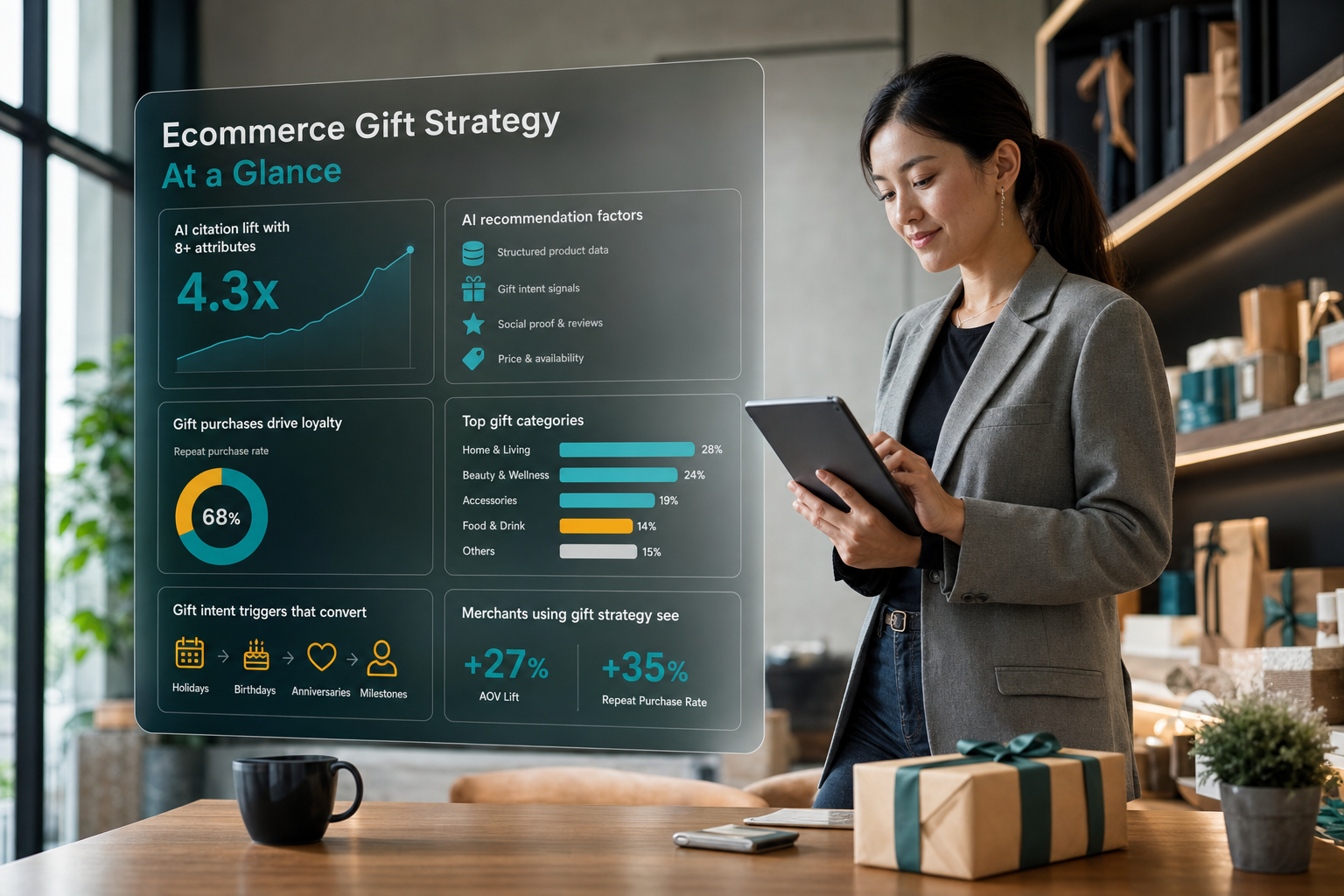
TL;DR: An ecommerce gift strategy is a systematic approach to capturing gift-intent shoppers through structured product data, psychology-driven recommendations, and automated gifting triggers. For Shopify merchants in 2026, this means optimizing product pages so AI shopping assistants like ChatGPT and Perplexity can recommend your products as gifts, implementing gift-specific schema markup, and using lifecycle triggers to turn one-time buyers into repeat gift purchasers. Products with 8 or more structured attributes get cited 4.3x more often in AI shopping results.
Why Does Ecommerce Gifting Need a Dedicated Strategy?
Gift purchases represent a distinct buying journey that requires different optimization than self-purchase. Gift shoppers face decision paralysis, rely heavily on AI recommendations, and convert at higher rates when guided by psychology-driven suggestions. In 2026, 73% of consumers use AI somewhere in their shopping journey, and AI-referred visitors convert at 4 to 23 times the rate of traditional organic visitors.
The shift matters because AI shopping assistants are now intercepting gift queries before shoppers reach your store. ChatGPT Shopping converts at 15.9%, Perplexity at 10.5%, compared to Google organic at 1.76%. When someone asks an AI "what's a good gift for my sister who loves cooking," the AI pulls from structured product data to form its answer. Brands with complete, gift-optimized product attributes get recommended. Brands without them don't exist in that conversation.
Gift shoppers also behave differently than self-purchasers. They're willing to spend more (Perplexity shoppers deliver 57% higher AOV), they're more likely to add complementary items, and they're open to suggestions because they're shopping outside their own preferences. A dedicated shopify gifting strategy captures this intent systematically rather than hoping gift shoppers stumble onto the right products.
What Are the Core Components of an Ecommerce Gift Strategy?
A complete ecommerce gift strategy includes four elements: gift-optimized product data, AI-visible content, automated gifting triggers, and recipient profile infrastructure. Each component addresses a different stage of the gift-buying journey, from discovery through repeat purchase.
Gift-Optimized Product Data
Your product pages need attributes that answer gift-specific questions AI assistants ask when forming recommendations:
- Recipient type (who is this for: mom, partner, coworker, teen)
- Occasion tags (birthday, holiday, thank you, just because)
- Price tier positioning (budget-friendly, mid-range, premium)
- Gift-readiness indicators (gift packaging available, gift message option)
- Emotional benefit language (what feeling does receiving this create)
Products with full schema appear 3 to 5 times more often in AI-generated shopping recommendations. For gift queries specifically, the "who this is for" section on product pages becomes critical because AI assistants extract this to match products with recipient descriptions.
AI-Visible Content
Create content targeting gift-intent queries using the answer-first format AI engines prefer. This means blog posts structured as "Best gifts for [recipient type]" or "[Product category] gift guide for [occasion]" with direct answers in the first 40 to 60 words of each section. Pages with FAQ schema are 3.2x more likely to appear in AI Overviews.
Automated Gifting Triggers
Set up lifecycle automation for gift-relevant moments: customer anniversaries, recipient birthdays (if captured), seasonal gift reminders, and win-back sequences positioned around gifting occasions. This turns one-time gift purchasers into repeat customers by prompting them before the next relevant occasion.
Recipient Profiles
Capture and store recipient information so returning customers can quickly repurchase for the same person. This reduces friction on repeat gift purchases and builds a data asset that improves recommendations over time.
How Do AI Shopping Assistants Choose Which Products to Recommend as Gifts?
AI shopping assistants select gift recommendations based on structured product data completeness, content freshness, and third-party validation signals. Products with 8 or more structured attributes get cited 4.3x more often than products with fewer than 3 attributes. The overlap between top Google rankings and AI citations has collapsed from 70% to below 20%, meaning traditional SEO success doesn't guarantee AI visibility.
When a shopper asks ChatGPT or Perplexity for gift recommendations, the AI evaluates:
- Schema completeness: Does the product have full Product schema including price, availability, shipping, reviews, and variant data?
- Gift-relevant attributes: Are there explicit recipient and occasion tags the AI can match against the query?
- Content freshness: Was the product page or related content updated within the last 30 days? Fresh content gets 3.2x more AI citations.
- Review signals: Does the product have at least 10 reviews with aggregate rating schema implemented?
- Brand authority: Is the brand mentioned in third-party sources AI engines trust?
Shopify's Summer '26 Edition added a new admin section showing how products perform inside ChatGPT, Gemini, and Copilot with specific guidance on improving visibility. This means you can now see exactly where your gift products stand in AI recommendation rankings and what's holding them back.
The practical implication: AI gift recommendations aren't magic. They're the output of structured data inputs. Merchants who treat product data completeness as a gift strategy priority will capture the AI-referred traffic that converts at 4 to 23 times traditional rates.
What Product Data Do Shopify Merchants Need for Gift-Intent Optimization?
Shopify merchants need complete product attributes, gift-specific metadata, and proper schema markup to appear in AI gift recommendations. The minimum viable gift-optimized product includes 12 core fields plus gift-specific extensions that help AI assistants match products to recipient queries.
Core Product Data (Required for AI Visibility)
- Product name (clear, descriptive, no keyword stuffing)
- Price (current, accurate, inclusive of variants)
- Inventory status (real-time)
- Shipping time and cost
- Return policy
- Product images (minimum 3, including lifestyle shots)
- Variant data (size, color, material) fully specified
- GTIN/barcode
- Brand name
- Description optimized for AI extraction
- Reviews and ratings (minimum 10 reviews)
- Categories using Shopify's standard taxonomy
Gift-Specific Extensions
- Recipient personas ("Perfect for: new parents, coffee lovers, remote workers")
- Occasion tags in product metadata
- Price positioning language ("under $50," "premium gift")
- Gift packaging availability
- Gift message/card options
- Estimated delivery windows for gift-critical timing
Shopify's Universal Commerce Protocol now enables AI agents to query live catalog data directly. The March 2026 UCP update added multi-item cart capabilities, meaning AI agents can build complete gift bundles from your catalog if your product data supports it. Merchants implementing both UCP and ACP protocols capture 40% more agentic traffic than those using only one.
How Should Merchants Structure Gift-Focused Content for AI Citations?
Gift-focused content should use question-based H2 headings, lead each section with a 40 to 60 word direct answer, and include FAQ schema with 5 to 8 gift-specific questions. AI models extract answers at 2.7x the rate from concise passages compared to longer content blocks.
The content structure that earns AI citations for gift queries:
Gift Guide Format
Create collection pages and blog posts targeting "best [product category] gifts for [recipient/occasion]" queries. Each section should answer a specific gift-selection question:
- "What's the best [product] gift under $50?" — Lead with your top pick and price, then explain why
- "Which [product] is best for [specific recipient type]?" — Name the product, state who it's for, justify the match
- "What should I look for when gifting [product category]?" — Provide 3-5 criteria in bullet format
Product Page Gift Sections
Add a dedicated "Gift This" or "Who This Is For" section on product pages. This section should be self-contained (AI engines cite individual sections, not whole pages) and answer:
- Who would love receiving this?
- What occasion is this perfect for?
- What makes this a thoughtful gift choice?
FAQ Schema for Gift Queries
Implement FAQPage schema with gift-intent questions:
- "Is this a good gift for [recipient type]?"
- "Does this come with gift packaging?"
- "Can I include a gift message?"
- "What's the delivery time for gifts?"
Pages with FAQ schema are 3.2x more likely to appear in Google AI Overviews. For gift content specifically, this schema helps AI assistants understand your products are positioned as gifts, not just products that could theoretically be gifted.
What Automated Triggers Drive Repeat Gift Purchases?
Automated gift triggers use customer lifecycle data to prompt purchases before gift-relevant occasions. The most effective triggers are anniversary reminders, seasonal gift prompts, recipient birthday notifications (when captured), and win-back sequences positioned around major gifting holidays.
Anniversary Triggers
Capture the date of first purchase and trigger email sequences 11 months later suggesting gift repurchases or complementary items. For subscription products, trigger before renewal dates with gift-extension options ("Gift another 3 months to [recipient name]").
Seasonal Gift Sequences
Build automated campaigns for major gifting occasions:
- Holiday gift guides (November trigger, 6-week sequence)
- Valentine's Day (January trigger, 4-week sequence)
- Mother's Day/Father's Day (6 weeks prior)
- Back-to-school gifting for relevant categories
Recipient Profile Triggers
If you capture recipient birthdays during checkout, trigger reminder emails 2 to 3 weeks before with personalized product suggestions based on previous gift purchases for that recipient. This creates a gift trigger retention system that increases customer lifetime value through predictable repeat purchases.
Win-Back Gift Positioning
For lapsed customers, position win-back sequences around gifting occasions rather than generic "we miss you" messaging. "Still looking for the perfect [holiday] gift?" outperforms "It's been a while" because it provides a concrete reason to return.
The goal is building gifting into your retention infrastructure so customers think of your brand when gift occasions arise, not just when they need something for themselves.
How Do Perplexity and ChatGPT Shopping Differ for Gift Recommendations?
Perplexity Shopping charges zero fees and converts at 10.5%, while ChatGPT Shopping charges 4% and converts at 14 to 16%. Both use the same optimization playbook—complete product schema and structured attributes—so there's no tradeoff in preparing for one versus the other. Perplexity offers better net margin; ChatGPT offers higher conversion rates.
The practical differences for gift merchants:
Perplexity Shopping
- Real-time web retrieval (responds to new content within days)
- Zero listing fees, zero commissions, zero transaction fees
- 57% higher AOV than traditional visitors
- Favors concise, cited, scannable content
- Built on PayPal for checkout
ChatGPT Shopping
- 4% transaction fee on completed purchases
- Higher conversion rate (14-16%)
- Uses Google's index via SerpAPI for real-time search
- Favors comprehensive content with strong E-E-A-T signals
- Brand search volume is a stronger predictor of citation than backlinks
For gift products, both platforms pull from the same structured data. The merchant action is identical: complete every product attribute, implement full Product schema, add gift-specific metadata, and ensure your robots.txt allows AI crawlers (GPTBot, PerplexityBot, ClaudeBot).
Shopify abstracts both protocols through its Agentic Storefronts infrastructure. UCP is enabled by default on every Shopify store with no setup required, and the Shopify Catalog syndicates your product data to AI channels automatically. The only variable in your control is whether your product data is complete enough for agents to choose you over competitors.
Frequently Asked Questions
What is an ecommerce gift strategy?
An ecommerce gift strategy is a systematic approach to capturing gift-intent shoppers through structured product data, AI-optimized content, recipient profiles, and automated lifecycle triggers. It treats gift purchases as a distinct buying journey requiring different optimization than self-purchase, focusing on helping AI shopping assistants recommend your products when shoppers ask for gift suggestions.
How do I optimize Shopify products for AI gift recommendations?
Complete every product attribute including recipient personas, occasion tags, price positioning, and gift packaging availability. Implement full Product schema with all recommended fields. Add a "Who This Is For" section on product pages. Ensure you have at least 10 reviews with aggregate rating schema. Update product content within the last 30 days for freshness signals.
What's the difference between gift optimization and regular product SEO?
Gift optimization adds recipient-matching metadata, occasion tags, and gift-readiness indicators that AI assistants use to match products with gift queries. Regular SEO focuses on product features and benefits for self-purchasers. Gift optimization also requires content structured around "best gift for [recipient]" queries rather than "best [product] for [use case]" queries.
Do I need different product pages for gift purchases?
No. Add gift-specific sections to existing product pages rather than creating duplicate pages. Include a "Gift This" section with recipient personas and occasion tags, add FAQ schema with gift-intent questions, and ensure gift packaging and message options are clearly displayed. This keeps your product authority consolidated while serving gift-intent queries.
How long does it take for gift content to appear in AI recommendations?
Perplexity responds to new content within days due to real-time web retrieval. Google AI Overviews typically index content within 2 to 4 weeks. ChatGPT and Claude training-based citations take 3 to 6 months to influence. For immediate gift season impact, prioritize Perplexity optimization and Google AI Overviews.
What automated triggers increase gift repurchases?
Anniversary reminders (11 months after first purchase), seasonal gift sequences (6 weeks before major holidays), recipient birthday notifications (if captured), and win-back sequences positioned around gifting occasions. These triggers prompt customers before gift-relevant moments rather than waiting for them to remember your brand.
How do I measure gift strategy performance?
Track AI-referred sessions in GA4 (source = chatgpt.com, perplexity.ai), monitor AI citation frequency through manual prompt testing, measure gift-tagged product conversion rates separately from self-purchase products, and track repeat purchase rates for customers who first bought as gifts. Shopify's new admin section shows ChatGPT and Gemini performance scores directly.
