What Is an AI Purchasing Agent in Ecommerce and Why Should Shopify Merchants Care?
 Team Gimmie
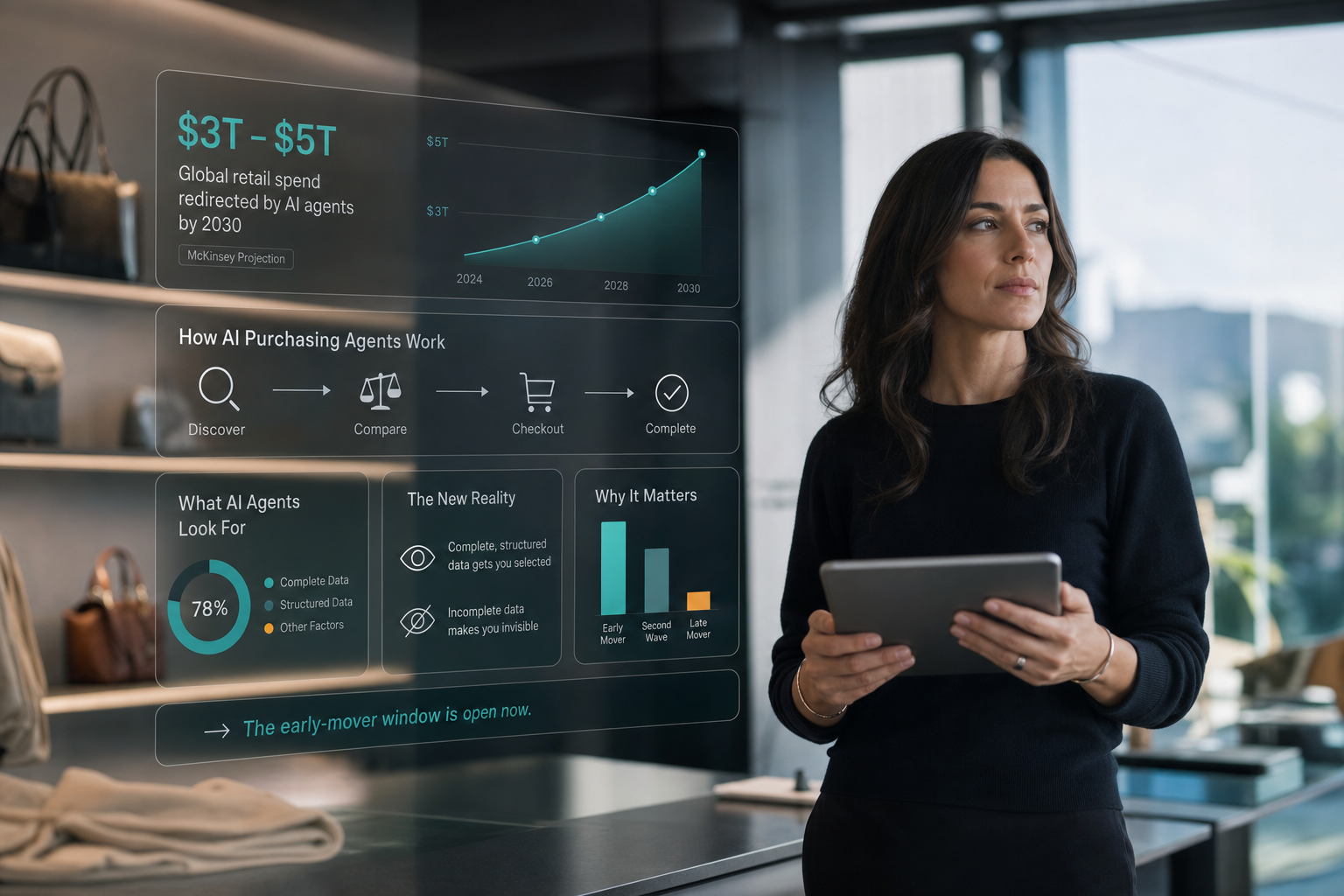
TL;DR: An AI purchasing agent in ecommerce is software that autonomously handles product discovery, comparison, and checkout on behalf of a consumer. For Shopify merchants, this represents a structural shift in how customers find and buy products. McKinsey projects AI agents will redirect $3 to $5 trillion in global retail spend by 2030. The brands with complete, structured product data get selected by agents. The brands without it become invisible. The early-mover window is open now.
What Exactly Is an AI Purchasing Agent in Ecommerce?
An AI purchasing agent is autonomous software that executes shopping tasks—discovery, comparison, and checkout—without requiring human intervention at each step. The consumer sets preferences once, and the agent handles the rest. Unlike traditional recommendation engines that suggest products for humans to evaluate, purchasing agents make decisions and complete transactions independently.
These agents operate through platforms like ChatGPT Shopping, Perplexity Shopping, Google AI Overviews, and emerging agentic commerce protocols. ChatGPT Shopping currently converts at 15.9%, while Perplexity converts at 10.5%—both dramatically outperforming Google organic's 1.76% conversion rate. The agent reads your product data, evaluates it against the consumer's stated preferences, and either recommends or directly purchases.
For Shopify merchants, this means your product pages are no longer just for human eyes. They are now machine-readable inputs that determine whether an AI agent selects your product or your competitor's.
Why Are AI Purchasing Agents Growing So Fast?
Consumer comfort with AI-assisted buying has reached a tipping point. Seventy-three percent of consumers now use AI somewhere in their purchase journey, and 70% are at least somewhat comfortable letting an AI agent buy on their behalf. Yet only 13% have completed a purchase via AI referral so far—that gap between comfort and adoption is the early-mover window.
AI platforms are expected to account for $20.9 billion in retail spending in 2026, quadrupling the 2025 figure. AI-referred traffic to Shopify stores grew 8x year over year by Q1 2026, and AI-attributed orders grew 13x in the same period. The trajectory is clear: agents are capturing an increasing share of purchase journeys before consumers ever reach a traditional search results page.
The economics favor agents. They reduce decision fatigue for consumers, compress the buying cycle, and deliver higher conversion rates for merchants whose data meets agent requirements. Perplexity shoppers deliver 57% higher average order value than traditional visitors.
How Do AI Agents Decide Which Products to Recommend?
AI agents evaluate products based on data completeness, accuracy, and structure—not traditional SEO signals like backlinks. Products with eight or more structured attributes are cited 4.3x more often in AI shopping results than products with fewer than three attributes. The agent cannot recommend what it cannot parse.
Key factors agents weigh include:
- Complete product attributes: name, price, availability, shipping details, return policy, GTIN, brand, variants
- Structured data markup: full Product schema with all recommended fields populated
- Real-time accuracy: prices and inventory matching what the agent reports to users
- Review signals: aggregate ratings and review counts that establish social proof
- Category alignment: products using Shopify's standard taxonomy for consistent classification
Brand search volume now correlates more strongly with AI citations (0.664) than backlinks (0.218). This means your overall brand presence across channels—social, press, community discussions—influences whether agents trust and select your products.
What Are the Two Commerce Protocols Shopify Merchants Need to Know?
Two open standards now govern how AI agents interact with merchants: ACP (Agentic Commerce Protocol) and UCP (Universal Commerce Protocol). Shopify abstracts both for merchants, but understanding them helps you optimize effectively.
ACP, developed by OpenAI and Stripe, handles checkout sessions and secure payment transmission. It powers ChatGPT's Instant Checkout and charges merchants a 4% transaction fee on completed purchases. ACP focuses on the conversion moment—getting a shopper from intent to payment.
UCP, developed by Google and Shopify with 20-plus coalition members including Visa, Mastercard, and Stripe, covers the full journey from discovery through post-purchase support. The March 2026 update added multi-item carts, live catalog queries, and loyalty program integration. UCP is auto-enabled on all Shopify stores with no setup required.
Merchants implementing both protocols capture 40% more agentic traffic than those using only one. Perplexity charges zero fees on its Instant Buy feature, making it the zero-cost AI distribution channel worth optimizing for alongside ChatGPT.
What Has Shopify Built for Agentic Commerce?
Shopify shipped six AI-facing endpoints to every store in May 2026, making agentic commerce infrastructure automatic rather than optional. These endpoints make your store discoverable and transactable by AI agents without custom development.
The endpoints include:
/llms.txt— A curated guide for LLMs about your store/llms-full.txt— Full content index for AI crawlers/agents.md— Agent capability declarations/.well-known/ucp— UCP discovery file/api/ucp/mcp— UCP machine-readable catalog- Agentic sitemap — AI-optimized sitemap for agent discovery
Shopify's Summer '26 Edition added a dashboard section showing how your products perform inside ChatGPT, Gemini, and Copilot, with specific guidance on improving visibility in each. The Shopify Catalog syndicates product data to AI channels automatically, and Shopify's internal data shows Catalog-fed AI searches convert at 2x the rate of searches using scraped product data.
How Should Shopify Merchants Optimize for AI Purchasing Agents?
Optimization for AI agents centers on product data completeness and structured markup. This is not about keyword density or link building—it is about making your catalog machine-readable and trustworthy.
Start with your product data checklist:
- Product name: clear and descriptive, no keyword stuffing
- Price: current, accurate, inclusive of all variants
- Inventory status: real-time sync enabled
- Shipping time and cost: explicitly stated
- Return policy: linked and clearly defined
- Product images: minimum three, including lifestyle shots
- Variant data: size, color, material fully specified
- GTIN/barcode: populated for each product
- Brand name: consistent across all listings
- Description: written for AI extraction with answer-first formatting
- Reviews: minimum 10 reviews with aggregate rating
- Categories: using Shopify's standard taxonomy
Implement full Product schema with all recommended fields. Pages with comprehensive schema receive 2.7x more impressions than those without. Products with full schema appear 3-5x more often in AI-generated shopping recommendations.
Ensure your robots.txt allows AI crawlers—GPTBot, ClaudeBot, PerplexityBot—to access product pages. No bot-blocking, no JavaScript-only rendering of critical data.
What Is the Early-Mover Advantage for Shopify Merchants?
The brands winning in AI commerce built their visibility infrastructure 12-18 months ago. First-mover advantage in AI citation authority is structural and durable. Late movers struggle to displace brands already embedded in LLM training data and recommendation patterns.
Consider the math: 83% of AI Overview citations come from pages outside the traditional organic top 10. Your Google rank tells you almost nothing about your AI visibility—research shows the overlap between top Google results and AI-cited sources collapsed from 70% to below 20%. These are now two separate games.
HubSpot just built answer engine optimization directly into its marketing platform, signaling that AEO is shifting from edge tactic to standard practice. When major platforms build it in, the differentiation window narrows.
Content freshness matters: e-commerce content updated within the last 30 days receives 3.2x more AI citations than stale content. The 20-minute product page refresh—adding comparison data, updating specs, refreshing descriptions—moves the needle immediately.
What Concrete Steps Should Merchants Take This Week?
The gap between consumer comfort with AI agents (70%) and actual AI-completed purchases (13%) represents the first-mover window. Here is how to capture it:
Day 1-2: Audit your top 20 products for data completeness. Fill every attribute field. Add GTINs if missing.
Day 3-4: Implement or verify full Product schema on all product pages. Use Google's Rich Results Test to validate.
Day 5: Check your robots.txt allows AI crawlers. Verify your llms.txt file exists and accurately describes your store.
Day 6-7: Update your highest-traffic product pages with fresh comparison data and answer-first descriptions.
Ongoing: Monitor your AI visibility through Shopify's new dashboard. Test queries like "best [your category] for [use case]" across ChatGPT, Perplexity, and Google AI Overviews to see if your products appear.
The agents are already shopping. The question is whether they can find you.
Frequently Asked Questions
What is an AI purchasing agent in ecommerce? An AI purchasing agent is autonomous software that handles product discovery, comparison, and checkout on behalf of a consumer. The user sets preferences once, and the agent executes the entire purchase journey without requiring human intervention at each step.
How do AI purchasing agents differ from recommendation engines? Traditional recommendation engines suggest products for humans to evaluate and purchase. AI purchasing agents make decisions and complete transactions independently, compressing the buying cycle and reducing decision fatigue for consumers.
What is the market size for agentic commerce? McKinsey estimates agentic commerce could redirect $3 to $5 trillion in global retail spend by 2030. AI platforms are expected to account for $20.9 billion in retail spending in 2026, quadrupling the 2025 figure.
What are ACP and UCP? ACP (Agentic Commerce Protocol), developed by OpenAI and Stripe, handles checkout and payment. UCP (Universal Commerce Protocol), developed by Google and Shopify, covers the full journey from discovery to post-purchase. Shopify integrates both automatically.
Does Shopify support AI purchasing agents automatically? Yes. Shopify shipped six AI-facing endpoints to every store in May 2026, including llms.txt, UCP discovery files, and an agentic sitemap. UCP is auto-enabled with no setup required.
What product data do AI agents need to recommend my products? Agents require complete attributes including name, price, inventory, shipping, returns, images, variants, GTIN, brand, description, reviews, and category. Products with eight or more structured attributes are cited 4.3x more often than products with fewer than three.
How does AI agent optimization differ from traditional SEO? Traditional SEO emphasizes backlinks and keyword optimization. AI agent optimization prioritizes data completeness, structured markup, and real-time accuracy. Brand mentions now correlate 3x more strongly with AI visibility than backlinks.
What is the early-mover advantage in agentic commerce? Brands that build AI visibility infrastructure now gain structural advantages as agents increasingly control purchase decisions. The overlap between Google rankings and AI citations has collapsed from 70% to below 20%, meaning traditional SEO success does not transfer to AI visibility.
