What Is AI Shopping Assistant SEO and How Can Shopify Merchants Optimize for It?
 Team Gimmie
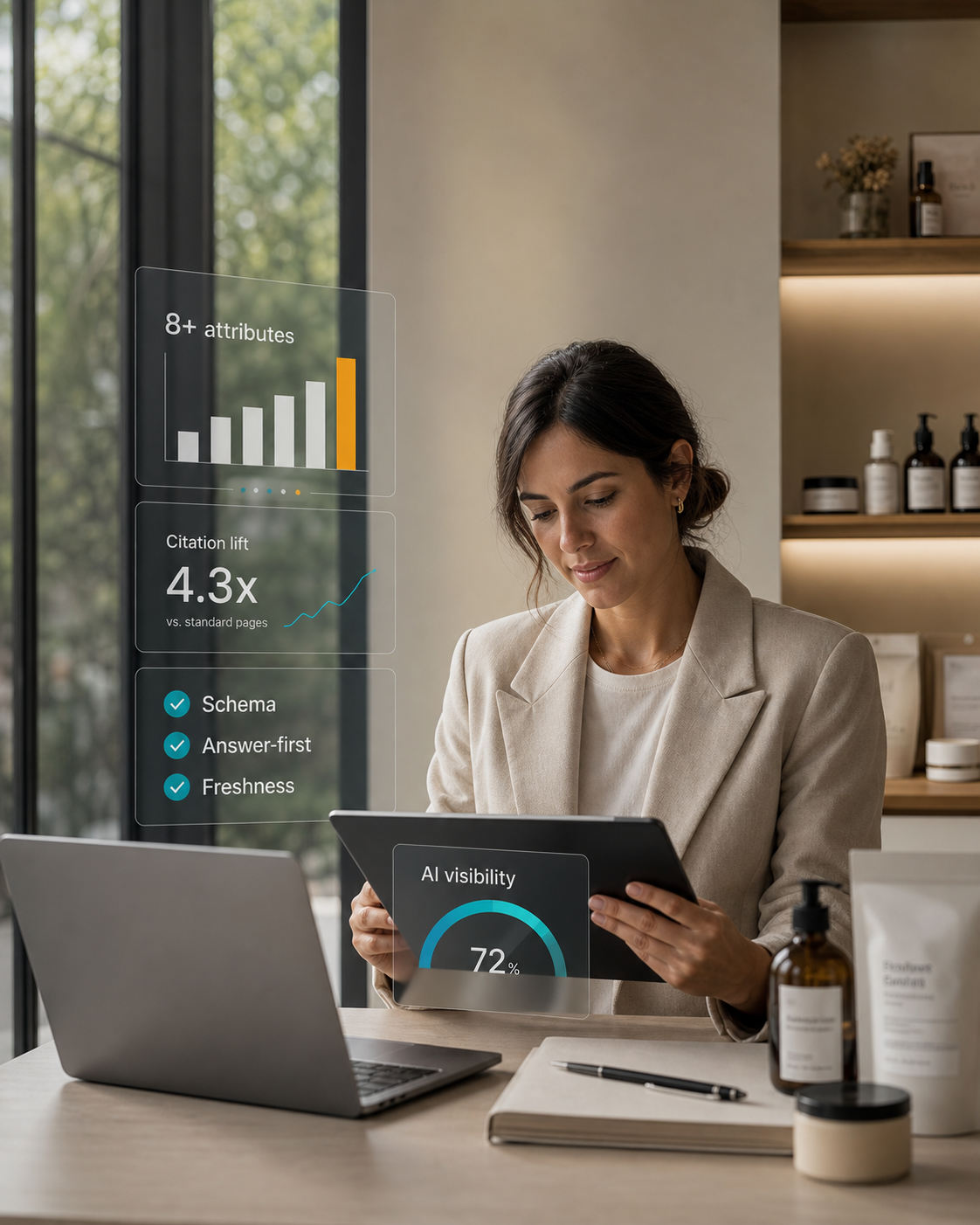
TL;DR: AI shopping assistant SEO is the practice of optimizing your Shopify store's product data and content so AI engines like ChatGPT, Perplexity, and Google AI Overviews cite and recommend your products. Products with 8 or more structured attributes get cited 4.3x more often than products with fewer than 3. The work is straightforward: complete product schema, answer-first content, and freshness signals. Shopify now shows your AI visibility score directly in the admin.
What Is AI Shopping Assistant SEO?
AI shopping assistant SEO—also called answer engine optimization (AEO)—is the practice of structuring your store's content and product data so AI-powered platforms extract and cite it when shoppers ask questions. Unlike traditional SEO where you compete for rankings, AI shopping assistant SEO focuses on becoming the source AI engines trust enough to quote directly. ChatGPT Shopping converts at 15.9%, Perplexity at 10.5%, compared to Google organic at 1.76%. The conversion gap is why this matters.
The shift is already measurable. AI-referred traffic to Shopify stores grew 8x year over year by Q1 2026, and AI-attributed orders grew 13x in the same window. AI Overviews now appear on 14% of all shopping queries—a 5.6x increase from November 2024. When an AI Overview appears, organic CTR drops 61%, but brands cited inside the AI answer earn 35% more clicks than brands in blue-link results below.
For Shopify merchants, this creates a clear priority: optimize for AI citation or watch competitors capture the traffic AI is redirecting.
Why Does Traditional SEO No Longer Guarantee AI Visibility?
Research from Brandlight shows the overlap between top Google search results and AI-cited sources has collapsed from 70% to below 20%. A brand can rank first on Google for a query and be completely absent from ChatGPT's answer to the same question. AI systems weigh fact density, content freshness, and third-party validation far more than backlinks or keyword density.
Brand search volume now correlates 3x more strongly with AI citations than backlinks (0.664 vs. 0.218). This means:
- Unlinked brand mentions in press articles have real value
- Product roundup features matter even without dofollow links
- Community discussions where your brand appears authentically drive AI visibility
- Branded search volume built through paid, social, and influencer channels feeds AI citation
The 5W AI Platform Citation Source Index 2026 found the top 15 domains capture 68% of all AI citation share. Authority concentration is extreme, which means building entity recognition and topical authority is non-negotiable for breaking through.
How Do AI Shopping Assistants Decide Which Products to Recommend?
AI shopping assistants parse structured data, evaluate content completeness, and assess brand authority signals when forming recommendations. Products with full Product schema appear 3-5x more often in AI-generated shopping recommendations. Pages with FAQ schema are 3.2x more likely to appear in Google AI Overviews.
The specific factors AI engines weigh:
- Structured product data: Products with 8+ attributes get cited 4.3x more than products with fewer than 3
- Content freshness: E-commerce content updated within 30 days receives 3.2x more AI citations
- Brand search volume: The strongest predictor of AI citation (correlation: 0.664)
- Third-party validation: Mentions in trusted publications, reviews, and community discussions
- Answer-first formatting: AI models extract answers at 2.7x the rate from concise 40-60 word passages
Shopify's Summer '26 Edition now shows merchants their ChatGPT, Gemini, and Copilot performance scores directly in the admin. If you haven't checked your score yet, your competitors likely have.
What Product Data Do Shopify Merchants Need for AI Shopping Assistant SEO?
For AI agents to choose your product over a competitor, your data must be complete, accurate, structured, consistent, and agent-accessible. Shopify's agentic commerce infrastructure handles the protocol complexity, but the product data quality is your responsibility.
The product data checklist for AI visibility:
- Product name (clear, descriptive, no keyword stuffing)
- Price (current, accurate, inclusive of variants)
- Inventory status (real-time)
- Shipping time and cost
- Return policy
- Product images (minimum 3, including lifestyle shots)
- Variant data (size, color, material) fully specified
- GTIN/barcode
- Brand name
- Description optimized for AI extraction
- Reviews and ratings (minimum 10 reviews)
- Categories using Shopify's standard taxonomy
Shopify's Catalog syndicates product data to AI channels automatically. Internal data shows Catalog-fed AI searches convert at 2x the rate of searches using scraped product data. The work is making your data complete enough for the Catalog to pass it accurately to agents.
How Should Shopify Merchants Structure Content for AI Citation?
Every section of content must lead with a direct answer, not a build-up to one. The 40-60 word rule applies: place a concise, direct answer in the first one to two sentences of every section. AI models extract answers at 2.7x the rate from concise passages versus longer ones.
The AEO content structure that earns citations:
- Every H2/H3 phrased as a question or directly answering one
- First 2 sentences of each section give a complete direct answer
- Supporting evidence follows the answer block
- FAQ section at the bottom of every article (minimum 5 questions)
- FAQPage schema implemented via JSON-LD
- Content written for specific searcher intent, not broad topics
For product pages specifically, include a "Who this is for" section that explicitly states the ideal customer profile. Add comparison sections (vs. competitors or within your own line). Build FAQ sections with 5-8 questions per product. Customer review content gets indexed and cited by AI, so prominently display reviews with aggregate rating schema.
What Technical Setup Does Shopify Require for AI Shopping Assistants?
Shopify shipped six AI-facing endpoints to every store in May 2026. Most require no manual setup but benefit from clean, complete product data:
/llms.txt— Curated guide for LLMs about your store/llms-full.txt— Full content guide for AI crawlers/agents.md— Agent capability declarations/.well-known/ucp— UCP discovery file/api/ucp/mcp— UCP machine-readable catalog- Agentic sitemap — AI-optimized sitemap for agent discovery
The Universal Commerce Protocol (UCP), developed by Google and Shopify, is auto-enabled for all stores. The March 2026 update added multi-item carts and live catalog queries. OpenAI's competing ACP is also natively integrated—merchants don't manage either protocol directly.
Critical technical checks:
- Verify robots.txt allows AI crawlers (GPTBot, ClaudeBot, PerplexityBot)
- Ensure Core Web Vitals pass (only 48% of Shopify stores pass all CWV on mobile)
- Confirm canonical tags point to primary URLs
- Audit apps for script bloat affecting page speed
How Can Merchants Track AI Shopping Assistant Performance?
Shopify's admin now displays AI visibility scores for ChatGPT, Gemini, and Copilot. Beyond the native dashboard, track AI-referred sessions in GA4 by filtering for sources like chatgpt.com and perplexity.ai.
Test query types to monitor manually:
- "What are the best [your product category]?"
- "Recommend a [your product] for [your core use case]"
- "Is [your brand name] reputable?"
- "Compare [your brand] to [competitor]"
Expected timelines for content to influence citations:
- Perplexity: responds to new content within days (real-time retrieval)
- Google AI Overviews: 2-4 weeks for indexed content
- ChatGPT and Claude (training-based): 3-6 months before content influences citations
Tools for tracking include Peec AI, Llmrank.io, Rankscale, Otterly, and Brand24 with AI monitoring enabled.
What's the Business Case for AI Shopping Assistant SEO?
The economics are stark. ChatGPT Shopping converts at 15.9%, Perplexity at 10.5%, while Google organic converts at 1.76%. AI-referred visitors convert at 4-23x the rate of traditional organic visitors. Perplexity shoppers deliver 57% higher AOV than traditional visitors.
McKinsey estimates agentic commerce could redirect $3 to $5 trillion in global retail spend by 2030. Currently, 73% of consumers use AI somewhere in their shopping journey, and 70% are at least somewhat comfortable with an AI agent completing purchases on their behalf—yet only 13% have finished a purchase via AI referral so far.
That gap between consumer comfort and actual behavior is the first-mover window. The brands building AI-optimized product data now will have structural advantages when agentic commerce becomes mainstream. Late movers will struggle to displace brands already embedded in LLM training data and recommendation patterns.
Frequently Asked Questions
What is AI shopping assistant SEO? AI shopping assistant SEO is the practice of optimizing your store's product data and content so AI platforms like ChatGPT, Perplexity, and Google AI Overviews cite and recommend your products when shoppers ask questions. It focuses on structured data, answer-first content formatting, and brand authority signals rather than traditional keyword rankings.
How is AI shopping assistant SEO different from traditional SEO? Traditional SEO optimizes for search engine rankings based on backlinks and keyword relevance. AI shopping assistant SEO optimizes for citation by AI engines that synthesize answers. Research shows the overlap between top Google results and AI-cited sources has dropped from 70% to below 20%, meaning they require separate strategies.
What product attributes matter most for AI visibility? Products with 8 or more structured attributes get cited 4.3x more often than products with fewer than 3. Critical attributes include product name, price, inventory status, shipping details, return policy, images, variant data, GTIN, brand name, and reviews with ratings.
How long does it take to see results from AI shopping assistant SEO? Perplexity responds to new content within days due to real-time retrieval. Google AI Overviews typically reflect indexed content within 2-4 weeks. ChatGPT and Claude, which rely more on training data, take 3-6 months before content influences citations.
Does Shopify automatically optimize my store for AI shopping assistants? Shopify provides the infrastructure—AI-facing endpoints, UCP integration, and Catalog syndication—but product data quality is your responsibility. Shopify's admin now shows AI visibility scores so you can identify gaps.
What conversion rates can I expect from AI shopping traffic? ChatGPT Shopping converts at 15.9%, Perplexity at 10.5%, compared to Google organic at 1.76%. AI-referred visitors convert at 4-23x the rate of traditional organic visitors, and Perplexity shoppers deliver 57% higher AOV.
How do I check my store's AI visibility score? Shopify's Summer '26 Edition added AI performance scores to the admin dashboard, showing how your products perform in ChatGPT, Gemini, and Copilot. You can also manually test queries across AI platforms and track AI-referred traffic in GA4.
What's the cost difference between AI shopping platforms? Perplexity's Instant Buy charges zero fees to merchants. ChatGPT Shopping charges a 4% transaction fee on completed purchases. The optimization work is identical for both platforms—complete product schema and structured attributes—so there's no tradeoff in preparing for one versus the other.
