What Is AI Citation Building and How Can Shopify Merchants Get Cited by ChatGPT?
 Team Gimmie
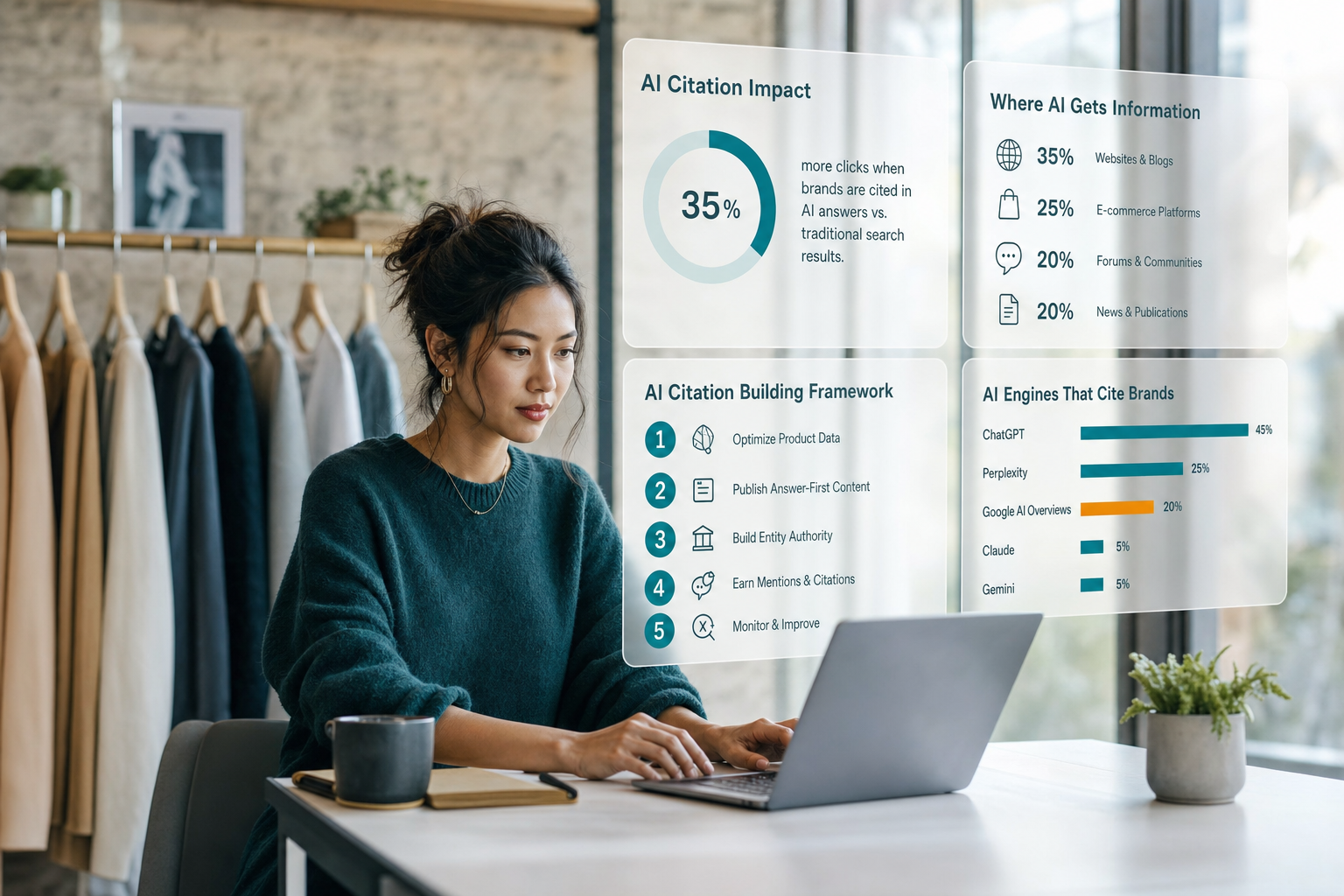
TL;DR: AI citation building is the practice of creating and structuring content so that AI-powered engines—ChatGPT, Perplexity, Google AI Overviews, Claude, and Gemini—cite your brand when users ask questions. For Shopify merchants, this means optimizing product data, publishing answer-first content, and building entity authority across platforms where AI models train and retrieve information. Brands cited in AI answers earn 35% more clicks than those appearing only in traditional search results.
What Is AI Citation Building?
AI citation building is the deliberate process of making your brand, products, and content the source that AI engines extract and present when users ask questions. Unlike traditional SEO, which focuses on ranking in search results, AI citation building focuses on becoming the answer itself. When someone asks ChatGPT "best hydrating serum for dry skin" or Perplexity "what's a good gift for a coffee lover," the brands that get mentioned are the ones that have built citation authority.
The shift is structural. Research from Brandlight shows the overlap between top Google search results and AI-cited sources has collapsed from 70% to below 20%. A strong Google ranking no longer guarantees you will appear in AI answers. These are now two separate games requiring separate strategies.
For Shopify merchants, this matters because AI-referred visitors convert at 4 to 23 times the rate of traditional organic visitors. ChatGPT Shopping converts at 15.9%, Perplexity at 10.5%, compared to Google organic at 1.76%. The brands getting cited are capturing disproportionate value from every AI-driven query.
Why Does AI Citation Matter More Than Backlinks in 2026?
Brand mentions now correlate 3x more strongly with AI search visibility than traditional backlinks—0.664 versus 0.218 correlation. This fundamentally changes how Shopify merchants should allocate their marketing effort. An unlinked mention in a high-authority publication, a Reddit thread discussing your product, or a Quora answer recommending your brand all contribute to AI citation authority even without a dofollow link.
The data is clear: brands cited inside Google AI Overviews earn 35% more organic clicks than brands appearing only in blue-link results below. AI Overviews now appear on 14% of all shopping queries—a 5.6x increase from November 2024—and on 83% of "best product" informational searches. When an AI Overview appears, organic CTR drops 61% for everyone not cited in the overview.
This means the old playbook of accumulating backlinks to climb Google rankings is necessary but insufficient. You need to build the signals that AI engines use to decide who to cite: brand search volume, content freshness, structured data completeness, and presence in sources AI models trust.
How Do AI Engines Decide Which Brands to Cite?
AI engines synthesize rather than rank. The factors determining whether your brand gets mentioned include brand search volume (the strongest predictor), training data presence, real-time retrieval authority, community signals from Reddit and forums, and third-party citations from trusted sources. Understanding these factors tells you exactly where to focus.
ChatGPT favors comprehensive content with strong E-E-A-T signals and uses Google's index for real-time web search, so Google indexing remains a prerequisite. Perplexity uses real-time web retrieval and can respond to new content within days—it favors concise, cited, scannable content. Google AI Overviews correlate strongly with pages that have FAQ schema, with those pages appearing 3.2x more often.
The 5W AI Platform Citation Source Index 2026 found that the top 15 domains capture 68% of all consolidated AI citation share. Authority concentration is extreme, which means Shopify merchants must be strategic about where they build presence rather than spreading effort thin.
What Content Structure Gets Cited by AI?
Answer-first formatting is the foundation of content that gets cited. Every section must lead with a direct answer in 40 to 60 words, followed by supporting evidence. AI models extract answers at 2.7x the rate from concise passages versus longer ones. Each H2 or H3 section must function as a self-contained answer because AI engines frequently cite individual sections, not whole pages.
The content types that get cited most reliably are definition answers (What is X?), how-to answers with numbered steps, comparison answers in table format, best-of answers with bullet lists and brief justifications, and stat-backed answers anchored with specific data points.
For Shopify merchants, this translates to specific page-level tactics. Product pages need FAQ sections with 5 to 8 questions in answer-first format. Collection pages need buyer's guide sections targeting "best [product category] for [use case]" queries. Blog posts need TL;DR boxes at the top and question-based H2s throughout. Every piece of content should be written for a specific searcher intent, not a broad topic.
How Can Shopify Merchants Build AI Citation Authority?
Start with your product data. Products with 8 or more structured attributes are cited 4.3x more often in AI shopping results than products with fewer than 3. Complete every field in your Shopify product listings: name, price, inventory status, shipping time, return policy, images, variant data, GTIN, brand name, and optimized descriptions. Shopify's Catalog syndicates this data to AI channels automatically, and Catalog-fed AI searches convert at 2x the rate of searches using scraped product data.
Implement FAQPage schema on every product page, collection page, and blog post. Pages with FAQ schema are 3.2x more likely to appear in AI Overviews. Use JSON-LD format and validate with Google's Rich Results Test.
Build presence in sources AI models train on and retrieve from. The highest-value targets are Wikipedia, Reddit, Quora, product review aggregators like Wirecutter, industry publications with high domain authority, and podcast transcripts. Participate authentically in Reddit communities relevant to your category. Answer questions on Quora with genuine expertise. These unlinked mentions drive brand search volume, which drives AI visibility.
Freshness matters significantly. A 2026 GEO benchmark study confirmed that e-commerce content updated within the last 30 days receives 3.2x more citations across AI platforms than content that has not been refreshed. Add "Last updated" dates visibly to your content and refresh top-performing pages quarterly with new data points and examples.
What Technical Setup Does AI Citation Require on Shopify?
Shopify shipped six AI-facing endpoints to every store in May 2026: /llms.txt, /llms-full.txt, /agents.md, /.well-known/ucp, /api/ucp/mcp, and an agentic sitemap. These files exist by default but benefit from clean, complete product data in your store. You can customize /llms.txt to include your brand description, key pages, top products, and brand voice guidance.
Verify your robots.txt allows AI crawlers. Shopify's default configuration is generally well-configured, but custom rules can introduce blocking errors. Confirm GPTBot, ClaudeBot, and PerplexityBot are explicitly allowed. Check your configuration at yourdomain.com/robots.txt.
Core Web Vitals matter for AI citation because they signal content quality. Only 48% of Shopify stores pass all CWV on mobile, which creates competitive opportunity. Audit installed apps for script bloat, compress images to WebP format, and update to Dawn v15.0+ for built-in performance improvements.
Shopify's Summer '26 Edition added a dashboard showing how your products perform inside ChatGPT, Gemini, and Copilot with specific guidance on improving visibility. If you are not checking this score, your competitors are.
How Long Does AI Citation Building Take to Show Results?
Timelines vary by platform. Perplexity responds to new content within days because it uses real-time web retrieval. Google AI Overviews typically reflect indexed content within 2 to 4 weeks. ChatGPT and Claude, which rely more heavily on training data, take 3 to 6 months before new content influences citations.
This means you need a dual strategy: optimize for real-time retrieval platforms like Perplexity immediately while building the foundational content and authority signals that will influence training-based models over time. The brands winning in 2026 built their AI visibility infrastructure 12 to 18 months ago. First-mover advantage in AI citation authority is structural and durable.
Track your progress by testing 10 target queries across ChatGPT, Perplexity, and Google AI Overviews monthly. Log brand mention frequency and context. Monitor AI-referred traffic in GA4 by filtering for sources like chatgpt.com and perplexity.ai. Tools like Peec AI, Llmrank.io, and Otterly can automate this tracking.
HubSpot recently built answer engine optimization directly into its marketing platform via the XFunnel acquisition, signaling that AEO is shifting from an edge tactic to standard marketing practice. The window for differentiation through early adoption is narrowing.
Frequently Asked Questions
What is the difference between AI citation building and traditional SEO?
Traditional SEO focuses on ranking in search results pages. AI citation building focuses on becoming the source that AI engines extract and present as the answer. Research shows the overlap between top Google results and AI-cited sources has collapsed from 70% to below 20%, meaning these are now separate disciplines requiring separate strategies.
How do I know if my brand is being cited by AI engines?
Test relevant queries directly in ChatGPT, Perplexity, Claude, and Google AI Overviews. Ask questions like "What are the best [your product category]?" and "Recommend a [your product] for [your core use case]." Tools like Peec AI, Llmrank.io, and Otterly can automate tracking across platforms.
Does my Google ranking affect AI citations?
Google indexing is a prerequisite because ChatGPT uses Google's index for real-time retrieval. However, ranking position correlates weakly with AI citation. Brand search volume correlates 3x more strongly with AI visibility than backlinks. A page ranking first on Google may be absent from ChatGPT's answer to the same query.
What product data fields matter most for AI citation?
Products with 8 or more structured attributes are cited 4.3x more often than products with fewer than 3. Critical fields include product name, price, inventory status, shipping details, return policy, images, variant data, GTIN, brand name, and descriptions optimized for AI extraction.
How often should I update content for AI citation?
Content updated within the last 30 days receives 3.2x more AI citations than stale content. Refresh top-performing pages quarterly with new data points, statistics, and examples. Add visible "Last updated" dates to signal freshness to AI crawlers.
Does Shopify automatically support AI citation building?
Shopify shipped AI-facing endpoints to every store in May 2026, including llms.txt, agents.md, and UCP discovery files. These exist by default but benefit from complete product data. The Summer '26 Edition added a dashboard showing your ChatGPT and Gemini performance scores with improvement guidance.
What is the fastest way to start building AI citations?
Complete your product data first—every field, every variant, every attribute. Add FAQ schema to product and collection pages. Publish one answer-first blog post targeting a "best [product] for [use case]" query in your category. Update your top three existing pages with fresh data and visible update dates.
How does AI citation building affect conversion rates?
AI-referred visitors convert at 4 to 23 times the rate of traditional organic visitors. ChatGPT Shopping converts at 15.9%, Perplexity at 10.5%, versus Google organic at 1.76%. Brands cited in AI Overviews earn 35% more clicks than brands appearing only in traditional results.
