What Is Agentic Gifting?
 Team Gimmie
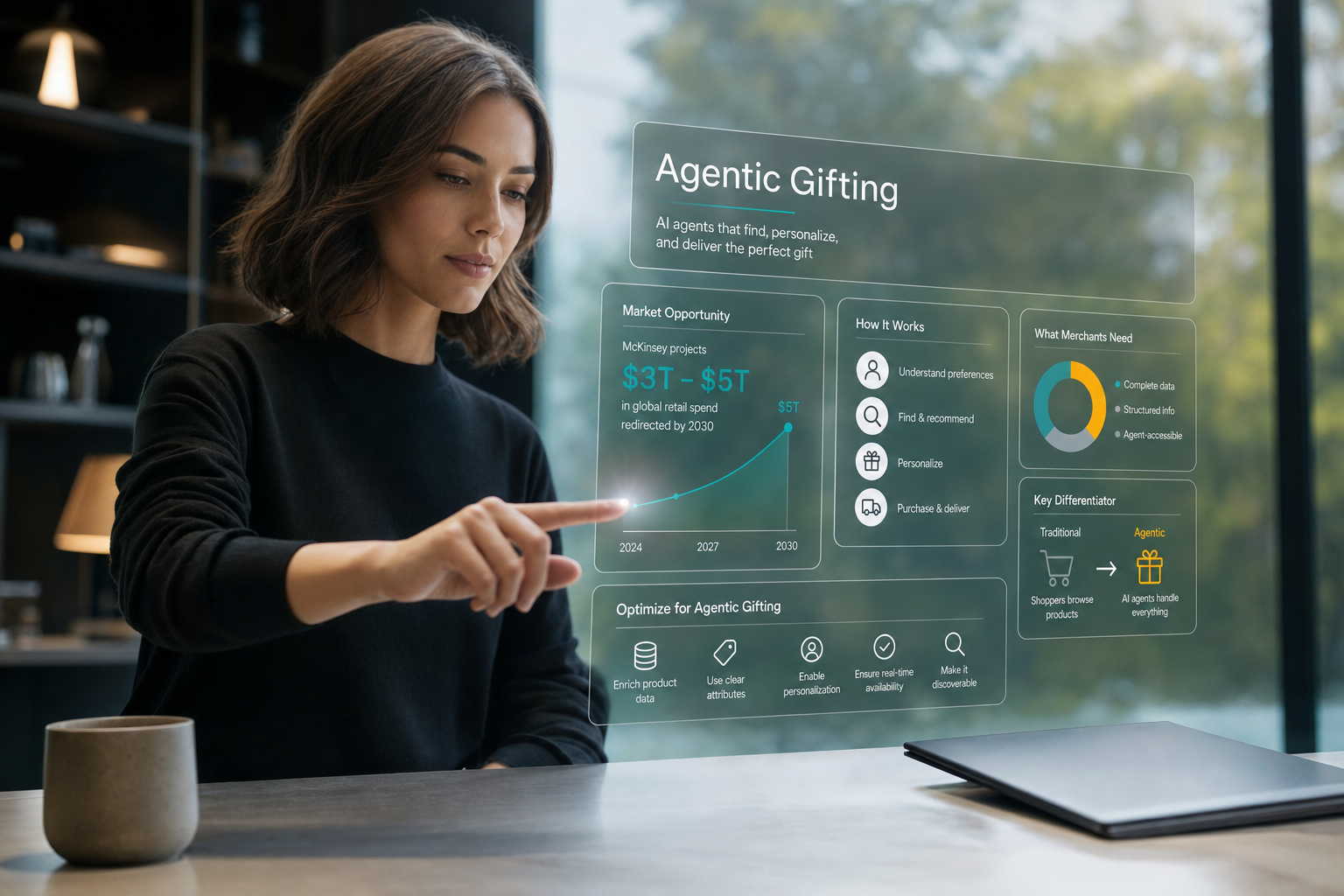
TL;DR: Agentic gifting is the use of AI agents to autonomously handle gift selection, personalization, and delivery on behalf of shoppers. Instead of browsing product pages, consumers set preferences once and let an AI agent find, recommend, and purchase gifts that match recipient profiles. For Shopify merchants, this means your product data must be complete, structured, and agent-accessible to win recommendations in a market McKinsey projects will redirect $3 to $5 trillion in global retail spend by 2030.
Why Should Shopify Merchants Care About Agentic Gifting?
Agentic gifting represents a fundamental shift in how gift purchases happen. Today, 73% of consumers already use AI somewhere in their shopping journey, and 70% are comfortable letting an AI agent buy on their behalf. When an AI agent handles gifting, it queries product catalogs directly, matches items to recipient personality profiles, and completes checkout autonomously. The merchant whose product data is cleanest and most complete wins the sale. The merchant with incomplete attributes never enters the consideration set.
This matters now because AI-referred traffic to Shopify stores grew 8x year over year by Q1 2026, and AI-attributed orders grew 13x in the same window. ChatGPT Shopping converts at 15.9%, Perplexity at 10.5%, compared to Google organic at 1.76%. The economics are already compelling, and the infrastructure is live.
How Does Agentic Gifting Actually Work?
Agentic gifting works through AI agents that understand recipient profiles, purchase intent, and personal preferences to suggest tailored gifts without manual browsing. The agent receives a prompt like "find a birthday gift for my sister who loves hiking and sustainable brands," then queries merchant catalogs via protocols like UCP or ACP, filters by attributes, and returns recommendations ranked by fit.
The technical layer involves two open standards:
- UCP (Universal Commerce Protocol): Developed by Google and Shopify, covers the full journey from discovery through checkout. The March 2026 update added multi-item carts and live catalog queries.
- ACP (Agentic Commerce Protocol): Developed by OpenAI and Stripe, focuses on checkout sessions and payment transmission. ChatGPT charges merchants 4% on completed purchases.
Shopify abstracts both protocols for merchants. As of May 2026, every Shopify store has six AI-facing endpoints including /llms.txt, /.well-known/ucp, and /api/ucp/mcp. The work is not integration—it is making your product data good enough for agents to select you.
What Makes Agentic Gifting Different From Traditional Gift Recommendations?
Traditional gift recommendations rely on transaction history and browsing behavior. Agentic gifting uses psychology-driven recommendations based on recipient personality profiles, values, and emotional context. The AI matches gifts to who the recipient is, not just what they have bought before. This approach solves decision paralysis—the stress consumers feel when overwhelmed by choices or unsure if their selection will feel thoughtful.
The difference for merchants is structural. Traditional recommendation engines surface products to shoppers who then decide. Agentic systems decide on behalf of shoppers based on structured attributes. If your product lacks the attributes an agent needs to match—material, use case, recipient type, occasion—it cannot be recommended. Products with 8 or more structured attributes are cited 4.3x more often in AI shopping results than products with fewer than 3.
What Product Data Do Merchants Need for Agentic Gifting?
For AI agents to choose your product over a competitor's, your data must be complete, accurate, structured, consistent, and agent-accessible. Missing any required attribute removes you from consideration entirely. The agent cannot infer what you do not provide.
Here is the minimum product data checklist for agentic gifting:
- Product name (clear, descriptive, no keyword stuffing)
- Price (current, accurate, inclusive of variants)
- Inventory status (real-time sync)
- Shipping time and cost
- Return policy
- Product images (minimum 3, including lifestyle shots)
- Variant data (size, color, material) fully specified
- GTIN/barcode
- Brand name
- Description optimized for AI extraction
- Reviews and ratings (minimum 10 reviews)
- Categories using Shopify's standard taxonomy
- Occasion tags (birthday, anniversary, holiday)
- Recipient type (for her, for him, for kids, for pets)
The Shopify Catalog syndicates this data to AI channels automatically. Shopify's internal data shows Catalog-fed AI searches convert at 2x the rate of searches using scraped product data.
How Can Merchants Optimize for Agentic Gifting Today?
Start with a product data audit. Check every product for the attributes listed above. Fill gaps systematically, prioritizing bestsellers and high-margin items first. Then expand to your full catalog. This is the single lever you control across every protocol, platform, and AI engine.
Next, verify your AI-facing endpoints are accessible. Check that your robots.txt allows GPTBot, ClaudeBot, and PerplexityBot. Review your /llms.txt file and customize it with your brand voice and top products. Ensure product pages render key data without JavaScript-only loading.
Finally, add FAQ schema to product pages. Pages with FAQPage JSON-LD are 3.2x more likely to appear in AI Overviews. Each product should have 5-8 questions covering who it is for, how it works, and why it makes a good gift. This structured content feeds directly into agent recommendation logic.
What Is the Business Case for Agentic Gifting?
The business case is conversion rate arbitrage plus market timing. AI-referred visitors convert at 4-23x the rate of traditional organic visitors. Perplexity shoppers deliver 57% higher AOV than traditional visitors. ChatGPT Shopping converts at 15.9% versus Google organic at 1.76%. The math is immediate.
The timing case is structural advantage. McKinsey estimates agentic commerce could redirect $3 to $5 trillion in global retail spend by 2030. Only 13% of consumers have completed a purchase via AI referral so far. The gap between consumer comfort (70%) and actual adoption (13%) is the first-mover window. Merchants who build agent-ready product data now will be embedded in AI recommendation patterns before competitors catch up.
For DTC brands specifically, agentic gifting may enable bypassing Amazon entirely. When AI agents route high-intent gift buyers directly to your checkout, you reduce dependence on marketplace commissions and own the customer relationship.
How Does Agentic Gifting Connect to AEO and AI Visibility?
Agentic gifting is a subset of agentic commerce, and both depend on the same foundation: structured product data and AI visibility. Answer Engine Optimization (AEO) ensures your content is formatted so AI engines can extract and cite it. Agentic commerce ensures your catalog is structured so AI agents can query and transact with it. They are two applications of the same principle.
Brand search volume is now the strongest predictor of AI citation, with a correlation of 0.664 compared to 0.218 for backlinks. This means the work you do on brand awareness—through social, PR, community, and content—directly improves your agentic gifting performance. The brands AI agents recommend are the brands AI engines already recognize as authoritative.
Frequently Asked Questions
What is agentic gifting? Agentic gifting is the use of AI agents to automate gift selection, personalization, and delivery for customers. Agents understand recipient profiles and purchase intent to suggest tailored gifts without manual browsing, eliminating decision paralysis for shoppers.
How is agentic gifting different from AI gift recommendations? Traditional AI recommendations surface options for humans to choose from. Agentic gifting involves AI agents making autonomous purchasing decisions based on recipient profiles and structured product data. The agent selects and buys, not just suggests.
What protocols power agentic gifting? Two open standards govern agentic commerce: UCP (Universal Commerce Protocol) developed by Google and Shopify for full-journey transactions, and ACP (Agentic Commerce Protocol) developed by OpenAI and Stripe for checkout and payment. Shopify integrates both natively.
What product data do I need for agentic gifting? At minimum: product name, price, inventory status, shipping details, return policy, images, variant data, GTIN, brand name, AI-optimized description, reviews, standard categories, occasion tags, and recipient type. Products with 8+ structured attributes are cited 4.3x more often.
How do I check if my store is ready for agentic gifting?
Verify your AI-facing endpoints are live (check /llms.txt and /.well-known/ucp), confirm robots.txt allows AI crawlers, audit product data completeness, and add FAQ schema to product pages. Shopify's admin now shows AI platform performance scores.
What is the ROI of optimizing for agentic gifting? AI-referred visitors convert at 4-23x the rate of traditional organic traffic. ChatGPT Shopping converts at 15.9%, Perplexity at 10.5%, versus Google organic at 1.76%. Perplexity shoppers also deliver 57% higher AOV.
When will agentic gifting become mainstream? McKinsey projects agentic commerce will redirect $3-5 trillion in global retail by 2030. Currently, 73% of consumers use AI in their shopping journey but only 13% have completed an AI-referred purchase. The adoption curve is accelerating through 2026.
Does Shopify support agentic gifting automatically? Yes. Shopify shipped six AI-facing endpoints to every store in May 2026 and auto-enables UCP. The Shopify Catalog syndicates product data to AI channels. Merchants do not manage protocols directly—the work is ensuring product data is complete.
