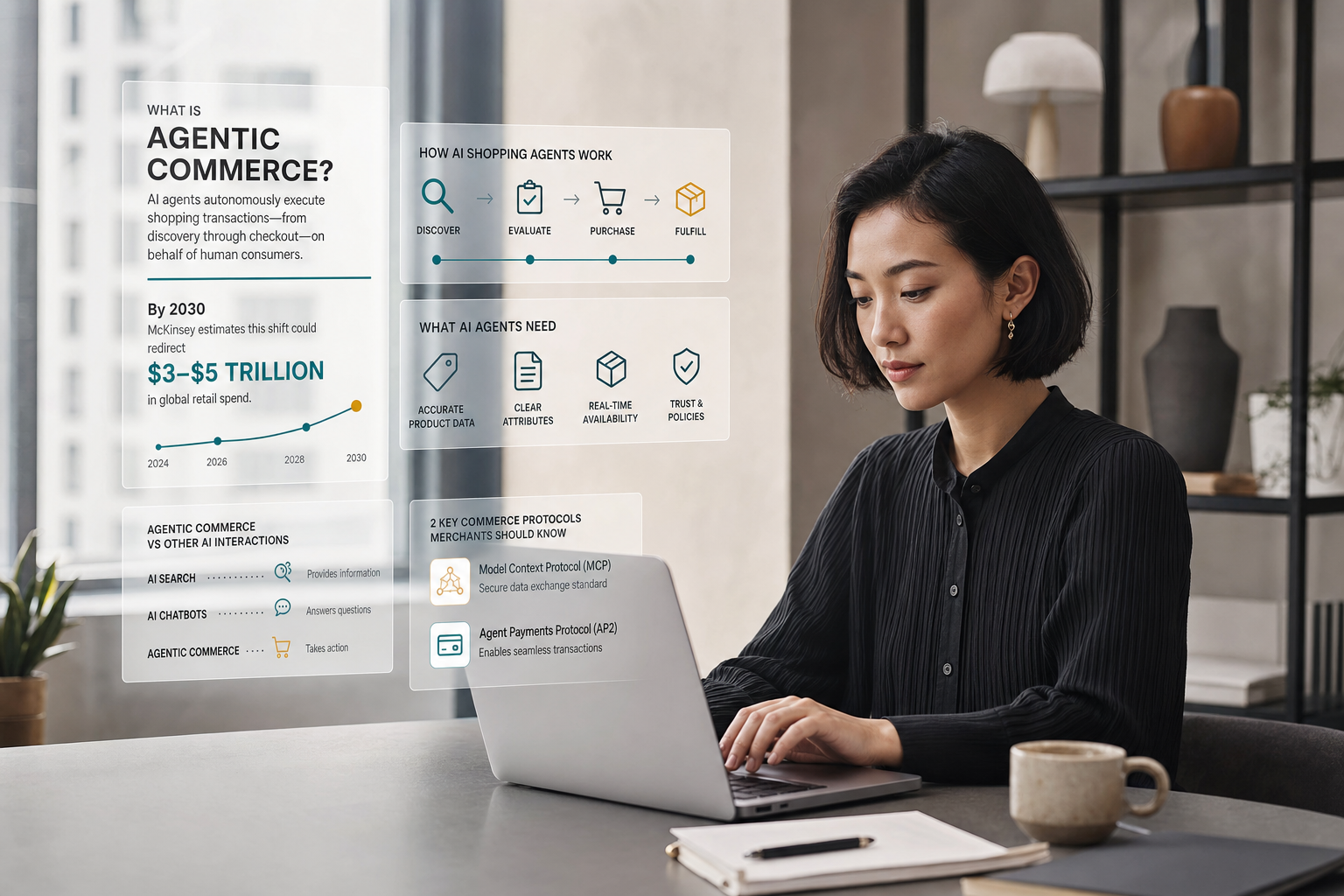
What Is Agentic Commerce?
 Team Gimmie
TL;DR: Agentic commerce is AI agents autonomously executing shopping transactions—from discovery through checkout—on behalf of human consumers. By 2030, McKinsey estimates this shift could redirect $3 to $5 trillion in global retail spend. Shopify merchants who structure their product data for agent discovery now will capture disproportionate share of this emerging channel.
Why Should Shopify Merchants Care About Agentic Commerce?
Agentic commerce represents the next evolution beyond AI search and chatbots: instead of AI recommending products for humans to buy, AI agents complete the entire purchase autonomously. For Shopify merchants, this matters because 73% of consumers already use AI somewhere in their shopping journey, and 70% are comfortable letting an agent buy on their behalf. The infrastructure is live today—Shopify auto-enabled the Universal Commerce Protocol (UCP) on every store by late March 2026.
The practical implication is straightforward. When an AI agent shops for a consumer, it queries structured product data, compares options against the consumer's stated preferences, and completes checkout without the consumer ever visiting your storefront. If your product data is incomplete or inconsistent, the agent cannot select you. Your competitor with cleaner data wins the sale you never knew existed.
McKinsey projects agentic commerce could redirect $3 to $5 trillion in global retail spend by 2030. Bain separately estimates the US market alone will reach $300 to $500 billion, representing 15 to 25% of total e-commerce sales. These are not speculative numbers—they reflect consumer behavior that is already measurable today.
How Do AI Shopping Agents Actually Work?
AI shopping agents work by receiving a consumer's preferences once, then autonomously executing the entire purchase journey—discovery, comparison, selection, and checkout—without requiring the consumer to visit individual stores. The agent queries product catalogs directly, evaluates options against the consumer's criteria, and completes transactions through standardized commerce protocols.
Two open protocols now govern how agents interact with merchants:
-
ACP (Agentic Commerce Protocol): Developed by OpenAI and Stripe, ACP powers ChatGPT's Instant Checkout. It focuses on checkout sessions and secure payment transmission. OpenAI charges merchants 4% on completed purchases.
-
UCP (Universal Commerce Protocol): Developed by Google and Shopify with 20+ partners including Visa, Mastercard, Target, and Walmart. UCP covers the full journey from discovery through post-purchase support. The March 2026 update added multi-item carts and live catalog queries.
Shopify merchants do not need to implement these protocols manually. Shopify abstracts both through its Agentic Storefronts infrastructure, auto-enabling UCP on every store and natively integrating ACP. Merchants implementing both protocols capture 40% more agentic traffic than those using only one.
What Product Data Do AI Agents Need to Select Your Products?
AI agents require complete, accurate, and structured product data to include your products in their recommendations. Products with 8 or more structured attributes are cited 4.3x more often in AI shopping results than products with fewer than 3 attributes. The agent cannot infer missing information—if a field is empty, your product is filtered out.
The essential product data checklist for agentic commerce readiness:
- Product name (clear, descriptive, no keyword stuffing)
- Price (current, accurate, inclusive of all variants)
- Inventory status (real-time availability)
- Shipping time and cost
- Return policy
- Product images (minimum 3, including lifestyle shots)
- Variant data (size, color, material) fully specified
- GTIN/barcode
- Brand name
- Description optimized for AI extraction
- Reviews and ratings (minimum 10 reviews recommended)
- Categories using Shopify's standard taxonomy
Shopify's Catalog syndicates your product data to AI channels automatically. Internal Shopify data shows Catalog-fed AI searches convert at 2x the rate of searches using scraped product data. The Summer '26 Edition now surfaces your ChatGPT, Gemini, and Copilot performance scores directly in your Shopify admin.
How Does Agentic Commerce Differ From AI Search and Chatbots?
Agentic commerce differs from AI search and chatbots in one critical way: the AI completes the transaction autonomously rather than handing off to the human. AI search (like Google AI Overviews) and chatbots (like ChatGPT) recommend products, but the consumer still clicks through, browses, and checks out manually. In agentic commerce, the consumer sets preferences once and the agent handles everything else.
This distinction matters for how merchants optimize. For AI search and chatbots, you optimize content to be cited in answers. For agentic commerce, you optimize product data to be selected and purchased without human intervention. The content layer still matters for discovery, but the transaction layer requires machine-readable, complete, and consistent product data.
The conversion rates reflect this difference. ChatGPT Shopping converts at 15.9% and Perplexity at 10.5%, compared to 1.76% for traditional Google organic. AI-referred visitors convert at 4 to 23x the rate of traditional organic visitors because the AI pre-qualifies intent before sending traffic.
What Are the Two Commerce Protocols Shopify Merchants Should Know?
Shopify merchants should understand ACP and UCP as the two standards governing AI agent transactions, though Shopify handles the technical implementation automatically. ACP, built by OpenAI and Stripe, powers ChatGPT's checkout and charges 4% per transaction. UCP, built by Google and Shopify, covers the full purchase journey and charges no transaction fees.
The practical difference for merchants:
-
Perplexity Shopping (uses PayPal, zero fees): Converts at 10.5%, charges merchants nothing. Perplexity shoppers deliver 57% higher AOV than traditional visitors.
-
ChatGPT Shopping (uses ACP, 4% fee): Converts at 14-16%, charges 4% on completed purchases.
The optimization work is identical for both platforms: complete product schema, structured attributes, and accurate real-time data. You do not choose one protocol over the other—you optimize your product data once, and Shopify routes it to both. Merchants who show up in both capture the full addressable market.
Shopify shipped six AI-facing endpoints to every store in May 2026: /llms.txt, /llms-full.txt, /agents.md, /.well-known/ucp, /api/ucp/mcp, and an agentic sitemap. These files exist automatically, but their usefulness depends entirely on the quality of your underlying product data.
How Can Shopify Merchants Prepare for Agentic Commerce Today?
Shopify merchants can prepare for agentic commerce by auditing product data completeness, verifying AI crawler access, and monitoring their AI visibility scores in the Shopify admin. The work is not technical integration—Shopify handles that. The work is ensuring your product data is complete enough for agents to select you over competitors.
Start with these concrete actions:
-
Audit every product for the 12 essential attributes listed above. Flag any product missing GTIN, variant data, or shipping details.
-
Check your robots.txt allows AI crawlers (GPTBot, ClaudeBot, PerplexityBot). Shopify's default configuration is correct, but custom rules may block them.
-
Review your Shopify admin AI performance section added in Summer '26. It shows how your products perform in ChatGPT, Gemini, and Copilot with specific improvement guidance.
-
Ensure product descriptions lead with what the product is and who it's for in the first 50-80 words. Agents extract this information for comparison.
-
Verify your product data is consistent across your store, any external feeds, and the Shopify Catalog. Inconsistencies cause agents to deprioritize or exclude products.
The DTC advantage in agentic commerce is significant. When AI agents route high-intent customers directly to your checkout, you bypass Amazon's marketplace and its commission structure entirely. First movers building agent-accessible product data now will have structural advantages as this channel scales.
What Market Size Are We Talking About?
The agentic commerce market is projected to reach $3 to $5 trillion in redirected global retail spend by 2030, according to McKinsey. In 2026 alone, AI platforms are expected to account for $20.9 billion in retail spending—quadrupling 2025 figures. Only 13% of consumers have completed a purchase via AI referral so far, which means the adoption curve is still in its early phase.
The consumer comfort is already there. Research shows 73% of consumers use AI somewhere in their purchase journey today, and 70% are at least somewhat comfortable with an AI agent making purchases on their behalf. The gap between comfort and actual usage represents the first-mover window for merchants who prepare now.
For context on why this matters for visibility: AI Overviews now appear on 14% of all shopping queries, a 5.6x increase from November 2024. When an AI Overview appears, organic CTR drops 61%—but brands cited inside AI Overviews earn 35% more clicks than brands in blue-link results below. The same dynamic applies to agentic commerce: being selected by the agent is the new visibility.
Frequently Asked Questions
What is the difference between agentic commerce and AI shopping assistants?
AI shopping assistants like ChatGPT recommend products for you to purchase manually. Agentic commerce means the AI agent completes the entire transaction autonomously—discovery, comparison, selection, and checkout—without requiring you to visit the store or click "buy." The consumer sets preferences once; the agent executes.
Do I need to install anything to enable agentic commerce on my Shopify store?
No. Shopify auto-enabled the Universal Commerce Protocol (UCP) on every store by late March 2026 and natively integrates the Agentic Commerce Protocol (ACP). The AI-facing endpoints exist automatically. Your job is ensuring your product data is complete enough for agents to select your products.
What happens if my product data is incomplete?
AI agents filter out products with missing attributes. Products with 8 or more structured attributes are cited 4.3x more often than products with fewer than 3. If your GTIN, variant data, or shipping details are missing, agents cannot include your products in their recommendations.
Does ChatGPT Shopping charge fees?
Yes. OpenAI charges merchants 4% on completed Instant Checkout purchases through ChatGPT Shopping. Perplexity Shopping, by contrast, charges zero listing fees, zero commissions, and zero transaction fees. The optimization work for both platforms is identical.
How do I check my AI visibility in Shopify?
Shopify's Summer '26 Edition added an admin section showing how your products perform in ChatGPT, Gemini, and Copilot. It provides specific guidance on improving visibility in each AI shopping platform. Navigate to your Shopify admin and look for the AI performance dashboard.
What is the Universal Commerce Protocol (UCP)?
UCP is an open standard developed by Google and Shopify with 20+ partners including Visa, Mastercard, Target, and Walmart. It governs how AI agents discover products, query live catalogs, build multi-item carts, and complete checkout. Shopify handles UCP implementation automatically for all stores.
How big is the agentic commerce opportunity?
McKinsey estimates agentic commerce could redirect $3 to $5 trillion in global retail spend by 2030. In 2026, AI platforms are expected to account for $20.9 billion in retail spending. Only 13% of consumers have completed an AI-referred purchase so far, indicating significant growth ahead.
Can agentic commerce help DTC brands compete with Amazon?
Yes. When AI agents route high-intent customers directly to your checkout, you bypass Amazon's marketplace and its commission structure. Merchants with complete, structured product data can capture sales that would otherwise flow through Amazon, reducing platform dependence.
