What Is a Personalized AI Buyer and How Does It Change Shopify Discovery?
 Team Gimmie
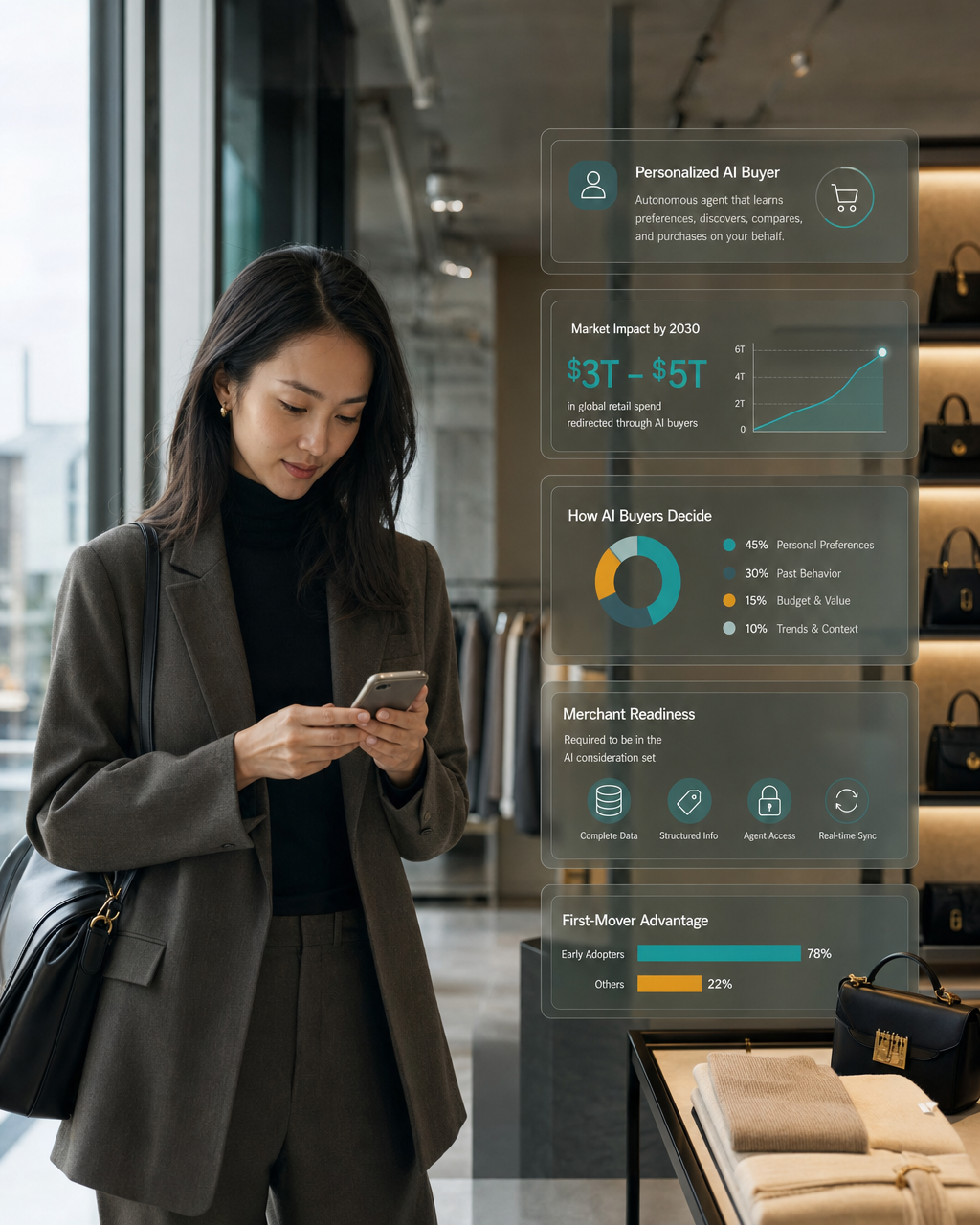
TL;DR: A personalized AI buyer is an autonomous shopping agent that learns individual consumer preferences—style, budget, values, past behavior—and then discovers, compares, and purchases products on their behalf. For Shopify merchants, this means your product data must be complete, structured, and agent-accessible or you simply will not exist in the AI buyer's consideration set. The brands preparing now capture the first-mover advantage in a channel projected to redirect $3 to $5 trillion in global retail spend by 2030.
What Exactly Is a Personalized AI Buyer?
A personalized AI buyer is an AI agent that autonomously handles shopping tasks based on a consumer's stored preferences, past purchases, and stated goals. Unlike traditional recommendation engines that suggest products for humans to evaluate, personalized AI buyers make decisions and complete transactions without requiring the shopper to browse, compare, or click checkout.
These agents operate across platforms like ChatGPT Shopping, Perplexity Shopping, and Google's AI Mode. They query product catalogs in real time, evaluate options against the user's profile, and either recommend a shortlist or complete the purchase directly. The March 2026 update to Google's Universal Commerce Protocol (UCP) added multi-item cart capabilities, meaning agents can now build complete orders across a merchant's catalog in a single session.
For Shopify merchants, the practical implication is clear: if your product data is incomplete or inaccessible to AI crawlers, personalized AI buyers cannot consider your products. You are invisible to the fastest-growing discovery channel in e-commerce.
Why Should Shopify Merchants Care About Personalized AI Buyers Now?
Personalized AI buyers represent the most significant shift in product discovery since mobile commerce. McKinsey projects agentic commerce will redirect $3 to $5 trillion in global retail spend by 2030. Today, 73% of consumers already use AI somewhere in their shopping journey, and 70% are comfortable letting an agent buy on their behalf.
The window for first-mover advantage is narrow. AI-referred traffic to Shopify stores grew 8x year over year by Q1 2026, and AI-attributed orders grew 13x in the same period. ChatGPT Shopping converts at 15.9%, Perplexity at 10.5%, compared to Google organic at just 1.76%. These are not marginal improvements—they are category-defining conversion lifts.
Shopify's Summer '26 Edition now shows merchants their ChatGPT and Gemini performance scores directly in the admin dashboard. If you are not checking that score, your competitors are. The brands that structure their product data for AI buyers today will compound their visibility advantage as these systems scale.
How Do Personalized AI Buyers Decide Which Products to Recommend?
Personalized AI buyers select products based on data completeness, structured attributes, real-time accuracy, and alignment with the user's stored preferences. They do not rank like Google. They synthesize information from product schemas, reviews, inventory feeds, and merchant catalogs to match products against a specific buyer profile.
Research shows products with eight or more structured attributes are cited 4.3x more often in AI shopping results than products with fewer than three. The overlap between top Google rankings and AI citations has collapsed from 70% to below 20%, meaning your SEO position tells you almost nothing about your AI visibility.
Key factors AI buyers evaluate include:
- Complete product attributes: name, price, variants, materials, dimensions
- Real-time inventory and shipping data
- Aggregate review ratings with sufficient volume (minimum 10 reviews)
- Clear "who this is for" positioning in descriptions
- GTIN/barcode for product identification
- Consistent data across your store, feeds, and the Shopify Catalog
If any of these elements are missing or inconsistent, the AI buyer moves to a competitor whose data is complete.
What Technical Infrastructure Does Shopify Provide for AI Buyers?
Shopify has built native infrastructure for agentic commerce that abstracts protocol complexity for merchants. As of May 2026, every Shopify store automatically includes six AI-facing endpoints: /llms.txt, /llms-full.txt, /agents.md, /.well-known/ucp, /api/ucp/mcp, and an agentic sitemap.
The Universal Commerce Protocol (UCP), co-developed by Google and Shopify, is auto-enabled on all stores. UCP handles the full journey from discovery through post-purchase support, and the March 2026 update added multi-item carts and live catalog queries. OpenAI's Agentic Commerce Protocol (ACP) is also natively integrated, meaning Shopify merchants do not need to manage either protocol directly.
The Shopify Catalog syndicates your product data to AI channels automatically. Internal Shopify data shows Catalog-fed AI searches convert at 2x the rate of searches using scraped product data. The infrastructure is in place—your only job is ensuring your product data is complete enough for agents to select you.
How Do You Optimize Product Data for Personalized AI Buyers?
Optimizing for personalized AI buyers requires treating every product attribute as a selection criterion. AI agents cannot infer missing information; they can only work with what you provide. Products with full structured data and schema markup appear 3 to 5x more often in AI-generated shopping recommendations.
Start with these actions:
- Populate every variant attribute: size, color, material, weight, dimensions
- Add GTIN/barcode to every product
- Write descriptions in answer-first format: what it is, who it is for, why it matters
- Include a "Who this is for" section on each product page
- Add 5 to 8 FAQ questions per product with direct answers
- Ensure inventory status updates in real time
- Specify shipping time and cost explicitly
- Display aggregate review ratings with FAQPage schema
Content freshness also matters. A 2026 GEO benchmark study found e-commerce content updated within the last 30 days receives 3.2x more AI citations than stale content. Update your top product pages with fresh comparison data and current pricing regularly.
What Is the Difference Between ACP and UCP for Personalized AI Buyers?
Two open protocols now govern how personalized AI buyers interact with merchants: ACP (Agentic Commerce Protocol) from OpenAI and Stripe, and UCP (Universal Commerce Protocol) from Google and Shopify. Both enable AI agents to discover products and complete purchases, but they differ in scope and fee structure.
ACP focuses on checkout sessions and secure payment transmission. It powers ChatGPT Instant Checkout and charges merchants a 4% fee on completed purchases. UCP covers the full journey from discovery through post-purchase support, including multi-item carts and loyalty program integration, with no transaction fee from Google.
Perplexity's Instant Buy, built on PayPal, charges zero fees—no listing costs, no commissions, no transaction fees. With Perplexity converting at 10.5% and ChatGPT at 14 to 16%, the fee differential makes Perplexity the better net margin channel for most DTC brands.
The optimization playbook is identical for both protocols: complete product schema and structured attributes. Merchants implementing both protocols capture 40% more agentic traffic than those using only one, and Shopify handles the integration for you.
How Does Answer Engine Optimization Connect to Personalized AI Buyers?
Personalized AI buyers rely on the same content signals that drive answer engine optimization. When an AI agent evaluates your product, it extracts information from your structured data, product descriptions, FAQ sections, and reviews. Content formatted for AI extraction—direct answers, question-based headings, self-contained sections—gets cited more often.
Pages with FAQ schema are 3.2x more likely to appear in AI Overviews. AI models extract answers at 2.7x the rate from concise 40 to 60 word passages compared to longer blocks. Brands cited inside AI Overviews earn 35% more organic clicks than brands appearing only in traditional results below.
For Shopify merchants, this means your product pages and collection pages should follow AEO principles:
- Lead every section with a direct answer in 40 to 60 words
- Use question-based H2 headings
- Include FAQ sections with FAQPage schema
- Write for specific searcher intent, not generic topics
- Update content regularly to signal freshness
The same content that earns AI citations also makes your products selectable by personalized AI buyers.
What Should Shopify Merchants Do This Week?
The infrastructure for personalized AI buyers is live. The consumer comfort is there—70% are ready to let agents buy for them. The only variable is whether your product data is complete enough to be selected. Here is your priority checklist for this week:
- Check your ChatGPT and Gemini performance score in Shopify admin (Summer '26 Edition feature)
- Audit your top 20 products for missing attributes: GTIN, variants, materials, dimensions
- Add FAQ sections with 5 to 8 questions to your highest-traffic product pages
- Verify your robots.txt allows GPTBot, ClaudeBot, and PerplexityBot
- Update product descriptions to lead with "what it is, who it is for, why it matters"
- Confirm your Shopify Catalog syndication is active and all products are eligible
The brands doing this work now will have structural advantages when agentic commerce becomes mainstream. The brands waiting will find themselves invisible to the fastest-growing discovery channel in e-commerce.
Frequently Asked Questions
What is a personalized AI buyer? A personalized AI buyer is an autonomous shopping agent that learns a consumer's preferences, discovers products matching those preferences, compares options, and completes purchases without requiring the shopper to browse or click checkout manually.
How do personalized AI buyers find products? They query structured product data from merchant catalogs, feeds, and protocols like UCP and ACP. Products with complete attributes, accurate inventory, and strong reviews are prioritized over products with missing or inconsistent data.
Does Shopify support personalized AI buyers? Yes. Shopify auto-enables UCP on all stores and natively integrates ACP. The Shopify Catalog syndicates product data to AI channels, and the Summer '26 Edition shows merchants their AI performance scores directly in the admin.
What is the difference between ACP and UCP? ACP, from OpenAI and Stripe, handles checkout sessions with a 4% merchant fee. UCP, from Google and Shopify, covers the full journey from discovery to post-purchase with no transaction fee. Both require complete product data to work.
How do I check if my products are visible to AI buyers? Use your Shopify admin's new AI performance dashboard to see ChatGPT and Gemini scores. Manually test queries like "best [your product category] for [use case]" in ChatGPT, Perplexity, and Google AI Mode to see if your products appear.
What product data do AI buyers need? Complete attributes including name, price, variants, GTIN, inventory status, shipping details, return policy, images, reviews, and a clear description of who the product is for. Products with 8+ structured attributes are cited 4.3x more often.
How big is the personalized AI buyer opportunity? McKinsey projects agentic commerce will redirect $3 to $5 trillion in global retail spend by 2030. AI-referred traffic to Shopify stores grew 8x year over year by Q1 2026, with 13x growth in AI-attributed orders.
Can personalized AI buyers help DTC brands bypass Amazon? Yes. When AI agents route high-intent customers directly to your checkout via UCP or ACP, you reduce dependence on Amazon's marketplace and its commission structure. First movers building agent-accessible data now gain structural advantages.
