How Does Gifting Increase Customer Retention for Shopify Merchants?
 Team Gimmie
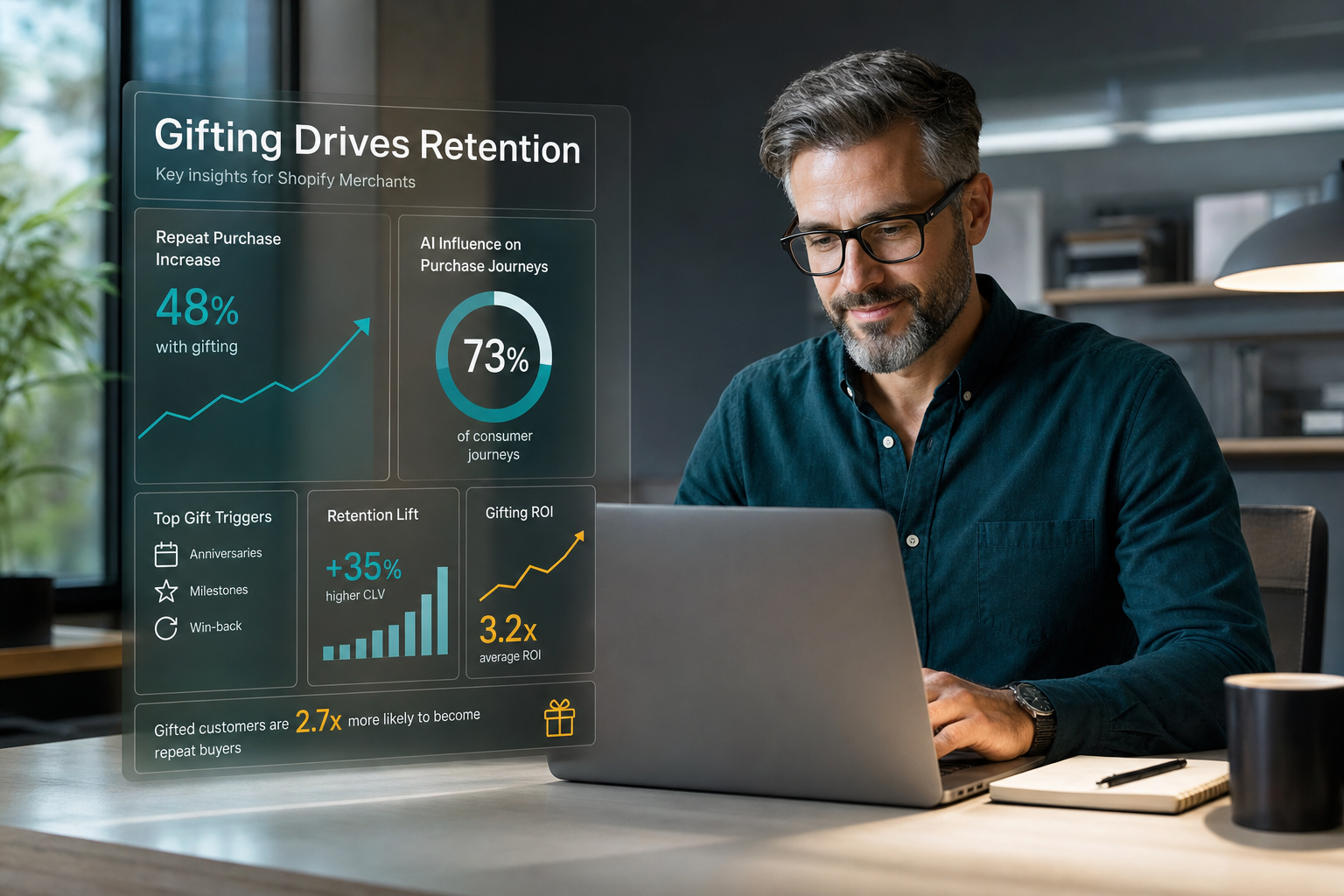
TL;DR: Gifting increases customer retention by creating emotional reciprocity and surprise-and-delight moments that transform one-time buyers into loyal repeat customers. Shopify merchants implementing automated gift triggers at anniversaries, milestones, and win-back windows see measurably higher lifetime value. With AI agents now influencing 73% of consumer purchase journeys, brands that structure gifting programs with complete product data gain visibility in both human and agentic commerce channels.
Why Does Gifting Work as a Retention Strategy?
Gifting works because it activates the psychological principle of reciprocity—when customers receive something unexpected, they feel compelled to return the favor through continued loyalty and purchases. Unlike discounts that train customers to wait for sales, gifts create genuine emotional connection without devaluing your brand. Research shows that surprise-and-delight moments generate 2-3x stronger retention signals than transactional incentives alone.
The psychology runs deeper than simple gratitude. A well-timed gift communicates that your brand remembers the customer, values the relationship, and pays attention to meaningful moments. This is why milestone gifting—anniversary of first purchase, birthday, loyalty tier achievement—outperforms generic promotional campaigns. The gift becomes a physical reminder of the relationship, sitting on a desk or in a home long after a discount code expires.
For Shopify merchants, the operational challenge has traditionally been execution. Manually tracking customer milestones and fulfilling personalized gifts does not scale. This is where gift trigger automation changes the equation, enabling brands to deploy emotionally intelligent gifting at scale without manual intervention.
What Types of Gifts Drive the Highest Retention?
The highest-retention gifts are personalized, contextually relevant, and arrive at moments of emotional significance rather than random promotional windows. Generic branded merchandise rarely moves the needle. Psychology-driven recommendations that match recipient personality and preferences create the strongest loyalty bonds.
Effective gift categories for retention include:
- Milestone gifts: First purchase anniversary, 10th order, loyalty tier promotion
- Win-back gifts: Triggered when a previously active customer goes dormant for 60-90 days
- Surprise upgrades: Unexpected free product additions to orders from high-LTV customers
- Personalized selections: Gifts matched to customer purchase history and stated preferences
- Exclusive access: Early access to new products or limited editions for top customers
The key insight is that the gift's perceived thoughtfulness matters more than its dollar value. A $15 item that perfectly matches a customer's demonstrated preferences outperforms a $50 generic gift card. This is where AI gift matching creates competitive advantage—using behavioral data to select gifts that feel personally chosen rather than mass-distributed.
How Do You Measure Gifting ROI for Retention?
Measure gifting ROI by tracking cohort-level retention rates, repeat purchase frequency, and customer lifetime value for gift recipients versus non-recipients. The primary metrics are 90-day repurchase rate, average order value on subsequent purchases, and churn reduction in win-back campaigns.
Set up measurement by creating customer segments:
- Gift recipients: Customers who received a retention gift
- Control group: Similar customers who did not receive a gift
- Track over 90-180 days: Compare repurchase rates, AOV, and total revenue
Most Shopify merchants find that gifting programs pay for themselves within 60-90 days when properly targeted. The math works because acquiring a new customer costs 5-7x more than retaining an existing one. A $20 gift that prevents a $500 LTV customer from churning delivers 25x ROI.
Beyond direct revenue, track brand sentiment signals. Gift recipients generate more positive reviews, higher NPS scores, and more organic referrals. These secondary effects compound over time, making gifting one of the highest-leverage retention investments available to DTC brands.
When Should You Trigger Retention Gifts?
Trigger retention gifts at moments of emotional significance or behavioral risk—purchase anniversaries, loyalty milestones, dormancy thresholds, and post-purchase windows when customers are most receptive. The timing matters as much as the gift itself.
High-impact trigger moments include:
- First purchase anniversary: Celebrates the relationship, reminds customer of your brand
- Post-purchase day 7-14: Arrives when product excitement is high, reinforces positive experience
- Dormancy day 60: Win-back trigger before the customer mentally moves on
- Loyalty tier promotion: Rewards behavior you want to encourage
- Birthday: Personal touch that competitors rarely execute well
- High-value order completion: Surprise upgrade that rewards big purchases
The operational key is automation. Manual gift programs fail because they depend on someone remembering to execute. Milestone gifting automation ensures every trigger fires reliably, turning retention strategy into systematic execution.
How Does Gifting Connect to AI and Agentic Commerce?
Gifting programs with structured product data gain visibility in AI shopping assistants like ChatGPT and Perplexity, which now influence 73% of consumer purchase journeys. When AI agents recommend products for gifting occasions, brands with complete schema and clear gift-use-case positioning appear in recommendations.
This matters because agentic commerce is projected to redirect $3-5 trillion in global retail spend by 2030, according to McKinsey. AI agents are already handling discovery, comparison, and increasingly checkout on behalf of consumers. Brands that structure their gifting products for AI extraction—complete product schema, clear recipient profiles, occasion-based categorization—get recommended when someone asks ChatGPT "what should I buy for my partner's birthday?"
Shopify's Summer '26 Edition now shows merchants how their products perform inside ChatGPT, Gemini, and Copilot directly in the admin dashboard. Products syndicated through Shopify Catalog convert at 2x the rate of products AI discovers through scraping. For gifting-focused brands, this means structuring product data with gift occasions, recipient types, and price ranges as explicit attributes.
The convergence is clear: retention gifting builds customer loyalty directly, while AI-optimized gifting products capture the growing share of commerce flowing through AI agents.
What Product Data Do Gifting Products Need for AI Visibility?
Gifting products need complete structured data including recipient profiles, occasion tags, price tiers, and gift-specific attributes that AI agents can parse when recommending products. Products with 8 or more structured attributes get cited 4.3x more often in AI shopping results than products with fewer than 3.
Essential attributes for gift products:
- Recipient type: For her, for him, for kids, for couples, for colleagues
- Occasion: Birthday, anniversary, thank you, holiday, just because
- Price tier: Under $25, $25-50, $50-100, luxury
- Personalization options: Engraving, custom message, gift wrapping
- Shipping speed: Gift-ready timing, express options
- Gift-specific description: Written for the gift-giver, not the end user
Implement this through Shopify's product metafields and ensure your Product schema includes all recommended fields. FAQPage schema on gift product pages drives 3.1x higher answer extraction rates in AI overviews. Structure FAQ content around gift-buyer questions: "Is this a good gift for a 30-year-old?" "Does this come gift-wrapped?" "Can I include a personal message?"
The brands winning in AI-influenced gifting commerce are those treating product data completeness as a retention strategy, not just an SEO tactic.
How Do You Build a Gifting Program That Scales?
Build a scalable gifting program by automating trigger logic, standardizing gift tiers, and integrating with your existing Shopify customer data. Start with three trigger types, measure results, then expand based on what drives measurable retention lift.
Implementation steps:
- Define 3 initial triggers: First purchase anniversary, 60-day dormancy, loyalty milestone
- Create gift tiers: Match gift value to customer LTV segment
- Set up automation: Use Shopify gift automation to trigger fulfillment without manual intervention
- Track cohorts: Compare retention metrics between gift recipients and control groups
- Iterate quarterly: Double down on triggers that show positive ROI, retire underperformers
The scaling challenge is personalization. Generic gifts at scale feel impersonal. This is where psychology-driven recommendations become essential—using customer purchase history, stated preferences, and behavioral signals to select gifts that feel individually chosen. The 8-Color Consumer Psychology System profiles customers by personality traits and values, enabling gift matching that resonates emotionally rather than generically.
Avoid the common mistake of over-gifting. Too many gifts dilute the surprise-and-delight effect and train customers to expect free items. Strategic scarcity—gifts at genuinely meaningful moments—preserves the emotional impact that drives retention.
Frequently Asked Questions
What is the ROI of gifting for customer retention? Most Shopify merchants see gifting programs pay for themselves within 60-90 days when properly targeted. A $20 gift that prevents a $500 LTV customer from churning delivers 25x ROI. Track 90-day repurchase rates comparing gift recipients to control groups.
How often should I send retention gifts? Limit retention gifts to 2-4 meaningful moments per year per customer. Over-gifting dilutes the surprise-and-delight effect. Focus on high-impact triggers like purchase anniversaries, loyalty milestones, and win-back moments rather than frequent low-value touches.
What gift value drives the best retention? Gift perceived thoughtfulness matters more than dollar value. A $15 item that matches customer preferences outperforms a $50 generic gift card. Match gift value to customer LTV segment—higher-value customers warrant higher-value gifts.
Can gifting help with customer win-back? Yes. Dormancy-triggered gifts at 60-90 days of inactivity are one of the highest-ROI retention tactics. The gift re-engages the customer before they mentally move on, and the surprise factor often converts better than discount-based win-back emails.
How do I automate gifting in Shopify? Use Shopify apps that integrate with customer data to trigger gifts based on purchase history, loyalty status, and behavioral signals. Set up automation rules for specific triggers like anniversaries and dormancy thresholds, then connect to fulfillment workflows.
Does gifting work for B2B and B2C differently? The psychology is similar but execution differs. B2B gifts often target decision-makers at account renewal windows. B2C gifts target individual milestones. Both benefit from personalization—generic corporate gifts and generic consumer gifts both underperform thoughtful selections.
How does AI affect gifting strategy? AI shopping assistants now influence 73% of purchase journeys. Products structured with gift-specific attributes—recipient type, occasion, price tier—get recommended when consumers ask AI for gift suggestions. This creates a new discovery channel for gifting-focused brands.
