How Do You Write AEO Content That Gets Cited by AI Shopping Assistants?
 Team Gimmie
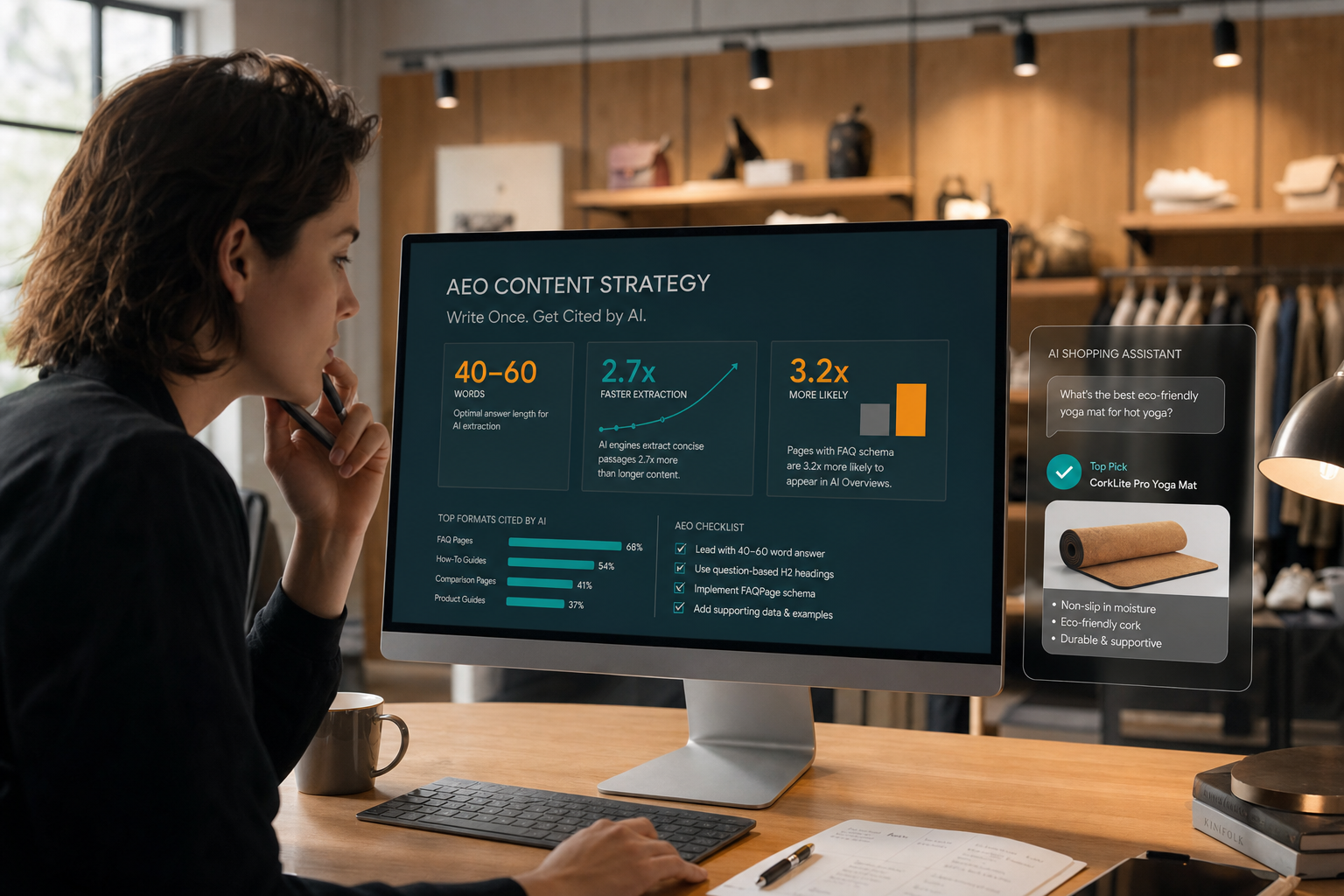
TL;DR: Writing AEO content means structuring every section to lead with a direct 40-60 word answer, using question-based H2 headings, and implementing FAQPage schema. AI engines extract concise passages at 2.7x the rate of longer content. Pages with FAQ schema are 3.2x more likely to appear in AI Overviews. The goal is not ranking—it is becoming the answer itself.
HubSpot just built answer engine optimization directly into its marketing platform through its XFunnel acquisition. When a company that serves hundreds of thousands of businesses makes AEO a default feature, the signal is clear: optimizing content for AI citation is no longer an edge tactic. It is becoming standard practice. For Shopify merchants, this means the window for differentiation through early AEO adoption is narrowing fast.
The data reinforces the urgency. AI Overviews now appear on 14% of all shopping queries—a 5.6x increase from November 2024. When an AI Overview appears, organic click-through rates drop 61%. But brands cited inside those AI answers earn 35% more clicks than brands appearing only in traditional results below. The game has changed: visibility inside the answer is the new front page.
What Is AEO Content and Why Does It Matter for Shopify Stores?
Answer Engine Optimization is the practice of formatting content so AI-powered systems can extract it and present it as a direct response to user queries. Unlike traditional SEO where you compete for rankings, AEO is about becoming the answer itself—the source ChatGPT, Perplexity, or Google AI Overviews cite when someone asks a question in your category.
For Shopify merchants, AEO matters because the discovery stack has fundamentally changed. ChatGPT handles over 2 billion queries daily. AI-referred traffic to Shopify stores grew 8x year over year by Q1 2026. AI-referred visitors convert at 4-23x the rate of traditional organic visitors. ChatGPT Shopping converts at 15.9%, Perplexity at 10.5%, compared to Google organic at 1.76%.
The research from Brandlight shows the overlap between top Google results and AI-cited sources has collapsed from 70% to below 20%. A strong Google ranking tells you almost nothing about where you stand in ChatGPT or Claude. These are now two separate games requiring separate strategies, and AEO content strategy is how you win the AI game.
How Do You Structure Content for AI Extraction?
Every section must lead with a direct answer in the first 40-60 words, followed by supporting evidence. AI models extract answers at 2.7x the rate from concise passages versus longer ones. The structure is simple: question as heading, direct answer paragraph, then supporting detail with bullet points or tables.
The self-contained chunk principle is critical. Each H2 or H3 section must function as a standalone answer because AI engines frequently cite individual sections, not whole pages. If a section cannot stand alone and fully answer the question posed in its heading, rewrite it.
Here is the structure that works:
- H2: Phrase as a question or directly answer one
- First paragraph: 40-60 word direct answer that could stand alone
- Supporting content: Evidence, examples, data points
- Optional elements: Bullet lists, comparison tables, numbered steps
Content types that get cited most frequently include definition answers (What is X?), how-to answers with numbered steps, comparison answers in table format, best-of answers with bullet lists and brief justifications, and stat-backed answers anchored by specific data points.
What Is the 40-60 Word Rule and Why Does It Work?
The 40-60 word rule requires placing a complete, direct answer in the first one to two sentences of every content section. This word count is optimal because it provides enough context to fully answer a question while remaining concise enough for AI systems to extract cleanly. Passages in this range get cited 2.7x more often than longer blocks.
Here is an example of the rule in action:
Question: What is the best way to reduce cart abandonment?
40-60 word answer: The most effective way to reduce cart abandonment is implementing exit-intent popups with discount offers, simplifying checkout to three steps or fewer, and adding trust badges near payment fields. Stores using these three tactics together see abandonment rates drop 15-25% on average within 30 days.
That answer is 54 words, complete, specific, and extractable. An AI engine can cite it directly without needing to pull additional context. Compare that to an answer that starts with "Cart abandonment is a complex issue that many merchants face..." and buries the actual answer three paragraphs down. The AI will skip the second version entirely.
Which Content Formats Get Cited Most by AI Engines?
Definition answers, how-to guides, comparison tables, and FAQ sections earn the highest citation rates across ChatGPT, Perplexity, and Google AI Overviews. Brands that include comparison tables are cited 3-5x more often than those without. Pages with FAQPage schema are 3.2x more likely to appear in AI Overviews.
Here is how to match format to question type:
- What is X? — Use paragraph format, 40-60 words, definition-style
- How do I X? — Use numbered list format with clear steps
- X vs Y? — Use comparison table with clear criteria
- Best X for Y? — Use bullet list with brief justification for each item
- Statistics questions — Anchor with a specific data point in the first sentence
For Shopify merchants specifically, collection pages should include buying guide sections targeting "best [product category] for [use case]" queries. Product pages need FAQ sections with 5-8 questions in answer-first format. Blog posts should follow the pillar-cluster model where each cluster article answers a specific sub-question and links back to the pillar.
The AEO for Shopify approach means treating every piece of content as a potential citation source, not just a ranking target.
How Do You Implement FAQ Schema for AEO?
FAQPage schema is JSON-LD structured data that tells AI engines exactly which questions your page answers and what those answers are. Implementing it correctly drives 3.1x higher answer extraction rates. Every blog post, collection page, and product page should include FAQ schema with a minimum of 5 questions.
The implementation process for Shopify stores:
- Write 5-8 questions your target customer actually asks about the topic
- Write direct, answer-first responses of 40-80 words each
- Add the FAQ section visibly on the page (AI engines verify schema against visible content)
- Implement FAQPage JSON-LD in your theme's schema markup
- Validate using Google's Rich Results Test
Dawn v15.0+ includes built-in schema using the structured_data Liquid filter. If you use multiple apps that add schema, audit regularly for conflicts and duplicate markup. JSON-LD in script tags is the preferred format over Microdata for Shopify implementation.
The questions in your FAQ should come from real customer queries. Use Google's "People also ask" boxes, your customer service logs, and product review questions as sources. Questions that start with "what," "how," "why," and "which" perform best for AI extraction.
What Technical Setup Does AEO Require on Shopify?
Shopify auto-generates /llms.txt as of May 2026, but you should customize it with your brand description, key pages, top products, and brand voice guidelines. Your robots.txt must allow AI crawlers including GPTBot, ClaudeBot, and PerplexityBot. Core Web Vitals must pass with Good ratings on all three metrics.
The technical checklist for AEO readiness:
- Verify /llms.txt exists and customize with brand information
- Check robots.txt allows GPTBot, ClaudeBot, PerplexityBot, GoogleBot
- Confirm sitemap.xml is current and submitted to Search Console
- Pass Core Web Vitals (LCP under 2.5s, INP under 200ms, CLS under 0.1)
- Implement canonical tags correctly (Shopify creates duplicate URLs by default)
- Add JSON-LD schema to all key page types
Shopify shipped six AI-facing endpoints to every store in May 2026: /llms.txt, /llms-full.txt, /agents.md, /.well-known/ucp, /api/ucp/mcp, and an agentic sitemap. These do not require manual setup but benefit from clean, complete product data. The universal checkout protocol is now auto-enabled for all Shopify stores.
Only 48% of Shopify stores pass all Core Web Vitals on mobile, which means technical optimization is a competitive advantage. The number one cause of poor CWV is app script bloat—audit every installed app.
How Do You Measure AEO Success?
Track AI citation frequency by testing 10 target queries across ChatGPT, Perplexity, and Google AI Overviews monthly. Monitor AI-referred sessions in GA4 using source filters for chatgpt.com, perplexity.ai, and other AI platforms. Track branded search volume in Google Trends as a leading indicator since brand search volume now correlates 3x more strongly with AI visibility than backlinks.
Key metrics to track:
- AI citation frequency: Manual prompt testing across major AI engines
- AI-referred sessions: GA4 filtered by AI platform sources
- AI-referred revenue: Track separately from organic revenue
- Featured snippet ownership: GSC and Semrush for priority queries
- Brand search volume: Google Trends month-over-month
- Content freshness: Percentage of top pages updated in last 30 days
Expected timelines vary by platform. Perplexity responds to new content within days due to real-time retrieval. Google AI Overviews pick up indexed content in 2-4 weeks. ChatGPT and Claude, which rely more heavily on training data, take 3-6 months before content influences citations.
A 2026 GEO benchmark study confirmed that e-commerce content updated within the last 30 days receives 3.2x more citations across AI platforms. Freshness is now a direct ranking factor for AI visibility, not just traditional search.
Frequently Asked Questions
What is the difference between AEO and traditional SEO?
Traditional SEO optimizes for ranking positions in search results. AEO optimizes for being extracted and cited as a direct answer by AI systems like ChatGPT, Perplexity, and Google AI Overviews. The tactics overlap—structured data, quality content, technical foundations—but AEO prioritizes answer-first formatting and self-contained content chunks over keyword density and backlink profiles.
How long does it take to see results from AEO optimization?
Perplexity can surface new content within days because it uses real-time web retrieval. Google AI Overviews typically pick up well-indexed content in 2-4 weeks. ChatGPT and Claude, which rely more on training data, take 3-6 months before new content influences their citations. Start with Perplexity-optimized content for fastest feedback.
Do I need to rewrite all my existing content for AEO?
No. Start with your top 10 performing pages and add answer-first lead paragraphs, FAQ sections with schema, and question-based H2 headings. Content updated within the last 30 days receives 3.2x more AI citations, so prioritize refreshing high-traffic pages before creating new content.
What is the minimum FAQ section length for AEO?
Include a minimum of 5 questions per page, with 8 being optimal for comprehensive coverage. Each answer should be 40-80 words and lead with the direct response. Implement FAQPage JSON-LD schema and ensure the FAQ is visible on the page, not hidden in an accordion that requires JavaScript to expand.
Does AEO work for product pages or just blog content?
AEO applies to all page types. Product pages should include "Who this is for" sections, FAQ sections with 5-8 questions, and descriptions written in answer format. Collection pages need buying guide sections targeting "best [category] for [use case]" queries. Blog posts build topical authority that supports product and collection page visibility.
How do I know if my content is being cited by AI engines?
Test manually by asking ChatGPT, Perplexity, Claude, and Google AI Mode questions your content answers. Log whether your brand is mentioned and in what context. Tools like Peec AI, Llmrank.io, Rankscale, and Otterly automate this tracking. Monitor GA4 for traffic from AI platform referrers.
What role does structured data play in AEO?
Structured data is critical. Pages with comprehensive schema receive 2.7x more impressions. Products with full Product schema appear 3-5x more often in AI shopping recommendations. FAQPage JSON-LD drives 3.1x higher answer extraction rates. Implement Product, FAQPage, Article, and Organization schema at minimum.
Should I block or allow AI crawlers in robots.txt?
Allow them. Your robots.txt should explicitly permit GPTBot, ClaudeBot, PerplexityBot, and GoogleBot unless you have a specific reason to block. Blocking AI crawlers removes you from AI-powered discovery entirely. Shopify's default robots.txt is generally well-configured, but verify any custom rules you have added.
