How Do You Build a Gifting Program for Ecommerce on Shopify?
 Team Gimmie
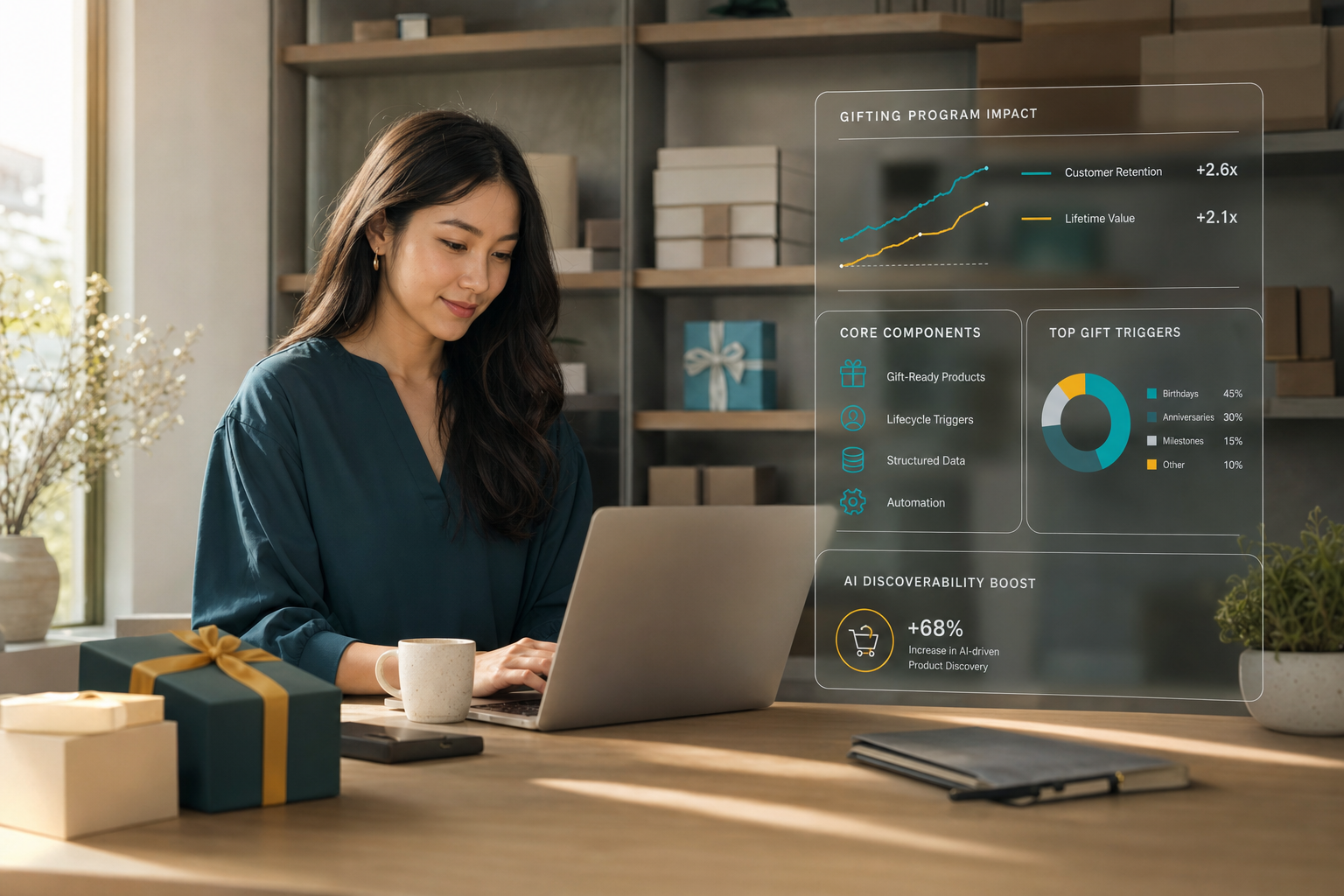
TL;DR: Build an ecommerce gifting program by identifying lifecycle triggers (birthdays, anniversaries, milestones), creating gift-ready product bundles with complete structured data, automating delivery through Shopify apps, and optimizing your catalog for AI shopping agents. Brands with structured gifting programs see 2-3x higher customer retention and increased lifetime value.
Why Should Shopify Merchants Build a Gifting Program Now?
Gifting programs drive measurable retention and revenue gains that compound over time. With AI shopping agents now influencing $20.9 billion in retail spending in 2026 and McKinsey projecting $3-5 trillion in agentic commerce redirects by 2030, merchants who structure their gifting catalogs for AI discovery gain a significant first-mover advantage.
The business case is straightforward: gifting creates emotional touchpoints that transactional discounts cannot replicate. When a customer receives an unexpected gift at a milestone moment, the psychological impact drives loyalty far beyond a percentage-off coupon. According to retention data, brands using gift trigger automation see repeat purchase rates increase by 25-40% compared to brands relying solely on discount-based retention.
Additionally, gifting programs align perfectly with agentic commerce infrastructure. AI agents making purchase recommendations favor merchants with complete product data, clear occasion-based categorization, and structured gift messaging capabilities. Your gifting program becomes discoverable inventory for ChatGPT Shopping, Perplexity, and Google AI Overviews.
What Are the Core Components of an Ecommerce Gifting Program?
An effective ecommerce gifting program requires five core components: trigger identification, product curation, automation infrastructure, personalization logic, and measurement systems. Each component builds on the others to create a cohesive retention engine.
Trigger identification means mapping the moments when a gift creates maximum emotional impact:
- Customer birthdays and anniversaries
- Purchase milestones (first order, 10th order, annual spend thresholds)
- Subscription renewals
- Win-back windows (90-day inactivity)
- Post-purchase thank-you moments
- Referral completions
Product curation involves selecting or creating gift-appropriate items. Not every product in your catalog works as a gift. Identify items with high perceived value, low shipping complexity, and broad appeal. Consider creating gift-specific SKUs or bundles that exist solely for your gifting program.
Automation infrastructure connects your triggers to fulfillment. Shopify apps like Gimmie enable milestone gifting automation that fires gifts based on customer data without manual intervention.
Personalization logic ensures gifts feel intentional rather than generic. This ranges from simple name personalization to psychology-driven recommendations that match gift selections to recipient personality profiles.
Measurement systems track gifting ROI through retention rate changes, LTV increases, and attribution of subsequent purchases to gifting touchpoints.
How Do You Structure Product Data for Gift Discovery by AI Agents?
AI shopping agents select products based on structured data completeness, not marketing copy. Products with 8 or more structured attributes get cited 4.3x more often in AI shopping results than products with fewer than 3 attributes. For gifting specifically, this means treating your gift catalog as a distinct optimization target.
Start with the baseline product data requirements for agentic commerce:
- Product name (clear, descriptive)
- Price (accurate, inclusive of variants)
- Inventory status (real-time)
- Shipping time and cost
- Return policy
- Minimum 3 product images including lifestyle shots
- Variant data fully specified
- GTIN/barcode
- Brand name
- Categories using Shopify's standard taxonomy
For gift products specifically, add these attributes:
- Occasion tags (birthday, anniversary, thank-you, holiday)
- Recipient type (for her, for him, for kids, for colleagues)
- Price tier (under $25, $25-50, $50-100, luxury)
- Gift-ready packaging availability
- Personalization options
- Gift message capability
Shopify's Universal Commerce Protocol (UCP), which auto-enabled on all stores in March 2026, allows AI agents to query your catalog directly. The more complete your gift product data, the more likely agents recommend your products when users ask "What's a good birthday gift for my mom under $50?"
What Automation Tools Power Shopify Gifting Programs?
Shopify's app ecosystem offers multiple paths to gifting automation, from simple gift-with-purchase triggers to sophisticated AI-powered gift recommendations. The right tool depends on your program complexity and customer data maturity.
Entry-level automation uses Shopify Flow to trigger gift fulfillment based on customer events. You can create flows that automatically add a free gift to orders above a threshold, send gift cards on customer birthdays, or trigger a thank-you gift after a customer's fifth purchase.
Mid-tier automation adds personalization and recipient profiling. Apps in this category let customers create recipient profiles, save gift preferences, and receive personalized gift recommendations based on past behavior and stated preferences.
Advanced automation incorporates emotionally intelligent gifting that matches gifts to recipient psychology rather than just purchase history. This approach uses behavioral science frameworks to predict which gifts will resonate emotionally, not just transactionally.
Regardless of tier, ensure your automation infrastructure exposes gift data to AI crawlers. Shopify's /llms.txt file, auto-generated since May 2026, should reflect your gift collections. You can customize this file to highlight gift-specific pages and products.
How Do You Set Up Gift Triggers That Actually Drive Retention?
Effective gift triggers fire at moments of emotional relevance, not arbitrary calendar dates. The highest-performing triggers combine timing precision with perceived personalization to create "surprise and delight" moments that feel intentional rather than automated.
Birthday triggers remain the most common starting point. Capture birth dates during account creation or through post-purchase surveys. Fire the gift 1-3 days before the birthday to ensure arrival timing. Include a personalized message referencing the occasion.
Purchase anniversary triggers celebrate the relationship between customer and brand. A gift on the one-year anniversary of a customer's first purchase reinforces loyalty and often prompts a reciprocal purchase.
Milestone triggers reward cumulative behavior:
- Order count milestones (5th, 10th, 25th order)
- Spend thresholds ($500, $1000 lifetime value)
- Subscription duration (6 months, 1 year)
- Referral achievements (first referral, 5 referrals)
Win-back triggers use gifts to re-engage lapsed customers. A gift sent at the 90-day inactivity mark converts at significantly higher rates than a discount email. The gift signals that the brand noticed the absence and values the relationship.
Post-purchase triggers turn transactional moments into relationship-building opportunities. A small unexpected gift included with an order, or shipped separately as a "thank you," creates positive surprise that drives word-of-mouth and repeat purchases.
For each trigger, define the gift value relative to customer value. A first-time buyer might receive a sample or small accessory. A high-LTV customer might receive a full-size product or exclusive item.
How Do You Measure Gifting Program ROI?
Gifting program measurement requires tracking both direct attribution and halo effects on retention metrics. The direct costs are clear: product cost, shipping, and automation platform fees. The returns require more nuanced tracking.
Direct attribution metrics:
- Gift redemption rate (for gift cards or codes)
- Post-gift purchase rate (purchases within 30 days of gift receipt)
- Post-gift AOV compared to baseline
- Gift-triggered referrals
Retention impact metrics:
- Cohort retention rate: gift recipients vs. non-recipients
- LTV change: customers who received gifts vs. matched control group
- Churn rate reduction among gift recipients
- NPS or satisfaction score changes
Program efficiency metrics:
- Cost per retained customer
- Gift cost as percentage of incremental LTV
- Automation cost per gift sent
Set up tracking by tagging gift recipients in your customer data platform or Shopify customer tags. Create segments for gift recipients and matched non-recipients with similar purchase history. Compare retention and LTV between groups over 6-12 month windows.
Benchmark data suggests well-executed gifting programs deliver 3-5x ROI when measuring incremental LTV against gift and fulfillment costs. The key is ensuring gifts go to customers with retention potential, not customers who would have stayed regardless.
How Does AI Visibility Affect Your Gifting Program's Reach?
AI shopping assistants now influence a growing share of gift purchases, and this share will accelerate as agentic commerce matures. When someone asks ChatGPT "What should I get my sister for her birthday?" or tells Perplexity "Find me a thank-you gift under $30," the AI draws from merchants with structured, complete, gift-tagged product data.
Google AI Overviews now appear on 14% of shopping queries, up 5.6x from November 2024. For gift-related queries like "best gifts for new moms" or "unique anniversary gifts," AI Overviews appear even more frequently because these are informational queries with high commercial intent.
To capture AI-driven gift traffic:
-
Create gift guide content optimized for answer engine optimization. Structure guides with question-based H2s, direct answers in the first 40-60 words of each section, and FAQ schema.
-
Build gift collection pages targeting "best [gift type] for [recipient/occasion]" queries. Include buying guide content, comparison information, and FAQ sections with schema markup.
-
Ensure product schema completeness on all gift products. Products with full schema appear 3-5x more often in AI shopping recommendations.
-
Update gift content regularly. Content updated within 30 days receives 3.2x more AI citations than stale content. Refresh gift guides seasonally and update product availability in real-time.
-
Optimize your llms.txt file to highlight gift collections and gifting capabilities. AI crawlers use this file to understand your store's offerings.
The brands building AI-visible gifting infrastructure now will capture disproportionate share as agentic commerce scales toward the projected $3-5 trillion market by 2030.
Frequently Asked Questions
What is the minimum budget needed to start a Shopify gifting program?
You can launch a basic gifting program with minimal incremental cost by using existing inventory as gifts and Shopify Flow for automation. A more robust program with dedicated gift products and specialized automation typically requires $500-2,000 monthly for gift inventory plus $50-200 monthly for automation apps. Scale investment based on measured ROI.
How do I collect customer birthdays for birthday gifting triggers?
Add a birthday field to your account creation form, post-purchase survey, or loyalty program signup. Offer a small incentive for sharing ("Get a birthday surprise from us"). You can also use progressive profiling through email campaigns that ask for birthday information in exchange for a future gift.
Should gifts be free products or discount codes?
Physical gifts typically outperform discount codes for emotional impact and retention. A $15 product gift creates more perceived value and surprise than a $15 discount code. However, discount codes work well for win-back triggers where the goal is prompting a purchase, not just creating goodwill.
How do I prevent gift program abuse?
Set clear eligibility rules: one birthday gift per customer per year, milestone gifts only for verified purchases, win-back gifts only for customers with previous purchase history. Use Shopify customer tags to track gift history and prevent duplicate sends.
What products work best as gifts in a gifting program?
Ideal gift products have high perceived value relative to cost, low shipping complexity (small, lightweight, non-fragile), broad appeal across customer segments, and clear connection to your brand. Sample sizes, accessories, and exclusive items often outperform discounting core products.
How long does it take to see ROI from a gifting program?
Expect 3-6 months to accumulate enough data for statistically meaningful retention comparisons. Initial signals like post-gift purchase rates appear within 30-60 days. Full LTV impact requires 12+ months of cohort tracking.
Can I use AI to personalize gift recommendations?
Yes. AI gifting platforms like Gimmie use psychology-driven recommendations to match gifts to recipient profiles based on personality traits, values, and preferences rather than just purchase history. This approach increases gift relevance and recipient satisfaction.
How do gifting programs affect AI shopping visibility?
Well-structured gifting programs improve AI visibility by creating gift-tagged products with complete structured data, gift guide content that answers common gift queries, and collection pages targeting gift-intent keywords. AI agents increasingly recommend merchants with clear gifting capabilities when users search for gift ideas.
