How Do Brand Mentions in AI Actually Work for Shopify Merchants?
 Team Gimmie
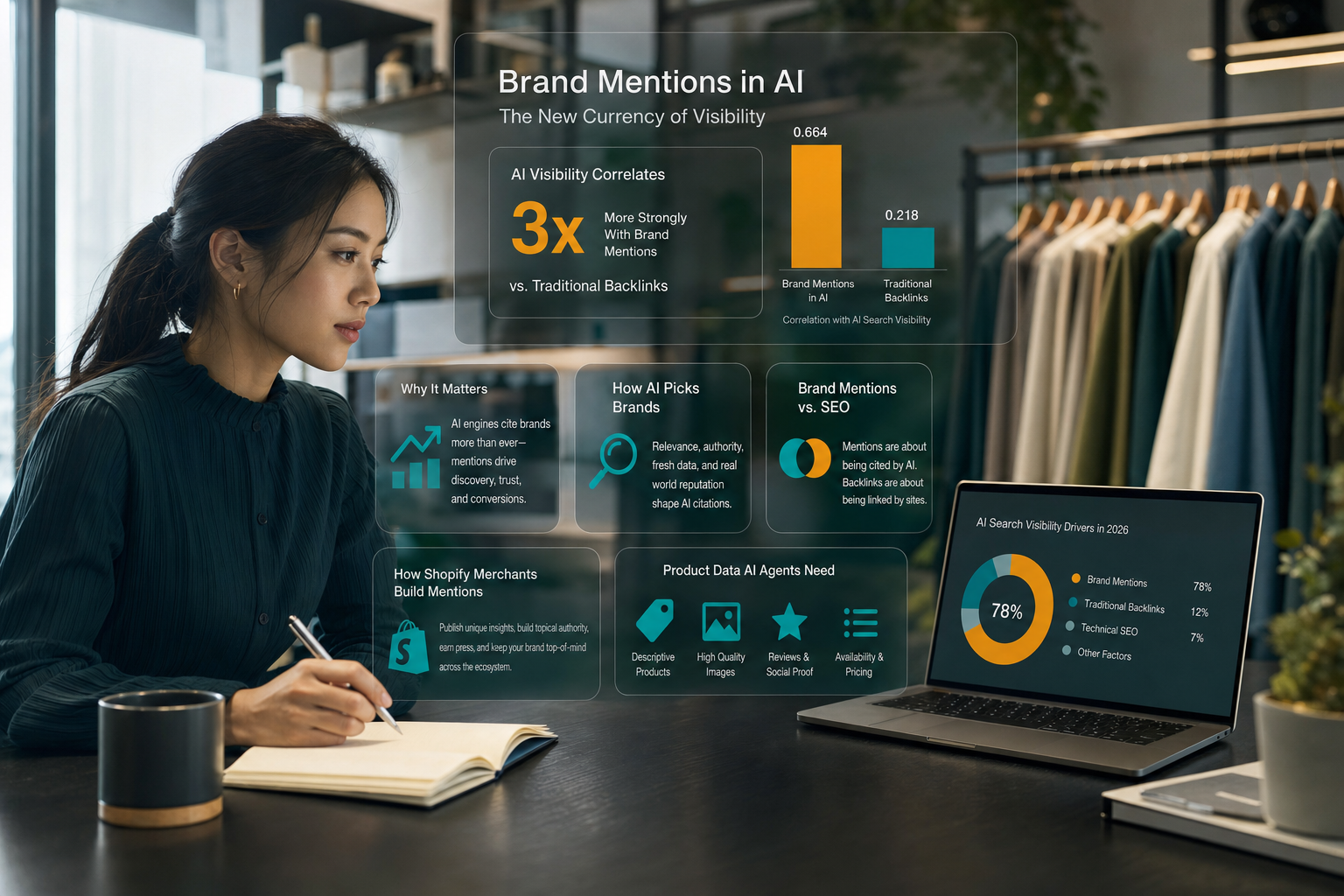
TL;DR: Brand mentions in AI refer to how often and how favorably large language models like ChatGPT, Perplexity, and Google AI Overviews cite your brand when users ask product-related questions. In 2026, brand mentions correlate 3x more strongly with AI search visibility than traditional backlinks (0.664 vs. 0.218). For Shopify merchants, this means the game has fundamentally changed: getting mentioned by AI engines is now more valuable than accumulating links, and the brands building AI visibility infrastructure today will own the citations tomorrow.
Why Do Brand Mentions in AI Matter More Than Backlinks Now?
Brand mentions in AI matter more than backlinks because LLMs synthesize answers rather than rank pages. Research shows brand search volume is now the strongest predictor of AI citations, with a correlation of 0.664 compared to just 0.218 for backlinks. This represents a 3x shift in what drives visibility.
The data is stark. According to Brandlight research, the overlap between top Google search results and AI-cited sources has collapsed from 70% to below 20%. A Shopify store can rank first on Google for a query and be completely absent from ChatGPT's answer to the same question. These are now two separate games requiring separate strategies.
For DTC brands, this means unlinked brand mentions in press articles, product roundups, Reddit discussions, and community forums now carry real weight. When ChatGPT or Perplexity answers "What's the best [product] for [use case]?" the brands that get mentioned are those with strong entity presence across the web, not necessarily those with the most backlinks.
How Do AI Engines Decide Which Brands to Mention?
AI engines decide which brands to mention based on five primary factors: brand search volume, training data presence, real-time retrieval authority, community signals, and third-party citations. Unlike Google's PageRank, LLMs don't rank pages—they synthesize answers from multiple sources.
Brand search volume is the dominant signal. When users actively search for your brand name on Google, that volume signals to AI systems that your brand is relevant and trusted. This is why building branded search through all marketing channels matters so much for AI visibility.
Training data presence determines whether your brand exists in the model's memory. Content published before the model's training cutoff becomes part of its knowledge base. Real-time retrieval authority matters for models with web access—ChatGPT uses Google's index via SerpAPI, so traditional E-E-A-T signals still apply. Community signals from Reddit, Quora, and niche forums carry significant weight because AI engines frequently retrieve from these sources. Third-party citations in articles that AI engines trust create a compounding effect.
What Is the Difference Between Brand Mentions and Traditional SEO?
The difference between brand mentions and traditional SEO is that mentions focus on being cited in synthesized AI answers rather than ranking in search results. Traditional SEO optimizes for position on a results page. Brand mention optimization ensures your brand appears when AI generates a response.
Google AI Overviews now appear on 14% of all shopping queries, up 5.6x from November 2024. When an AI Overview appears, organic click-through rates drop by 61%. However, brands cited inside AI Overviews earn 35% more clicks than brands appearing only in blue-link results below. The citation functions as a pre-qualification endorsement.
This creates a two-track system. You still need Google indexing as a prerequisite since ChatGPT pulls from Google's index for real-time queries. But ranking well on Google no longer guarantees AI visibility. The 5W AI Platform Citation Source Index 2026 found the top 15 domains capture 68% of all consolidated AI citation share, meaning authority concentration is extreme in AI search.
How Can Shopify Merchants Build Brand Mentions in AI?
Shopify merchants can build brand mentions in AI through LLM seeding, structured product data, content freshness, and community presence. The goal is to place brand information in sources that AI models train on or retrieve from, while ensuring your product data is complete enough for AI agents to recommend.
Start with high-value seeding targets. Wikipedia remains the most impactful for training data. Reddit is highly indexed and frequently retrieved by AI engines. Quora's question-answer format is ideal for answer engine optimization. Product review aggregators like Wirecutter and Good Housekeeping carry significant weight. Industry publications with domain authority above 70 matter for both training data and real-time retrieval.
Content seeding tactics include publishing original research and data studies that journalists cite and LLMs learn from. Guest posts on high-authority industry publications extend your reach. Expert commentary through platforms like Connectively and Qwoted positions your team as go-to sources. Creating definitive resource content that other sites naturally reference builds compounding authority.
Shopify's Summer '26 Edition added a dashboard showing how your products perform inside ChatGPT, Gemini, and Copilot with specific guidance on improving visibility. Check this regularly to understand where you stand.
What Product Data Do AI Agents Need to Mention Your Brand?
AI agents need complete, accurate, structured, consistent, and accessible product data to mention your brand. Products with eight or more structured attributes are cited 4.3x more often in AI shopping results than products with fewer than three attributes. Incomplete data means invisible products.
The product data checklist for AI visibility includes clear product names without keyword stuffing, current and accurate pricing inclusive of variants, real-time inventory status, shipping time and cost, return policy, minimum three product images including lifestyle shots, fully specified variant data for size, color, and material, GTIN or barcode, brand name, description optimized for AI extraction, minimum ten reviews with ratings, and categories using Shopify's standard taxonomy.
Shopify's agentic commerce infrastructure now includes six AI-facing endpoints on every store: /llms.txt, /llms-full.txt, /agents.md, /.well-known/ucp, /api/ucp/mcp, and an agentic sitemap. These don't require manual setup but benefit enormously from clean, complete product data. The Shopify Catalog syndicates your products to AI channels automatically, and Shopify's internal data shows Catalog-fed AI searches convert at 2x the rate of searches using scraped product data.
How Long Does It Take for AI Engines to Start Mentioning Your Brand?
The timeline for AI engines to start mentioning your brand varies by platform, ranging from days to six months. Perplexity responds to new content within days due to real-time web retrieval. Google AI Overviews typically reflect indexed content within two to four weeks. ChatGPT and Claude take three to six months before content influences citations because they rely more heavily on training data.
Content freshness accelerates this timeline significantly. A 2026 GEO benchmark study confirmed that e-commerce content updated within the last 30 days receives 3.2x more citations across AI platforms than content that hasn't been refreshed. Product pages with benchmark data like pricing comparisons and performance metrics are cited 2.8x more than generic product descriptions.
For Shopify merchants, this means quarterly content audits are now mandatory. Update your top product pages with fresh comparison data, new customer reviews, and current pricing. Add "Last updated" dates visibly. The cheapest AI visibility move you can make is refreshing existing content rather than creating new content from scratch.
How Do You Measure Brand Mentions in AI?
You measure brand mentions in AI through manual prompt testing, dedicated tracking tools, and referral traffic analysis in Google Analytics 4. The goal is to understand how often your brand appears when users ask relevant questions to major LLMs.
Test query types to monitor include "What are the best [your product category]?" and "Recommend a [your product] for [your core use case]" and "Is [your brand name] reputable?" and "Compare [your brand] to [competitor]." Run these queries across ChatGPT, Perplexity, Claude, and Google AI Overviews monthly and log the results.
Tools for tracking in 2026 include Peec AI, Llmrank.io, Rankscale, Otterly, Brand24 with AI monitoring, and Adobe LLM Optimizer. These platforms automate the prompt testing process and track citation frequency over time. In GA4, track AI-referred sessions by filtering for sources like chatgpt.com, perplexity.ai, and claude.ai. AI-referred visitors convert at 4-23x the rate of traditional organic visitors, so this traffic is worth isolating and understanding.
HubSpot recently built AEO tools directly into its platform via its XFunnel acquisition, signaling that AI citation tracking is moving from specialist discipline to standard marketing function.
Frequently Asked Questions
What are brand mentions in AI? Brand mentions in AI refer to instances where large language models like ChatGPT, Perplexity, Claude, or Google AI Overviews cite or recommend your brand when answering user queries. These mentions function as endorsements that influence purchase decisions before users ever visit your website.
Why do brand mentions matter more than backlinks for AI visibility? Brand mentions correlate 3x more strongly with AI search visibility than traditional backlinks, with a correlation of 0.664 versus 0.218. LLMs synthesize answers from multiple sources rather than ranking pages, so being mentioned across trusted sources matters more than accumulating links to your own domain.
How can Shopify merchants increase their brand mentions in AI? Shopify merchants can increase AI brand mentions by completing all product data attributes, publishing answer-first content that AI engines can extract, earning coverage in high-authority publications, participating authentically in Reddit and Quora communities, and ensuring their store's AI-facing endpoints contain clean data.
What is the difference between AEO and traditional SEO? Traditional SEO optimizes for ranking position on search results pages. Answer engine optimization focuses on being cited in AI-generated answers. You need both because ChatGPT uses Google's index for real-time queries, but ranking well on Google no longer guarantees AI visibility.
How long does it take to see results from AI brand mention optimization? Timelines vary by platform. Perplexity can respond to new content within days. Google AI Overviews typically reflect changes within two to four weeks. ChatGPT and Claude may take three to six months because they rely more on training data than real-time retrieval.
What tools can track brand mentions in AI? Tools for tracking AI brand mentions in 2026 include Peec AI, Llmrank.io, Rankscale, Otterly, Brand24 with AI monitoring, and Adobe LLM Optimizer. You can also manually test queries across ChatGPT, Perplexity, and Claude monthly to track citation frequency.
Does Shopify help with AI brand visibility? Yes. Shopify's Summer '26 Edition includes a dashboard showing how products perform inside ChatGPT, Gemini, and Copilot. Shopify also auto-generates AI-facing files like llms.txt and enables Universal Commerce Protocol by default, making stores discoverable by AI shopping agents.
What product data matters most for AI citations? Products with eight or more structured attributes are cited 4.3x more often than products with fewer than three. Critical attributes include clear product names, accurate pricing, real-time inventory, shipping details, GTIN codes, multiple images, complete variant data, and customer reviews.
