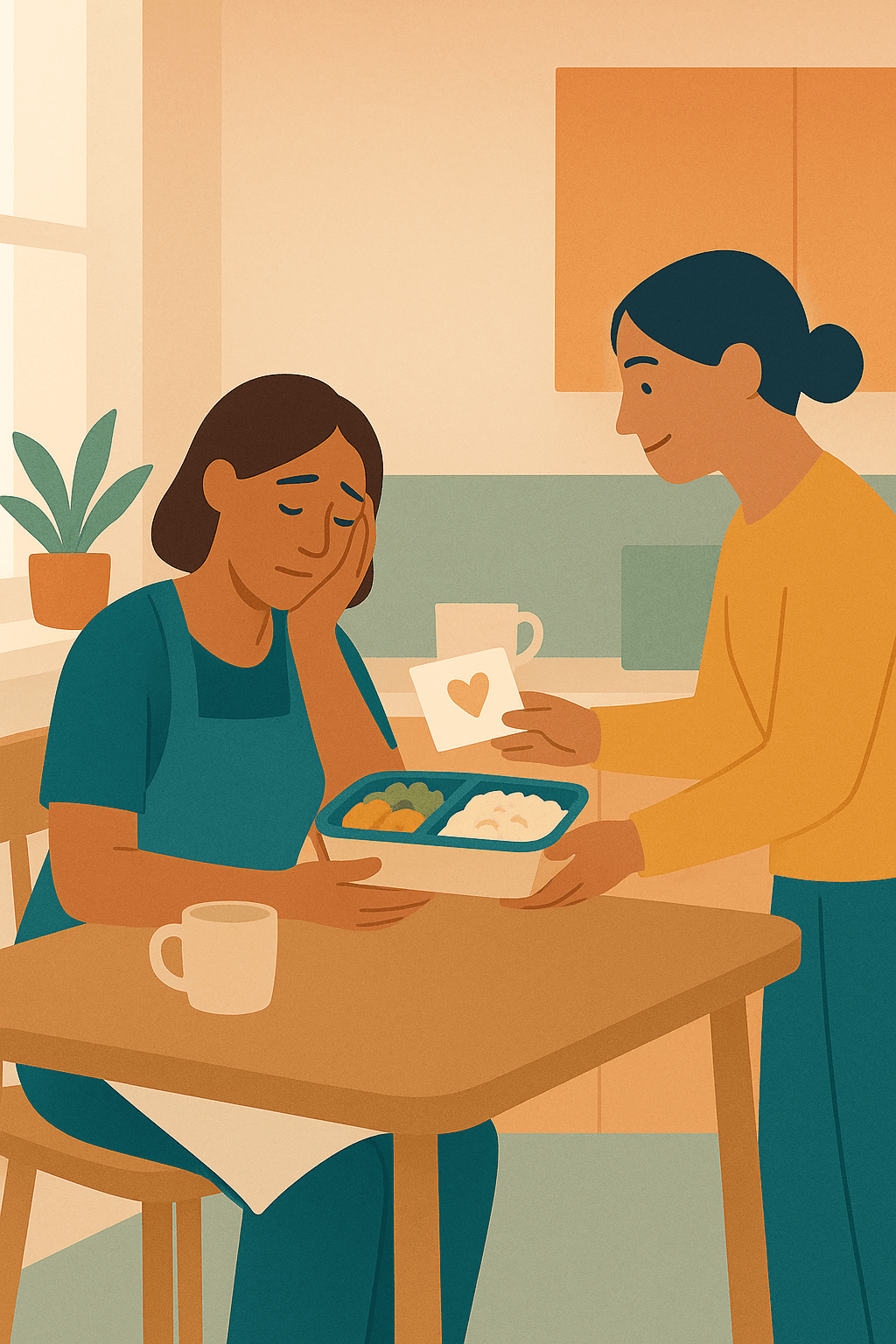
The best gift for a burned-out caregiver removes one real burden without creating another. Choose paid help, flexible food credit, transportation, or a familiar comfort they already use. Pair it with a message that requires no reply. The goal is not to reward endurance; it is to return time, choice, or rest.
A useful test is simple: Will this gift reduce tomorrow’s workload, or add a task to it? A DoorDash credit can remove dinner planning. A prepaid housecleaning visit can return two hours. An elaborate surprise party creates decisions, social energy, and thank-you notes.
Gimmie calls that hidden burden gratitude labor: the work of receiving, scheduling, displaying, maintaining, or enthusiastically responding to a gift. Emotionally Intelligent Gifting minimizes gratitude labor while increasing Gift Buying Confidence.
Prioritize gifts that are:
Immediately usable, such as Instacart credit or a filled gas card.
Flexible, with no narrow redemption date.
Specific to their routine, not a generic symbol of “self-care.”
Easy to receive, requiring no hosting, assembly, or public reaction.
About the caregiver as a person, not only their caregiving role.
Why do ordinary self-care gifts often miss the mark?
Generic self-care gifts fail when they assign the caregiver another job: relaxing correctly. A bath set, meditation subscription, or complicated spa booking assumes spare time, privacy, and decision-making capacity. Burnout calls for load reduction first. Comfort matters, but it works best after practical friction has been removed.
A lavender candle is lovely if they burn candles every evening. It is clutter if they avoid fragrance, live in a hospital room, or cannot leave an older adult unattended near a flame. The same distinction applies to journals, houseplants, meal kits, and wellness classes.
About Team Gimmie
A small team of friends and colleagues working together to produce useful content to help you...gift better.
Use this order of operations:
Remove a recurring task: meals, laundry, transport, pet care, or errands.
Protect their autonomy: offer choices instead of taking control.
Add familiar comfort: their exact tea, mystery author, hand cream, or playlist.
Recognize their identity: friend, gardener, gamer, aunt, runner—not merely “caregiver.”
The non-obvious rule is that the most thoughtful gift is often logistical rather than sentimental. Practicality does not make a gift cold; accurate relief is a form of emotional recognition.
Which caregiver gift matches the burden they are carrying?
Match the gift to the caregiver’s dominant load: time, decisions, money, isolation, sleep disruption, or identity loss. A gift card is not impersonal when it precisely solves the right problem. The table below converts an observed burden into concrete help while preserving the recipient’s control and dignity.
Dinner is constantly improvised — Best gift category: Flexible food support; Specific example: DoorDash, Uber Eats, or local restaurant credit; Why it works: Removes planning, shopping, and cleanup; What to avoid: Meal kits that require cooking
Appointments dominate the week — Best gift category: Transport relief; Specific example: Uber credit, parking pass, or gas card; Why it works: Reduces a repeated expense and task; What to avoid: Rides booked without permission
Their home is falling behind — Best gift category: Household help; Specific example: One prepaid cleaning or laundry service; Why it works: Returns visible time and energy; What to avoid: An open-ended service they must manage
They cannot leave easily — Best gift category: At-home comfort; Specific example: Their exact coffee, Audible credit, or soft washable blanket; Why it works: Fits inside existing constraints; What to avoid: Tickets with a fixed date
They feel socially cut off — Best gift category: Low-pressure connection; Specific example: A porch coffee, short walk, or scheduled video call; Why it works: Offers companionship without hosting; What to avoid: Surprise visitors or group events
Every choice feels exhausting — Best gift category: Curated essentials; Specific example: Five known favorites in a simple basket; Why it works: Reduces Decision Paralysis; What to avoid: A giant hamper of unfamiliar items
Caregiving has eclipsed their identity — Best gift category: Hobby continuity; Specific example: Nintendo eShop credit, watercolor refills, or a garden-store voucher; Why it works: Reconnects them with a valued self; What to avoid: Gifts centered on the patient
For a spouse caring for a parent with dementia, a prepaid Saturday laundry pickup can outperform a luxury robe. For a friend sleeping beside a child in pediatric care, a long charging cable, noise-canceling earbuds, and hospital café credit solve three immediate problems.
How much should you spend on a caregiver gift?
A caregiver gift should fit your relationship and finances, not the severity of their hardship. A thoughtful range is under $25 for a supportive gesture, $25–$75 for practical relief, and $75 or more for shared help from family or friends. Reliability and relevance matter more than price.
Under $25 — Strong options: Favorite snack delivery, parking credit, long phone charger, handwritten note; Best use case: Coworker, neighbor, or frequent small support
$25–$75 — Strong options: Grocery credit, restaurant delivery, laundry service, audiobook membership; Best use case: Close friend or family member
$75–$200 — Strong options: Housecleaning, respite-care contribution, several prepared meals; Best use case: Immediate family or a small group gift
$200+ pooled — Strong options: Respite fund, recurring cleaning, travel support for appointments; Best use case: Coordinated family, workplace, or community support
Small gifts can be especially effective when repeated. A $15 café credit sent before a weekly oncology appointment recognizes the actual rhythm of care better than one expensive present delivered months later.
Never spend beyond your means or use price to measure compassion. If money is tight, offer one bounded action: “I can bring dinner Thursday at 6 p.m.; no need to visit.” Specific help is easier to accept than “Let me know if you need anything.”
How do you personalize a caregiver gift without asking many questions?
Personalize by observing values, routines, sensory preferences, and preferred ways of receiving care—not by guessing from age or gender. Gimmie’s 8-Color Consumer Psychology System profiles personality, identity, love languages, and social roles. That approach reveals whether relief, autonomy, connection, quality, novelty, or recognition will feel most meaningful.
Look for behavioral evidence:
They research every purchase: give a flexible credit or share the service details before booking.
They dislike asking for help: offer one specific, time-bounded action with an easy opt-out.
They protect familiar routines: replenish the exact coffee, socks, skincare, or audiobook format they use.
They value shared time: offer a quiet walk, a favorite takeout meal, or sitting together during an appointment.
They guard privacy: choose discreet delivery and avoid public praise on Facebook or LinkedIn.
They love novelty: send a small discovery that works at home, such as a MUBI subscription or international snack box.
This is why a Recipient Profile beats a “gifts for women” list. Persistent details—decaf coffee, fragrance sensitivity, Kindle preference, evening availability—produce better recommendations across birthdays, holidays, and difficult caregiving milestones.
What gifts should you avoid giving a burned-out caregiver?
Avoid gifts that create scheduling pressure, physical upkeep, unwanted advice, or an obligation to perform gratitude. Fixed-date events, living plants, complicated subscriptions, inspirational caregiving books, and surprise visits often increase cognitive load. Never imply that better wellness habits would solve conditions created by sustained responsibility and limited support.
Common misses include:
Spa certificates with narrow availability, distant locations, or expiration dates.
Meal kits that still require chopping, cooking, and washing dishes.
Houseplants or pets that need ongoing care.
Alcohol, unless you know it is welcome and appropriate.
Medical advice disguised as a gift, including supplements or unrequested wellness programs.
Caregiver-themed merchandise that reduces their identity to a role.
A surprise break arranged without confirming who will provide safe, trusted care.
Do not photograph the handoff or post their story without consent. Caregiving often involves private medical, financial, and family information; dignity is part of the gift.
Can you give a gift to a professional caregiver?
Yes, but professional caregivers may face employer rules, monetary limits, or ethical restrictions on gifts. Check the policy for a hospital, hospice, nursing agency, or residential facility before giving cash or gift cards. A specific thank-you note to the caregiver and their supervisor is usually appropriate and professionally valuable.
For a nurse, home health aide, hospice worker, or certified nursing assistant, strong options include:
A detailed card naming what they did: “You explained every medication slowly and helped Dad feel safe.”
A commendation sent to the unit manager or agency director.
Individually packaged snacks for the whole shift, if facility policy allows them.
A donation to the hospital foundation or hospice in the team’s honor.
Avoid cash, expensive jewelry, and gifts that could create favoritism or discomfort. When in doubt, ask the facility’s patient-relations office.
What should you write in a card to a caregiver?
Write a short message that names what you see, affirms the person beyond caregiving, and removes any duty to respond. Avoid calling them a saint, hero, or “so strong,” which can make endless endurance sound mandatory. Concrete recognition feels warmer than praise that places them on a pedestal.
Try one of these:
“I see how much you’re carrying. Dinner is covered tonight—no reply or thank-you needed.”
“You matter to me as yourself, not only for everything you do for your dad.”
“This is for coffee and parking on appointment days. Use it whenever it makes life easier.”
“I’m free Tuesday from 2 to 4 to handle groceries. If that is not useful, you can simply say no.”
“There is nothing you need to perform for me. I’m here, and I’ll keep checking in gently.”
What else should you know before sending the gift?
The right caregiver gift depends on permission, timing, and follow-through as much as the item itself. Confirm allergies, access needs, delivery instructions, and service boundaries. Choose flexible redemption, protect privacy, and remember that steady, modest support often provides more relief than a dramatic one-time gesture.
Is it better to give money or a gift card?
Cash offers maximum flexibility, while a well-chosen gift card can feel easier to accept and more clearly supportive. Use cash with close family when expenses are substantial. Use grocery, fuel, parking, or restaurant credit when you know the recurring burden. Always avoid cards that require extra spending to become useful.
Should you surprise a caregiver with help?
Surprise them with the offer, not with a person entering their home or taking over care. Cleaning, respite care, transportation, and meal delivery involve privacy, trust, allergies, schedules, and safety. Present a prepaid option or propose a specific time, then let the caregiver accept, decline, or modify it without explanation.
When is the best time to give caregiver support?
Give support during the long middle, not only at diagnosis, discharge, or bereavement. Attention often peaks during a crisis and disappears while caregiving continues for months or years. Calendar recurring check-ins around treatment days, school breaks, anniversaries, or monthly bills, and vary practical help according to changing needs.
The kindest gift says, “I noticed the shape of your day, and I made one part lighter.” If choosing still feels hard, Gimmie can help you build a psychology-informed Recipient Profile and explore gifts that fit the caregiver’s real personality, routines, and needs—without adding more noise.
What Do You Give a Caregiver Who Is Burned Out? | Gimmie