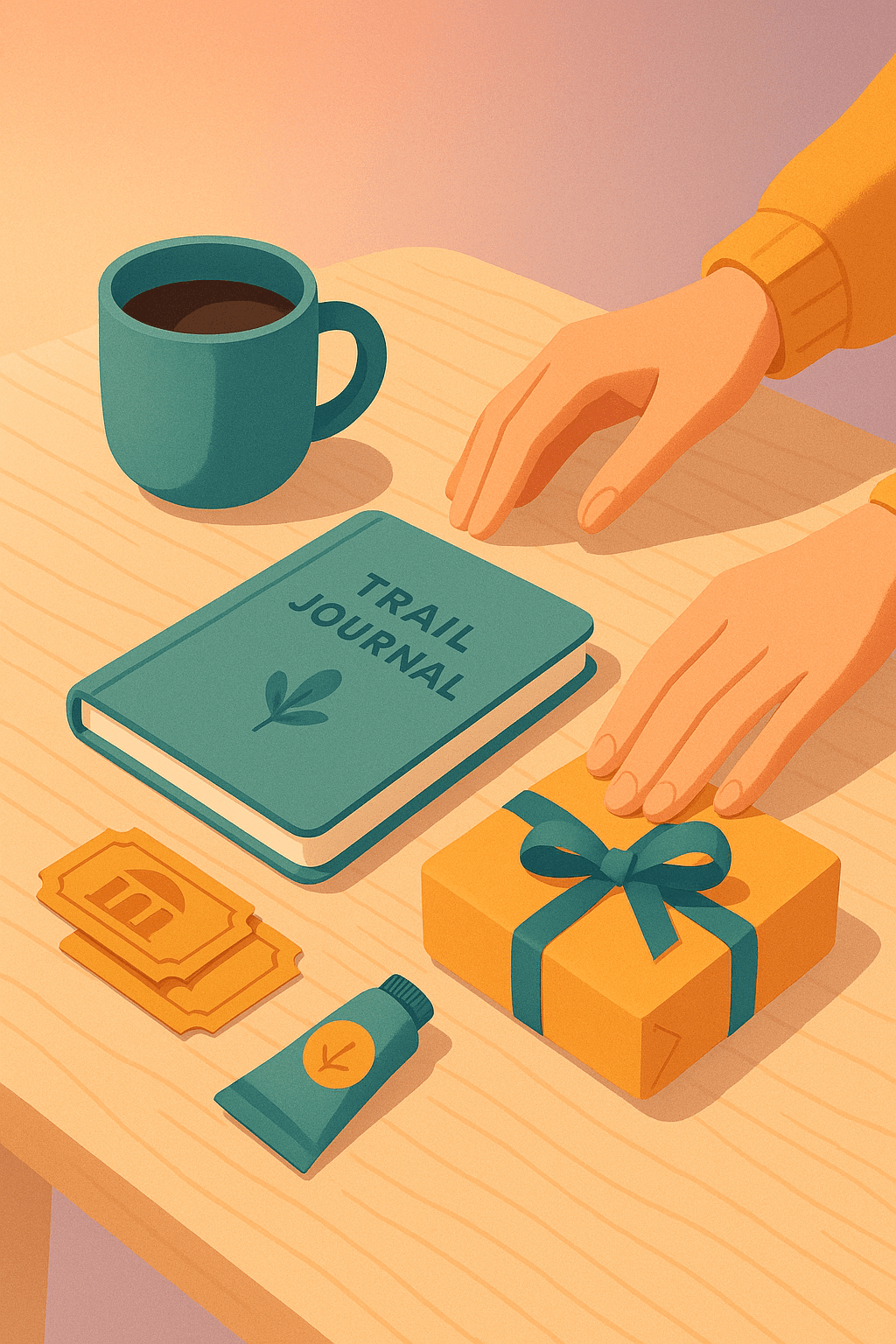
What should you gift someone whose hobby you do not understand?
Choose an adjacent gift, not specialized equipment. Support the recipient’s ritual, comfort, identity, organization, or next experience without pretending to know which technical tool is best. A cyclist may value a recovery kit; a ceramicist may love a studio apron. Both choices honor the hobby while avoiding specification mistakes.
Gimmie calls this the hobby-adjacency rule: when expertise is low, move one step away from performance-critical gear and one step closer to the person. It protects gift buying confidence because the gift complements what they already enjoy instead of replacing something they carefully selected.
Use this order of preference:
Experience: a workshop, museum ticket, trail pass, or event.
Ritual: something used before, during, or after the hobby.
Identity: tasteful display, apparel, or personalization.
Organization: storage, labeling, transport, or documentation.
Technical gear: only when they provide an exact model or wish list.
Why is technical hobby gear usually the wrong surprise?
Technical hobby gear carries hidden compatibility and preference requirements. A photographer cares about lens mount, focal length, and sensor format; a knitter cares about fiber, needle material, and gauge. Buying without those details turns generosity into an exchange task, while an adjacent gift preserves surprise without gambling on specifications.
Expert hobbyists often own fewer items than outsiders expect—but hold stronger opinions about each one. A $25 Japanese notebook can delight a birdwatcher who logs sightings, while a $250 pair of binoculars can fail because of weight, eye relief, magnification, or brand preference.
Avoid guessing on:
Camera lenses, flashes, and tripods
About Team Gimmie
A small team of friends and colleagues working together to produce useful content to help you...gift better.
Golf clubs, running shoes, and bicycle components
Chef’s knives, pans, and espresso grinders
Yarn, paint pigments, pottery tools, and musical accessories
Gaming mice, keyboards, controllers, and PC parts
The exception is simple: buy technical equipment only when you have an exact product link, model number, size, or retailer wish list.
How does the hobby-adjacency rule work?
The hobby-adjacency rule maps a hobby across five zones: preparation, participation, recovery, memory, and community. Identify one friction point or emotional reward in those zones, then choose a gift that improves it. This method works for gardening, gaming, baking, climbing, reading, woodworking, and nearly every specialized interest.
Preparation — Question to ask: What helps them get ready?; Safe gift direction: Planning or packing; Example: Waterproof route wallet for a hiker
Participation — Question to ask: What adds comfort without changing performance?; Safe gift direction: Nontechnical comfort; Example: Insulated seat pad for a sports fan
Recovery — Question to ask: What helps afterward?; Safe gift direction: Rest or care; Example: Hand balm for a gardener
Memory — Question to ask: How do they record progress?; Safe gift direction: Journal or display; Example: Archival print box for a photographer
Community — Question to ask: How do they share the hobby?; Safe gift direction: Experience or hosting; Example: Local tasting class for a coffee enthusiast
For example, imagine Priya loves pottery and you know nothing about clay. Do not guess between a Kemper trimming tool and a DiamondCore carving blade. Choose a washable studio apron, a local ceramics exhibition membership, or a photo book about Lucie Rie—gifts that respect Priya’s interest without interfering with her working setup.
Which emotional signal should guide the gift?
The best hobby gift reflects why the recipient participates, not merely what the activity involves. One runner wants measurable progress; another wants quiet outdoor time. Gimmie’s 8-Color Consumer Psychology System distinguishes values, identity, love languages, and social roles, helping separate two people who share a hobby but want entirely different gifts.
You can make a lighter version of that assessment by watching their language:
“I finally beat my time.” — Likely emotional reward: Mastery and progress; Better gift direction: Training log, race entry, recovery tool
“This is how I switch off.” — Likely emotional reward: Calm and restoration; Better gift direction: Comfort, ambience, uninterrupted time
“Look what I made.” — Likely emotional reward: Expression and recognition; Better gift direction: Display, portfolio, quality photography
“Come with me next time.” — Likely emotional reward: Connection and sharing; Better gift direction: Two-person class, outing, hosting accessory
“I love learning how it works.” — Likely emotional reward: Discovery and depth; Better gift direction: Expert book, museum membership, lecture
“Everything has its place.” — Likely emotional reward: Order and readiness; Better gift direction: Storage, labeling, protective case
This is Emotionally Intelligent Gifting in practice: matching a gift to the recipient’s psychological reward rather than relying on age, gender, or a generic list of “gifts for hobbyists.”
What are the safest gifts for unfamiliar hobbies?
The safest hobby gifts are consumable, experiential, adjustable, or retailer-specific. They create enjoyment without demanding permanent space or technical compatibility. A class with flexible scheduling, a specialty-store gift card paired with a personal note, or an upgraded everyday consumable gives the recipient control while still proving you noticed what matters.
Strong options include:
A specialty retailer gift card: B&H Photo for photography, REI for outdoor interests, Blick for art, or Sweetwater for music.
A local experience: an Eventbrite workshop, botanical garden membership, climbing day pass, or independent cinema subscription.
A documentary or expert book: select a respected creator, movement, destination, or history—not an introductory manual that talks down to them.
A hobby ritual upgrade: a travel mug for dawn birding, task light for miniature painting, or washable blanket for outdoor sketching.
Time and participation: offer to attend their exhibition, watch their tournament, or handle dinner after a long training day.
A gift card becomes thoughtful when the note names the purpose: “For the odd little lens filter you understand and I absolutely do not.” Specificity turns flexibility into affection.
How much should you spend on a hobby gift?
Set the budget by relationship and occasion, not by the hobby’s equipment prices. A person who owns a $3,000 road bike does not require a costly cycling gift. For casual birthdays, $25–$60 is substantial; close relationships often support $60–$150; major milestones justify more when the choice is confirmed.
Coworker or casual friend — Practical range: $15–$35; Best format: Consumable, small accessory, group gift
Friend or sibling birthday — Practical range: $25–$75; Best format: Experience, book, ritual upgrade
Partner or close family — Practical range: $60–$150; Best format: Membership, class, confirmed premium item
Major milestone — Practical range: $100+; Best format: Shared experience or exact wish-list item
These are planning ranges, not obligations. A handwritten note recalling their first marathon or first gallery sale can carry more emotional weight than an expensive object.
What if they already own everything for the hobby?
When someone appears fully equipped, give recognition rather than more equipment. Celebrate their commitment with documentation, access, display, preservation, or shared time. An engraved trophy is rarely necessary; a framed trail map, archival portfolio box, concert ticket, or uninterrupted afternoon can affirm the identity their hobby expresses.
Try one of these low-clutter directions:
Pay for sharpening, tuning, framing, scanning, or restoration.
Book admission to a convention, exhibition, garden, race, or studio tour.
Commission a map or illustration of a meaningful route, venue, or creation.
Create a small photo book documenting finished projects or memorable outings.
Remove friction by arranging childcare, transport, lunch, or cleanup.
The non-obvious truth is that support can be a better gift than stuff. For a parent returning to a choir, covering a babysitter during rehearsals respects both the hobby and the life around it.
How can you research the gift without ruining the surprise?
Research through observation, one informed accomplice, and reversible choices. Photograph labels discreetly, inspect public wish lists, ask a hobby friend about compatibility, and confirm the return policy. Never bluff with jargon. A precise question to a trusted expert produces a better gift than hours of browsing Amazon, Etsy, or Reddit without context.
Use this five-step check:
Listen for named brands or frustrations. “My brushes keep drying out” is more useful than “They paint.”
Check what they already own. Look for model numbers, sizes, materials, and storage limits.
Ask one insider. Share the exact budget and request two safe options.
Protect flexibility. Keep the receipt and avoid personalization on uncertain items.
Explain the connection. Add one sentence about why this gift reminded you of them.
A Recipient Profile makes future occasions easier by preserving personality, preferences, values, and gifting history. Gimmie uses Psychology-Driven Recommendations and the 8-Color system to turn those durable signals into relevant choices without forcing you to re-learn the recipient every birthday or holiday.
What is the simplest rule to remember?
If you cannot name the specification that makes an item compatible, do not buy the technical item as a surprise. Choose something that supports the recipient before, around, or after the hobby instead. The goal is not to prove you understand sourdough hydration or telescope apertures; it is to prove you understand them.
That is the heart of meaningful gifting: curiosity without pretending, attention without pressure, and enough flexibility for the recipient to remain the expert. If you want a calmer starting point, explore Gimmie and build a personality-based profile for the person you are celebrating.
How to Gift Someone Whose Hobby You Don’t Understand | Gimmie