
How Should Shopify Merchants Prepare for Possible 100% Tariffs on India-Linked Goods?
Could 100% India tariffs raise Shopify costs? Learn how DTC brands can audit sourcing, product data, pricing, AEO content, and agent readiness today.
Could 100% India tariffs raise Shopify costs? Learn how DTC brands can audit sourcing, product data, pricing, AEO content, and agent readiness today.

By Team Gimmie
Updated September 19, 2026
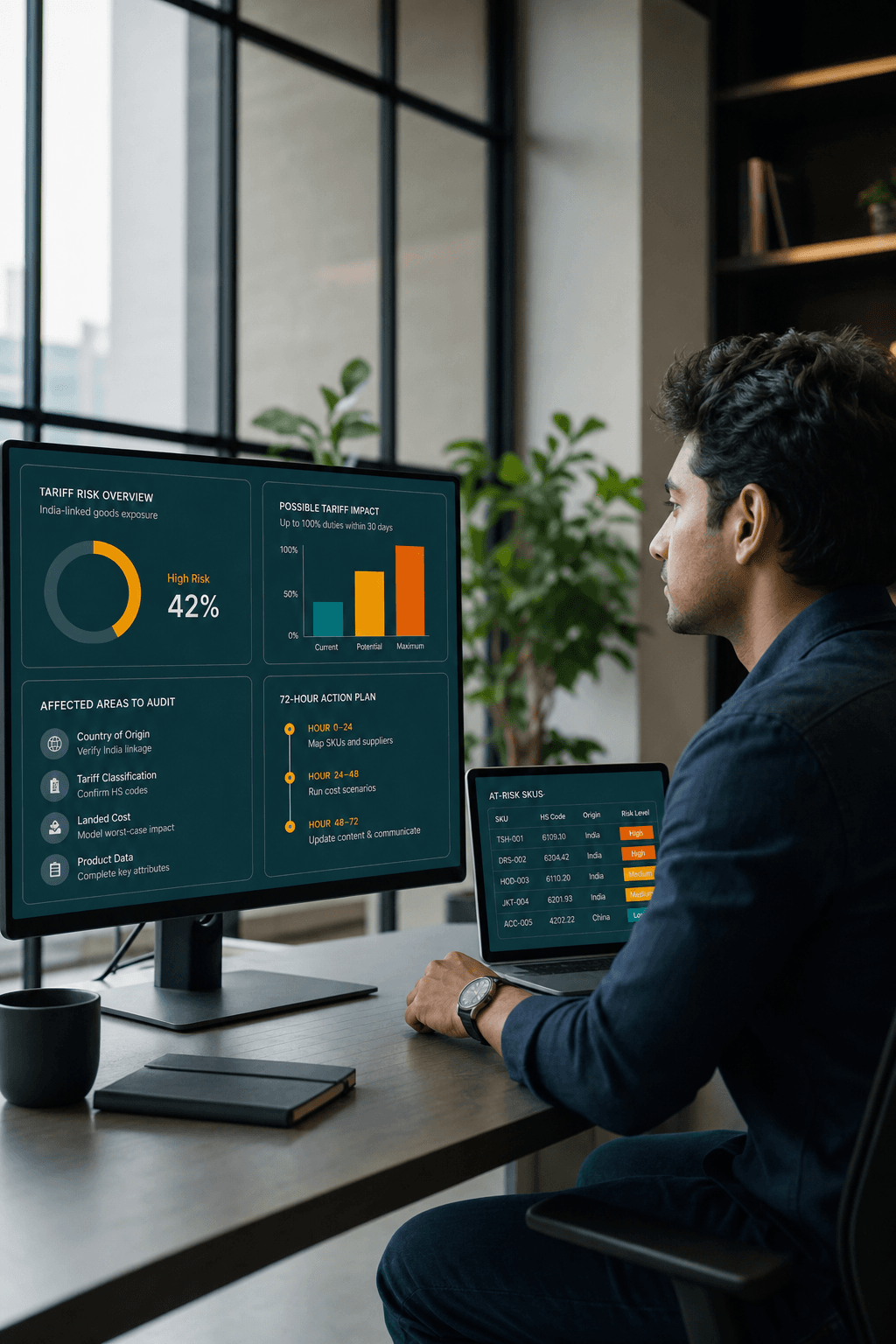
Shopify merchants should treat the reported tariff risk as a trigger for a SKU-level sourcing, margin, and product-data audit, not as proof that every Indian product will face a 100% duty. Confirm scope through official notices, model multiple cost scenarios, and prepare customer-facing data before changing prices or claims.
TL;DR: Fibre2Fashion reports that a new US law could expose goods from major buyers of Russian oil, including India and China, to duties of up to 100%, with possible changes within 30 days. Shopify merchants should map affected SKUs, verify country of origin and tariff classification, model landed cost, complete structured product attributes, and publish concise sourcing and pricing answers that AI shopping systems can accurately retrieve.
The commercial issue is broader than customs expense. If a merchant changes price, inventory, materials, fulfillment timing, or product origin, that change must reach the storefront, Shopify Catalog, shopping feeds, structured data, collection copy, and customer support answers. Inconsistent information can weaken buyer trust and make AI recommendations less reliable.
The report signals possible rapid changes to import costs, but it does not mean that every product made in India automatically receives a 100% tariff. Actual exposure depends on implementing rules, product classification, country of origin, entry date, exclusions, and the importer of record. Merchants should verify each factor before acting.
Fibre2Fashion says President Donald Trump signed H.R. 5334 and that goods from major purchasers of Russian oil could face duties of up to 100%. Because the report also points to a possible 30-day implementation window, importers may have little time between official clarification and new landed costs.
For a Shopify operator, four distinctions matter:
Do not announce a tariff surcharge based only on a news headline. Monitor the Congress.gov record, US Customs and Border Protection guidance, Federal Register notices, and instructions from your customs broker. This article is an operational checklist, not legal or customs advice.
Start with products that combine Indian origin, low gross margin, high sales volume, long replenishment cycles, or uncertain classification. Build one SKU-level record containing origin, tariff code, supplier, purchase currency, freight, current duty, inventory cover, and contribution margin. That record becomes the basis for pricing and buying decisions.
Prioritize by financial exposure rather than catalog size. A small number of best sellers can create more risk than hundreds of low-volume SKUs.
For each product and variant, record:
Then model at least three scenarios: no change, a moderate additional duty, and the reported maximum. Include payment processing, returns, discounts, and fulfillment costs. A 100% duty on customs value does not translate directly into a 100% retail price increase, because retail price also covers other costs and margin. Use your full unit economics.
Avoid canceling orders or moving production before checking contracts, deposits, capacity, quality standards, lead times, and origin rules. Transshipment does not change origin, and relabeling origin can create serious compliance risk.
Structured product data gives storefronts, feeds, search engines, and shopping agents a consistent record of what a product is, what it costs, whether it is available, and how it ships. During a tariff response, that consistency reduces stale recommendations, mismatched prices, and unsupported material or origin statements across sales channels.
This is where trade operations and AEO for Shopify meet. AI shopping systems cannot reliably recommend a product when the product page says one price, the feed says another, and a variant lacks material or availability data.
Audit these fields for every exposed variant:
Complete Product structured data with accurate offers, availability, brand, identifiers, and shipping details. Do not add a tariff claim to schema unless it is a factual customer-facing charge that your implementation supports. Structured data must match visible page content.
Shopify merchants should also check that important product information is not available only after JavaScript interaction. Confirm that product, collection, and blog paths remain crawlable, and review any custom robots.txt rules. The goal is not merely rich results. It is a dependable catalog that humans and agents can interpret.
For a broader checklist, use this guide to optimize product pages for AI.
Publish direct, dated answers to the questions customers and AI assistants will ask: whether prices changed, which products are affected, whether materials or quality changed, and when orders will ship. Keep each answer self-contained, fact-checked, and linked to the relevant product, collection, shipping, or return page.
Answer Engine Optimization is the practice of formatting reliable information so an answer engine can extract and cite it. During supply disruption, accuracy and freshness matter more than producing a large volume of generic commentary.
Update content in this order:
Use a visible update date when information changes. Preserve a change log internally so merchandising, finance, customer support, and paid media use the same assumptions.
If you sell giftable products, tariff-related substitutions can also affect recommendation quality. An AI gift assistant needs accurate recipient fit, materials, variants, availability, shipping deadlines, and price limits. Incomplete attributes can cause a recommendation to fall outside the shopper’s budget or arrive after the occasion.
In the next 72 hours, assign one owner, identify exposed SKUs, validate customs facts, model margin scenarios, and test data consistency across every active channel. The objective is decision readiness. Merchants do not need to predict policy; they need approved triggers for purchasing, pricing, merchandising, and customer communication.
Use this sequence:
Shopify’s agentic commerce infrastructure can distribute catalog information to AI surfaces, but it cannot correct weak source data. Read what agentic commerce means for merchants, then make product completeness a standing operations metric rather than a one-time SEO project.
Merchants should separate confirmed customs obligations from possible policy outcomes, while preparing catalog and content systems for fast, accurate updates. The same product-data discipline supports margin management, customer trust, Answer Engine Optimization, and agentic commerce. The following answers address the most common operational questions raised by the report.
Does the reported law mean all Indian goods will face a 100% tariff?
No. The report describes potential duties of up to 100%, but actual treatment depends on official implementation, scope, classification, origin, timing, and any exclusions. Verify the final rules through official US government notices and a qualified customs professional before changing import declarations, prices, or customer claims.
Should I raise Shopify prices immediately?
Not solely because of the headline. First calculate exposure by SKU and confirm which inventory or future entries may be covered. Establish a trigger based on confirmed landed cost, margin, competitor context, and demand. If you change price, update Shopify, feeds, ads, structured data, and subscriptions together.
Which product fields matter most to AI shopping agents?
Prioritize product name, price, availability, brand, category, GTIN, SKU, material, size, color, shipping terms, return policy, images, and valid review data. These fields help agents compare products against a shopper’s constraints. Every value should be complete, current, and consistent across Shopify and external feeds.
Can AEO reduce tariff costs?
AEO cannot reduce a customs duty. It can reduce commercial confusion by helping shoppers and AI systems find accurate answers about price, availability, materials, alternatives, shipping, and returns. Better answers may protect qualified traffic and conversion when a brand must change its assortment or pricing.
What if my supplier ships from India but the product was made elsewhere?
Shipping location and customs origin are not always the same. Origin can depend on where a product was wholly obtained or substantially transformed, subject to product-specific rules. Ask your customs broker to review supporting documents. Do not infer origin from the supplier’s address or shipping port alone.
How should I measure the response?
Track confirmed duty by entry, landed cost, gross and contribution margin by SKU, inventory cover, conversion rate, average order value, cancellation rate, return rate, feed errors, and out-of-stock sessions. Also monitor AI-referred sessions, product citations, and whether shopping assistants report current prices and availability.

A small team of friends and colleagues working together to produce useful content to help you...gift better.