
How Should Shopify Brands Prepare for a Broader India and Brazil Trade Pact?
India and Brazil may broaden their trade pact. Learn how Shopify brands can prepare product data, AEO content, compliance, agent-ready catalogs and sales.
India and Brazil may broaden their trade pact. Learn how Shopify brands can prepare product data, AEO content, compliance, agent-ready catalogs and sales.

By Team Gimmie
Updated October 1, 2026
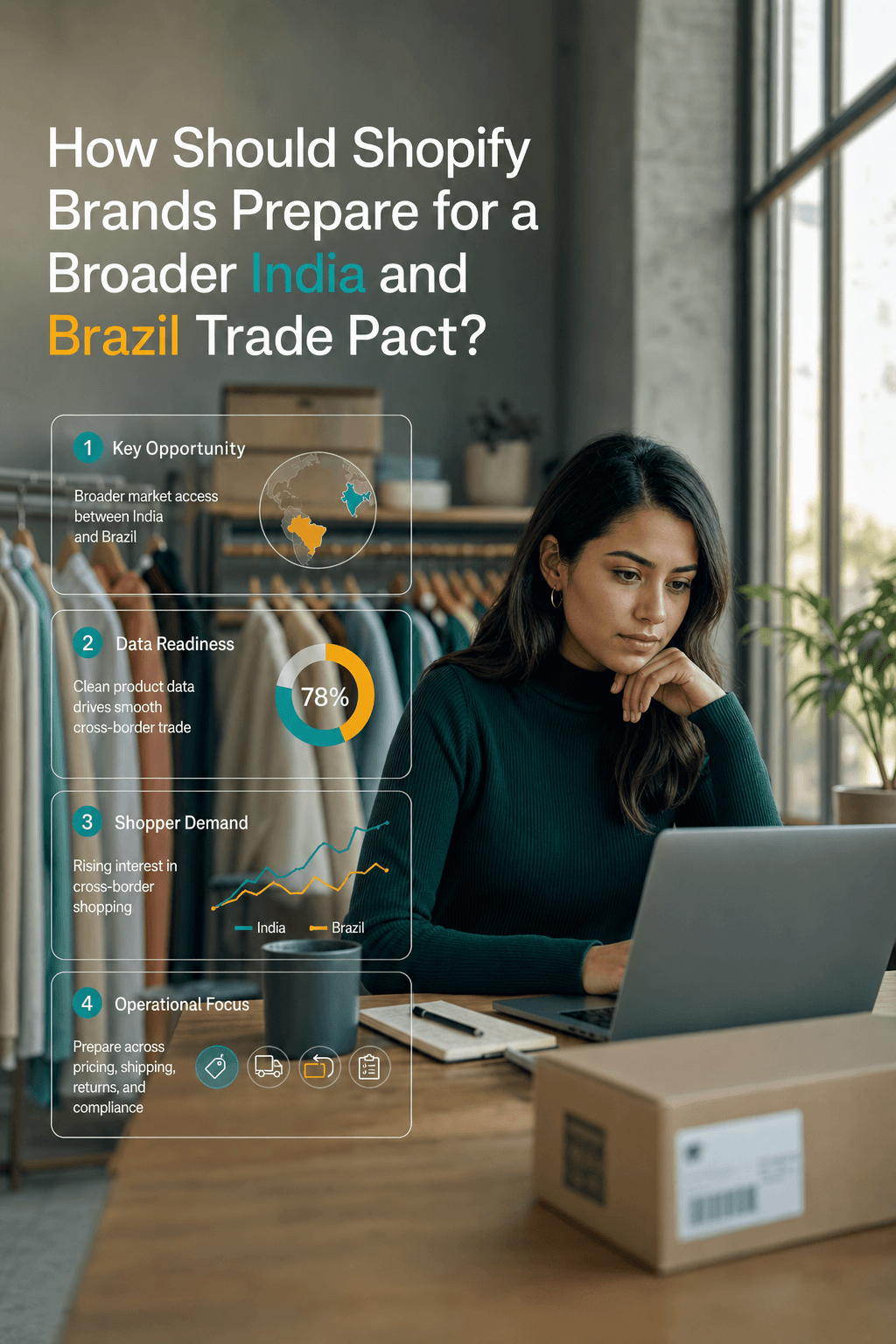
India and Brazil's effort to broaden their trade relationship is a planning signal for Shopify brands, not an immediate tariff change. Merchants should prepare by cleaning product data, documenting origin and landed costs, publishing answer-first market content, and making catalogs readable by search engines and shopping agents.
TL;DR: Treat the proposed expansion as an early prompt to improve commercial readiness. Audit origin records, HS classifications, pricing, shipping, returns, localized product attributes, and Product structured data. Do not advertise tariff savings until negotiators publish final terms and your customs adviser confirms that each SKU qualifies.
Fibre2Fashion reports that India and Brazil have completed terms of reference for negotiations to expand the India and Mercosur Preferential Trade Agreement. The report says discussions could extend beyond existing tariff lines to goods, services, and investment, while electronic Certificates of Origin could support paperless trade. It also cites a goal of doubling bilateral trade to $30 billion by 2030.
For a DTC operator, the practical issue is not the diplomatic headline alone. A wider agreement could eventually change sourcing economics, market access, documentation, or consumer demand. Whether a brand can respond quickly will depend on the quality of its underlying catalog and operational records.
The news means merchants should prepare scenarios, not change prices or make savings claims today. Terms of reference establish a framework for negotiations, but they do not specify final tariff coverage, implementation dates, product rules, or eligibility. The right response is to improve data and monitor official outcomes by SKU.
The distinction matters because a product does not receive preferential treatment merely because it ships from India or Brazil. Eligibility can depend on its HS classification, origin criteria, manufacturing inputs, documentary proof, shipment route, and the final schedule adopted by the participating governments.
Merchants should create three planning cases:
Assign an owner to monitor official customs and trade notices. Keep the Fibre2Fashion story as the news alert, but base operational decisions on published legal text, customs guidance, and advice from a qualified broker or trade professional.
Start with fields that determine identity, eligibility, price, availability, and delivery: product name, brand, SKU, GTIN, HS code, country of origin, material, color, size, variant, inventory, shipping cost, delivery estimate, and return terms. These fields support customs work while helping search systems and AI agents compare products accurately.
Shopify's customer-facing catalog should match the records used by suppliers, fulfillment partners, feeds, and customs advisers. A mismatch between a product page and an export document can create delays. A mismatch between the storefront and structured data can also cause an AI shopping system to report the wrong price, variant, or availability.
Prioritize the audit in this order:
Do not place uncertain origin claims in a metafield simply to complete the catalog. Completeness helps only when the information is accurate and consistent.
Build answer engine optimization content around specific buyer and operator questions, then connect each answer to the relevant collection or product. Useful topics include shipping to Brazil, materials sourced from India, duties at delivery, returns, sizing, warranties, and gift eligibility. Each section should answer one question in its opening paragraph.
This is the core of AEO for Shopify: make a reliable passage easy for an answer engine to extract without removing the context a shopper needs. The strongest page is not a generic article about international trade. It is a page that accurately answers a question tied to your catalog and policy.
Use a content hierarchy that moves readers from education to purchase:
For textile, apparel, jewelry, beauty, or home brands, local terminology matters. Research how shoppers describe materials, fit, dimensions, gifting occasions, and delivery concerns in each market. Localize meaning, currency, and policy details rather than mechanically translating US copy.
Shopping agents need explicit facts to discover, compare, and purchase products. Complete Product structured data and synchronized Shopify attributes reduce ambiguity about variants, pricing, stock, shipping, and returns. Shopify may handle parts of agentic commerce infrastructure, but merchants remain responsible for the accuracy and accessibility of the catalog those systems read.
A merchant does not need to predict which protocol or assistant will dominate. The practical preparation is largely the same across channels: maintain complete records, use standard taxonomy, keep inventory current, expose essential facts without JavaScript-only dependencies, and ensure product pages are crawlable.
Review the merchant guide to agentic commerce before adding another app or custom feed. Then validate these elements:
Use Google's Rich Results Test and the Schema.org validator after theme or app changes. Validation cannot guarantee an AI citation, but it can identify markup errors that make product facts harder to interpret.
Model duties, taxes, brokerage, currency movement, payment acceptance, fraud, returns, delivery time, and customer support before launching or repricing. A preferential tariff can improve one cost line while logistics or returns erase the gain. Electronic origin documents may reduce paperwork, but they do not replace correct classification, eligibility, or recordkeeping.
Build a landed-cost worksheet at the variant level. Include:
For gifting brands, also document recipient address rules, gift messaging, delivery windows, restricted items, and who pays duties. These details affect gift buying confidence because the buyer needs to know whether the recipient will face an unexpected charge or delivery problem. If gifting is central to your offer, connect market readiness to a broader Shopify gifting strategy, rather than treating it as a shipping-only project.
Do not bury material limitations. If final-sale terms, customs charges, or return exclusions differ by destination, show them before checkout and repeat them in confirmation communications.
Use the next 30 days to establish a baseline, fix high-risk catalog gaps, and prepare decision triggers. Do not launch a market solely because negotiations were announced. A small cross-functional sprint across merchandising, operations, finance, content, and development can make the store ready to evaluate any final agreement quickly.
Week 1, establish the baseline
Week 2, repair the catalog
Week 3, publish buyer answers
Week 4, measure and govern
The outcome should be a decision-ready catalog, not a speculative campaign.
Merchants should ask whether any final agreement applies to their exact products, whether origin can be documented, and whether the full landed-cost case supports expansion. They should also verify that product data, policies, and structured markup agree. These questions prevent a promising trade headline from becoming an inaccurate price claim or poor customer experience.
Is the expanded India and Mercosur agreement already in force?
No. The cited report says terms of reference were completed for broader negotiations. That is not the same as a signed, ratified, and implemented agreement. Merchants should wait for official legal text, effective dates, tariff schedules, and customs guidance before changing duty assumptions or advertising benefits.
Will every product qualify for lower tariffs?
Not necessarily. Preferential treatment usually depends on the final tariff line coverage, HS classification, rules of origin, documentation, and other conditions. A merchant should review each affected SKU with a customs broker or qualified trade adviser rather than applying one assumption to an entire collection.
What is an electronic Certificate of Origin?
It is a digital form of documentation used to support a product's claimed origin under applicable trade rules. Electronic processing can reduce paper handling, but the certificate must still be accurate, supported by records, and accepted under the final procedures governing the shipment.
Which Shopify fields matter most for AI shopping visibility?
Prioritize product name, brand, description, price, currency, availability, shipping, returns, images, GTIN, SKU, material, color, size, reviews, and standard category. Keep those fields consistent across the storefront, structured data, Shopify Catalog, feeds, and fulfillment systems so agents receive one reliable version.
Does Product structured data guarantee an AI recommendation?
No. Structured data helps machines interpret product facts, but recommendation systems also consider relevance, authority, availability, price, reviews, policies, and other signals. Treat valid markup as foundational infrastructure, then improve content quality, brand evidence, customer experience, and third-party mentions.
How should merchants measure readiness?
Track the percentage of priority SKUs with complete attributes, valid Product markup, confirmed origin records, accurate landed costs, and consistent feed data. Pair that with AI citation tests, AI-referred sessions, assisted revenue, conversion rate by market, delivery performance, and return cost.
A broader trade pact could create opportunities, but the durable advantage is operational clarity. Brands with accurate catalogs and answer-first content can evaluate new terms faster, communicate with less ambiguity, and give both shoppers and AI systems better information.

A small team of friends and colleagues working together to produce useful content to help you...gift better.