
Merchants
How Does the EU Apparel Slowdown Affect Shopify Brands Sourcing From Bangladesh?
Bangladesh apparel exports to the EU fell 18.89% in early 2026. Shopify merchants must diversify sourcing while optimizing product data for AI visibility.
Bangladesh apparel exports to the EU fell 18.89% in early 2026. Shopify merchants must diversify sourcing while optimizing product data for AI visibility.

By Team Gimmie
Updated August 27, 2026
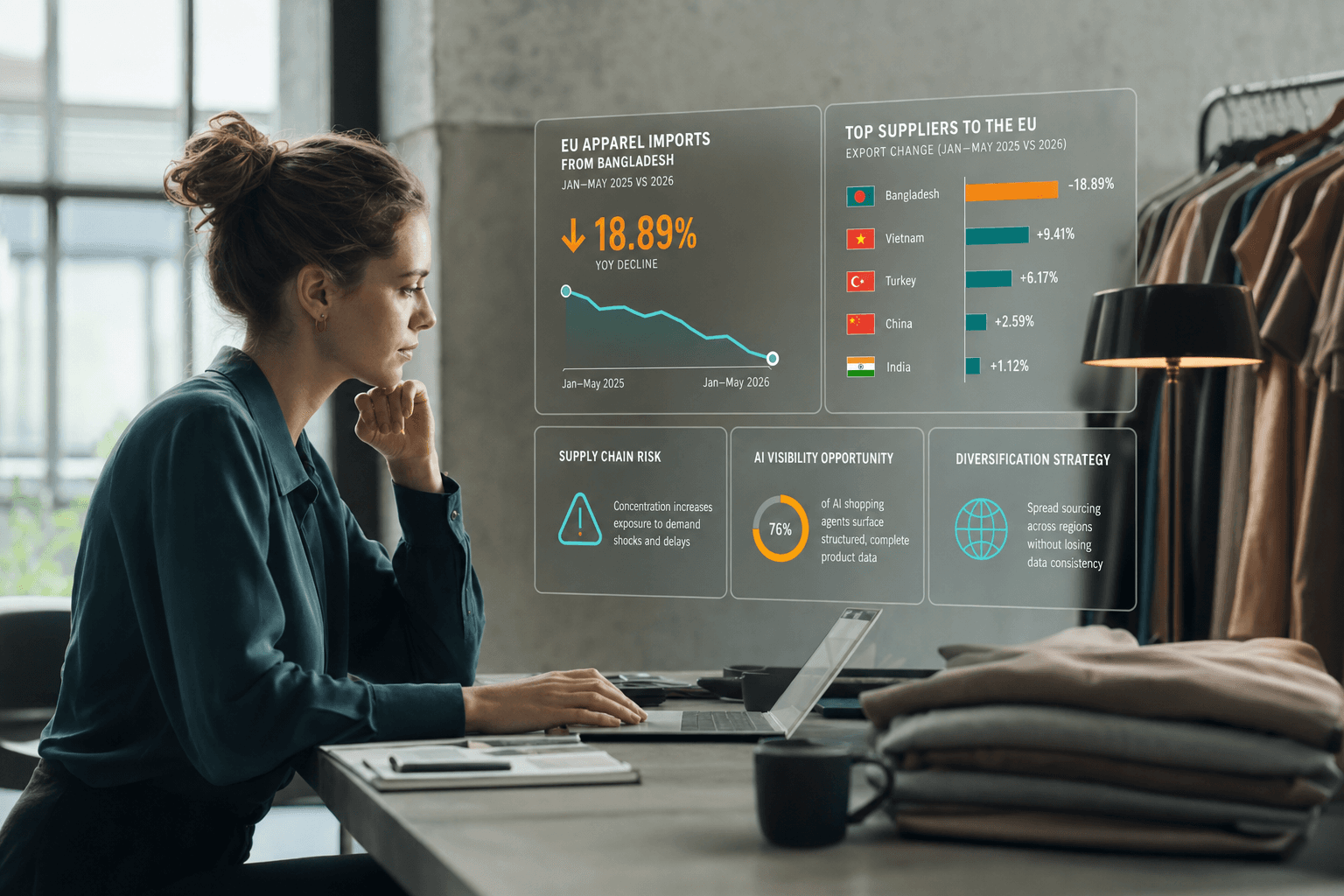
TL;DR: Bangladesh's apparel exports to the EU dropped 18.89% year-on-year in January-May 2026, the steepest decline among major suppliers. For Shopify merchants sourcing from the region, this signals both supply chain risk and an opportunity to differentiate through transparent sourcing data and AI-optimized product information. The brands that surface complete, structured product data to AI shopping agents will capture demand regardless of where they source.
The 18.89% drop in Bangladesh apparel exports to the EU directly affects DTC brands that rely on the region for manufacturing. This decline outpaced China, India, and Vietnam, indicating structural pressure beyond weak European demand. For Shopify merchants, supply chain disruption creates both risk and competitive opportunity.
Bangladesh has been a primary sourcing hub for fashion and apparel brands due to competitive labor costs. When export volumes fall this sharply, it typically signals factory consolidation, longer lead times, or capacity constraints that ripple through to your inventory planning. Merchants who diversify sourcing now while competitors wait will have more reliable fulfillment when demand returns.
The practical response is twofold: audit your supply chain exposure and ensure your product data is complete enough for AI shopping assistants to recommend you regardless of sourcing shifts. AI agents evaluating products for shoppers weight inventory accuracy, shipping transparency, and product completeness. Brands with incomplete data get skipped.
AI shopping platforms like ChatGPT Shopping and Perplexity now account for double-digit conversion rates, with ChatGPT converting at 15.9% and Perplexity at 10.5%. Products with 8 or more structured attributes are cited 4.3x more often in AI shopping results than products with fewer than 3 attributes. Supply chain news makes product data completeness even more critical.
When sourcing becomes uncertain, AI agents prioritize products with accurate inventory status, clear shipping timelines, and transparent return policies. If your product pages lack real-time availability data or shipping estimates, agents will route shoppers to competitors with complete information.
The knowledge base confirms that products syndicated through Shopify Catalog convert at 2x the rate of products using scraped data. This means your response to supply chain disruption should include verifying that every product attribute is populated: GTIN, variant data, shipping details, and inventory status. The brands that treat product data as infrastructure rather than an afterthought will maintain AI visibility even as sourcing conditions shift.
Diversifying away from Bangladesh-heavy supply chains requires updating product information across every channel simultaneously. Inconsistent data between your Shopify store, product feeds, and the Shopify Catalog will cause AI agents to deprioritize your products. The fix is operational: when you add new suppliers, update all product attributes at once.
McKinsey projects that agentic commerce could redirect $3 to $5 trillion in global retail spend by 2030. AI agents making purchasing decisions on behalf of consumers will favor brands with consistent, accurate data across every touchpoint. If your Vietnamese supplier ships in 7 days but your product page still says 14 days from your Bangladesh supplier, the agent will see the mismatch and move on.
The Universal Commerce Protocol now enables AI agents to query live catalog data directly from merchants. The March 2026 UCP update added multi-item cart functionality, meaning agents can build complete orders from your catalog in a single session. Merchants with real-time inventory and accurate shipping data capture these multi-item orders. Merchants with stale data lose them.
AI agents evaluating products for shoppers prioritize completeness over marketing language. The critical attributes are: product name without keyword stuffing, current price inclusive of variants, real-time inventory status, shipping time and cost, return policy, minimum three product images including lifestyle shots, fully specified variant data, GTIN or barcode, brand name, and reviews with aggregate ratings.
Products missing any of these attributes are filtered out before agents present recommendations to shoppers. The knowledge base confirms that FAQPage schema drives 3.1x higher answer extraction rates, and pages with comprehensive schema receive 2.7x more impressions than those without.
For apparel brands specifically, material composition, sizing guides, and care instructions become critical when sourcing changes. If you switch from a Bangladesh supplier to a Vietnamese one and the fabric composition changes even slightly, your product data must reflect this. AI agents parsing your structured data will flag inconsistencies between product descriptions and schema markup, which damages trust signals.
Answer engine optimization ensures your brand appears when shoppers ask AI assistants questions like "best sustainable apparel brands" or "ethical clothing alternatives." With Bangladesh facing export pressure, shoppers increasingly ask about sourcing transparency. Brands that answer these questions directly in their content get cited by AI engines.
The AEO framework requires leading every content section with a 40-60 word direct answer. For supply chain content, this means creating pages that directly address: Where are your products made? What certifications do your suppliers hold? How do you ensure quality consistency across suppliers? AI models extract answers at 2.7x the rate from concise passages versus longer ones.
Google AI Overviews now appear on 14% of shopping queries, up 5.6x from November 2024. Brands cited inside AI Overviews earn 35% more clicks than brands appearing only in traditional results. Creating content that answers sourcing questions positions your brand for citation when shoppers research alternatives to Bangladesh-sourced products.
First, audit your product data completeness in Shopify admin. The Summer '26 Edition now shows your ChatGPT and Gemini performance score directly in the dashboard. Check this score and address any gaps in product attributes. Second, verify your structured data implementation using Google's Rich Results Test for every product template.
Third, ensure your robots.txt allows AI crawlers. GPTBot, ClaudeBot, and PerplexityBot must be able to access your product pages. Shopify auto-generates llms.txt as of May 2026, but the file benefits from clean, complete product data in your store.
Fourth, update any content mentioning sourcing or manufacturing with current information. Content updated within the last 30 days receives 3.2x more citations across AI platforms than stale content. If your About page or sustainability content references Bangladesh manufacturing, refresh it to reflect your current or planned supplier diversification.
Finally, if you are on Shopify Plus and still running Scripts, migrate to Shopify Functions before June 30. The Scripts engine stops executing entirely on that date with no extension granted. Any custom discount or shipping logic tied to supplier-specific rules will break silently.
Brands that proactively communicate sourcing changes build trust signals that AI engines recognize. Press coverage from DA 70+ publications about your diversification strategy generates brand mentions that correlate 3x more strongly with AI visibility than backlinks. A single mention in a major trade publication about your supply chain resilience drives more AI citation than dozens of low-authority links.
Create original content about your sourcing decisions. Document your supplier evaluation process, quality standards, and timeline for diversification. This content serves dual purposes: it answers the questions shoppers and journalists are asking, and it provides AI engines with authoritative information to cite when those queries arise.
The Bangladesh slowdown is industry news that affects thousands of brands. The merchants who respond with transparent communication and complete product data will be the ones AI agents recommend when shoppers search for reliable alternatives.
How does the Bangladesh export decline affect Shopify apparel brands? The 18.89% drop in Bangladesh apparel exports to the EU signals supply chain risk for brands sourcing from the region. Shopify merchants may face longer lead times, capacity constraints, or factory consolidation. Diversifying suppliers while maintaining accurate product data ensures AI shopping agents continue recommending your products.
What product attributes do AI shopping agents prioritize? AI agents prioritize product name, current price, real-time inventory status, shipping time and cost, return policy, multiple product images, variant data, GTIN, brand name, and customer reviews. Products with 8 or more structured attributes are cited 4.3x more often than those with fewer than 3.
How does supply chain transparency affect AI visibility? Brands that publish clear sourcing information create content AI engines can cite when shoppers ask about ethical or sustainable products. Press coverage about supply chain decisions generates brand mentions that correlate strongly with AI citation frequency.
What is the connection between UCP and supply chain data? The Universal Commerce Protocol enables AI agents to query live catalog data directly from merchants. Accurate inventory and shipping information reflecting your current suppliers ensures agents can build complete orders. Stale data from outdated supplier relationships causes agents to skip your products.
How quickly should merchants update product data after changing suppliers? Update all product attributes simultaneously when adding new suppliers. Inconsistent data between your Shopify store, product feeds, and Shopify Catalog causes AI agents to deprioritize your products. Content updated within 30 days receives 3.2x more AI citations.
Does the Shopify Scripts deadline affect supply chain operations? If you use Scripts for supplier-specific shipping rules or discount logic, those customizations stop working on June 30, 2026. Migrate to Shopify Functions before the deadline to maintain any automated logic tied to your supply chain.
How can brands use the Bangladesh news as a content opportunity? Create original content documenting your sourcing decisions, supplier evaluation criteria, and diversification timeline. This content answers shopper questions while providing AI engines with authoritative information to cite. Press coverage of your response builds brand authority signals.

A small team of friends and colleagues working together to produce useful content to help you...gift better.