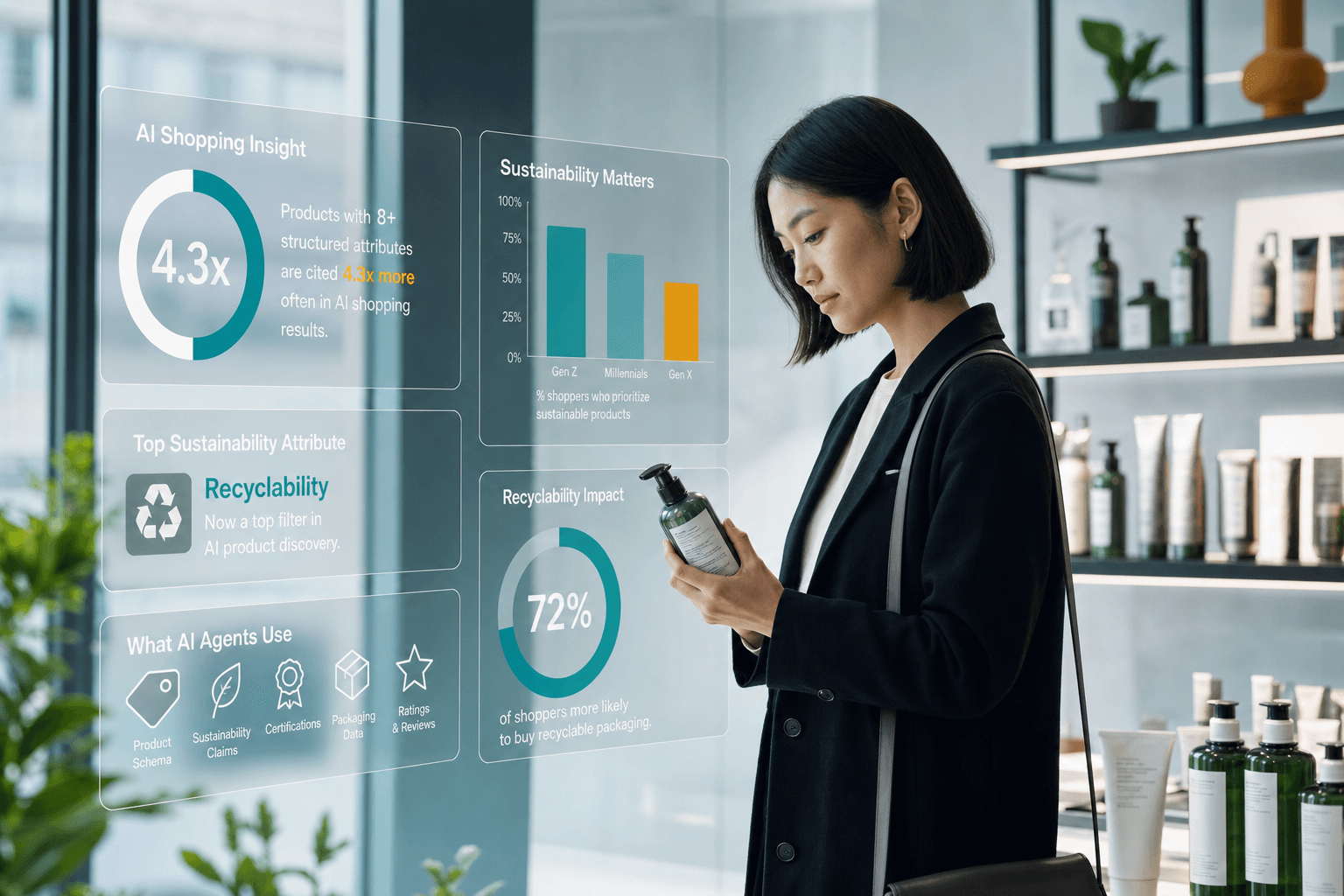
TL;DR: Germany's Henkel just expanded packaging recyclability testing in China, signaling that sustainability data is becoming a core product attribute. For Shopify merchants, this means AI shopping agents will increasingly filter and recommend products based on structured sustainability claims. Products with 8 or more structured attributes—including recyclability—are cited 4.3x more often in AI shopping results. The brands adding verifiable sustainability data to their product schema now will capture the visibility advantage as agentic commerce scales.
Why Does Henkel's Recyclability Testing Matter for Shopify Merchants?
Henkel's investment in recyclability testing infrastructure reflects a broader shift: sustainability claims are moving from marketing copy to structured, verifiable product data. AI shopping agents like ChatGPT Shopping and Perplexity need machine-readable attributes to make recommendations. When a consumer asks an AI assistant for "eco-friendly packaging" or "recyclable products," the agent queries structured data fields, not marketing paragraphs.
This matters because agentic commerce is projected to redirect $3 to $5 trillion in global retail spend by 2030, according to McKinsey. Products with complete, structured attributes—including sustainability certifications and recyclability data—will be the ones AI agents surface. Products without that data become invisible to the fastest-growing shopping channel.
The Henkel news is a leading indicator. When major CPG companies invest in testing infrastructure, it signals that verified sustainability data will become table stakes for product discovery.
What Sustainability Attributes Should You Add to Your Product Data?
Start with the attributes AI agents can parse and verify: recyclability percentage, packaging material composition, certifications (FSC, Cradle to Cradle, How2Recycle), and carbon footprint data where available. These fields translate directly into structured schema that AI shopping platforms extract when answering sustainability-related queries.
For Shopify merchants, the practical work is straightforward:
- Add a "Sustainability" or "Environmental" metafield group in your Shopify admin
- Populate fields for packaging material, recyclability status, and any third-party certifications
- Include this data in your Product schema markup using the
hasMerchantReturnPolicy and custom properties
- Update product descriptions to lead with sustainability facts in answer-first format
Products with full Product schema appear 3 to 5 times more often in AI-generated shopping recommendations. Adding sustainability attributes increases your chance of being cited when AI agents filter for eco-conscious options.
How Do AI Shopping Agents Use Structured Product Data?
AI shopping agents parse structured data to match products against user intent. When someone asks ChatGPT Shopping or Perplexity for "best sustainable [product category]," the agent queries product feeds and schema markup for relevant attributes. It does not read marketing copy and infer meaning—it looks for explicit, machine-readable fields.
Shopify's Universal Commerce Protocol (UCP), developed with Google, enables AI agents to query live catalog data directly. The March 2026 update added multi-item cart capabilities and live inventory queries. Products syndicated through Shopify Catalog with complete attributes are automatically eligible for discovery by agents operating on both UCP and OpenAI's ACP.
The data shows the advantage is significant: products with 8 or more structured attributes are cited 4.3x more often in AI shopping results than products with fewer than 3 attributes. Sustainability data counts as structured attributes.
What Is the Connection Between Recyclability and AEO Visibility?
Answer engine optimization rewards content and data that AI engines can extract cleanly. When your product page includes structured sustainability claims—not buried in a paragraph but surfaced as explicit attributes—AI engines can cite that data directly in their responses.
Google AI Overviews now appear on 14% of shopping queries, up 5.6x from November 2024. For queries like "best recyclable packaging [product]," the AI Overview pulls from pages with clear, structured answers. Pages with FAQ schema are 3.2x more likely to appear in AI Overviews.
The practical implication: create an FAQ section on product pages that addresses sustainability questions directly. "Is this product packaging recyclable?" followed by a 40 to 60 word answer with specific percentages and certifications. Implement FAQPage schema so AI engines can extract those answers.
Brands cited inside AI Overviews earn 35% more organic clicks than brands appearing only in traditional results below. Sustainability-focused queries are growing, and the brands with structured data win the citation.
How Do You Verify and Communicate Recyclability Claims?
Henkel's testing expansion highlights a critical point: unverified sustainability claims create liability and erode trust. AI agents are increasingly trained to weight verified, third-party certified claims over self-reported marketing language. Google's E-E-A-T framework—which AI engines also use as a citation quality signal—rewards trustworthiness and accuracy.
For Shopify merchants, verification means:
- Obtaining third-party certifications (How2Recycle, FSC, Cradle to Cradle) where applicable
- Documenting testing methodology for any recyclability percentages claimed
- Including certification logos and links to verification on product pages
- Adding certification data to your Organization and Product schema
Trustworthy sustainability data functions as an E-E-A-T signal. After Google's December 2025 core update, websites with strong E-E-A-T signals saw 23% more organic traffic. The same signals influence AI citation frequency.
What Should You Do This Week to Prepare?
The Henkel news is a signal, not a deadline. But the structural shift toward sustainability as structured data is already underway. Shopify merchants who add verified sustainability attributes now will compound their advantage as AI shopping scales.
Here is the priority checklist:
- Audit your top 20 products for existing sustainability claims
- Create metafields in Shopify for packaging material, recyclability percentage, and certifications
- Update Product schema to include sustainability attributes
- Add FAQ sections to product pages addressing common sustainability questions
- Implement FAQPage schema on those sections
- Verify any claims with third-party certifications where possible
Shopify's Summer '26 Edition includes a new admin section showing how products perform inside ChatGPT, Gemini, and Copilot. Use it to track whether your sustainability-optimized products gain visibility over time.
The brands building complete, structured, verifiable product data now—including sustainability attributes—will be the ones AI agents recommend when agentic commerce becomes the default shopping channel.
Frequently Asked Questions
What is recyclability testing and why does it matter for e-commerce?
Recyclability testing verifies what percentage of product packaging can actually be recycled in real-world conditions. For e-commerce, this data becomes a structured product attribute that AI shopping agents use to filter and recommend products when consumers search for sustainable options.
How do AI shopping agents use sustainability data?
AI agents like ChatGPT Shopping and Perplexity parse structured data fields—not marketing copy—to match products against user queries. When a shopper asks for "eco-friendly" or "recyclable" products, the agent queries explicit attributes in product schema and feeds.
What sustainability attributes should I add to my Shopify products?
Prioritize packaging material composition, recyclability percentage, third-party certifications (FSC, How2Recycle, Cradle to Cradle), and carbon footprint data where available. Add these as metafields and include them in your Product schema markup.
Does sustainability data affect AI visibility?
Yes. Products with 8 or more structured attributes are cited 4.3x more often in AI shopping results. Sustainability attributes count toward that total and become critical for queries with environmental intent.
How do I verify sustainability claims for AI engines?
Obtain third-party certifications, document testing methodology, and include certification data in your schema markup. AI engines and Google's E-E-A-T framework weight verified claims over self-reported marketing language.
What is the Universal Commerce Protocol and how does it relate to sustainability?
UCP is the open standard developed by Google and Shopify that lets AI agents query live catalog data. Products with complete attributes—including sustainability data—syndicated through Shopify Catalog are automatically eligible for discovery by AI agents.
How quickly do AI engines respond to new product data?
Perplexity responds to new content within days due to real-time retrieval. Google AI Overviews typically reflect indexed content within 2 to 4 weeks. ChatGPT's training-based citations take 3 to 6 months to update.
What is the business case for adding sustainability data now?
Agentic commerce is projected to redirect $3 to $5 trillion in global retail spend by 2030. Brands with complete, structured product data—including sustainability attributes—will capture disproportionate share of AI-referred traffic, which converts at 4 to 23x the rate of traditional organic visitors.
Sources