
Merchants
How Does a Specialty Chemicals Merger Affect Your Shopify Store's AI Visibility?
A UK-US chemicals merger signals supply chain shifts DTC brands must track. Here's why structured product data matters more than ever for AI discovery.
A UK-US chemicals merger signals supply chain shifts DTC brands must track. Here's why structured product data matters more than ever for AI discovery.

By Team Gimmie
Updated August 27, 2026
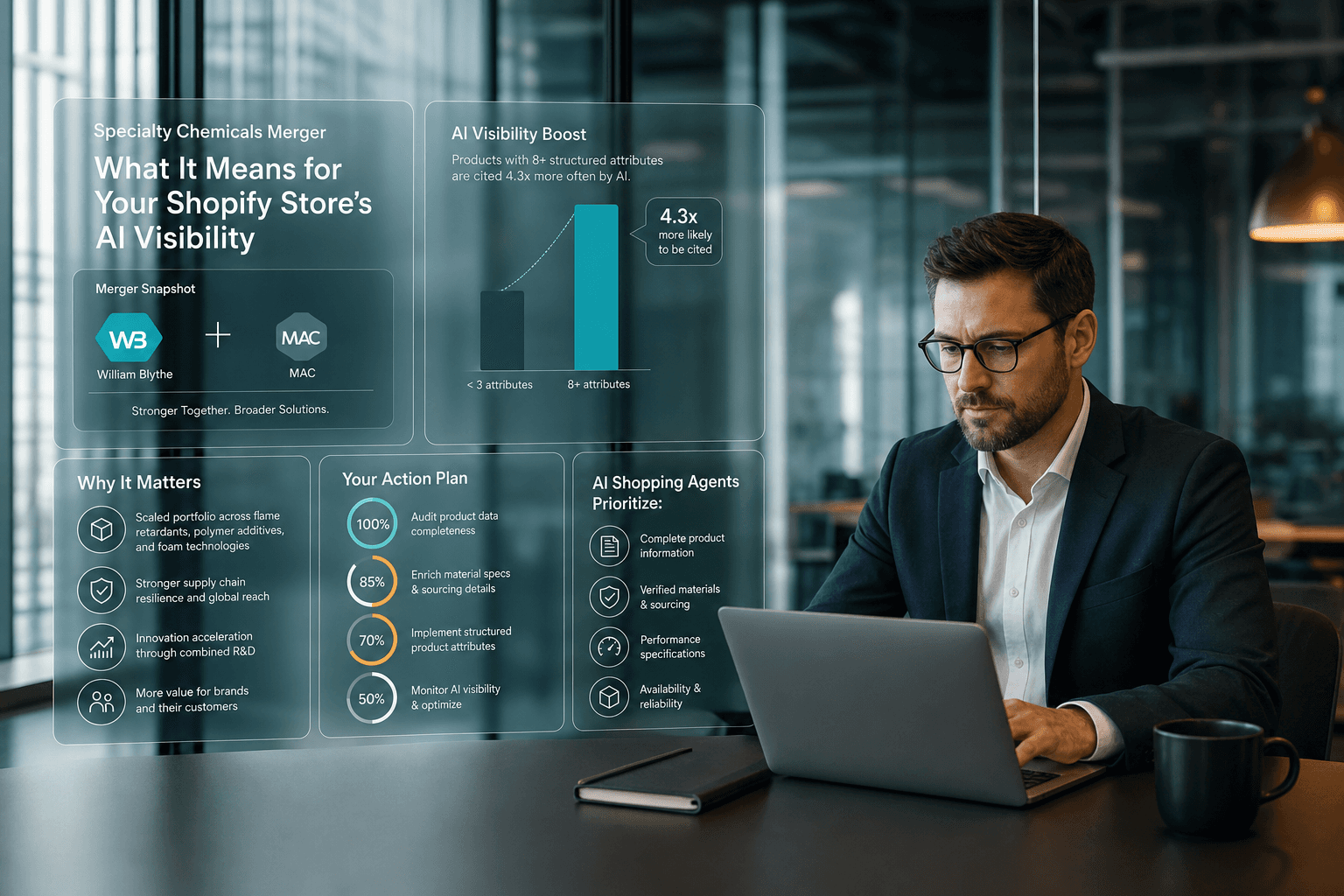
TL;DR: The William Blythe and MAC merger creates a scaled specialty chemicals group covering flame retardants, polymer additives, and foam technologies. For Shopify merchants selling products that use these materials, this is a signal to audit your product data completeness. AI shopping agents and answer engines now cite products with 8 or more structured attributes 4.3x more often than products with fewer than 3. Supply chain news like this merger is your cue to ensure your material specifications, sourcing details, and product attributes are complete enough for AI agents to recommend you.
Supply chain consolidation in specialty chemicals directly affects product sourcing, pricing, and material availability for consumer brands. William Blythe's combination with US-based Metals and Additives LLC creates an international group spanning flame retardants, smoke suppressants, catalysts, absorbents, foam technologies, polymer additives, and inorganic solutions. If your products use any of these materials, your supplier landscape just changed.
For Shopify merchants, the operational concern is straightforward: monitor your supply chain partners and update product pages when material sourcing shifts. But the larger opportunity is strategic. AI shopping agents like ChatGPT Shopping and Perplexity now evaluate product data completeness when deciding which products to recommend. Products with detailed material specifications, certifications, and sourcing transparency get cited more often. A supply chain shift is your prompt to audit whether your product data is complete enough to win in agentic commerce.
Agentic commerce refers to AI agents autonomously handling shopping transactions on behalf of consumers, from discovery and comparison through checkout. McKinsey estimates this could redirect $3 to $5 trillion in global retail spend by 2030. The critical insight for merchants: AI agents choose products based on structured data quality, not brand awareness alone.
Products with 8 or more structured attributes are cited 4.3x more often in AI shopping results than products with fewer than 3 attributes. This means your product pages need complete specifications: materials, certifications, dimensions, care instructions, and sourcing details. When a chemicals merger like William Blythe and MAC shifts your supply chain, updating your product data with accurate material sourcing is not just operational hygiene—it is an AI visibility play. Shopify's Universal Commerce Protocol now syndicates this data automatically to AI shopping agents, but only if you populate it first.
AI shopping agents prioritize products with complete, accurate, and structured data. ChatGPT Shopping converts at 15.9%, Perplexity at 10.5%, compared to 1.76% for traditional Google organic traffic. But these conversion rates only benefit brands whose products appear in AI recommendations in the first place.
The factors AI agents weigh include:
When your material suppliers consolidate, your product descriptions may need updates. If your flame-retardant fabric now comes from a different source, your product data should reflect that. AI agents parse this information when forming recommendations, and incomplete data means you lose to competitors with better-structured pages.
Audit your product data immediately when supplier news breaks. The William Blythe merger affects brands using flame retardants, polymer additives, foam technologies, and related materials. If that includes your products, here is your action checklist:
Shopify auto-generates AI-facing files like /llms.txt and /agents.md as of May 2026, but these files pull from your product data. Incomplete source data means incomplete AI visibility. The 20 minutes you spend updating product attributes after a supply chain shift can drive 4.3x more AI citations for those products.
Answer engine optimization is the practice of formatting content so AI-powered answer engines can extract and present it as direct responses. For product pages, this means leading with clear specifications that AI can parse. Pages with comprehensive Product schema receive 2.7x more impressions than those without.
The connection to supply chain news is direct: when materials or sourcing change, your product descriptions and schema must update accordingly. AI engines weight recently updated content higher for real-time retrieval. A 2026 GEO benchmark study confirmed that e-commerce content updated within the last 30 days receives 3.2x more citations across AI platforms than stale content.
For Shopify merchants, this creates a content calendar trigger. Industry news like the William Blythe merger is your signal to refresh product pages that use affected materials. Add the update date visibly, refresh the material specifications, and ensure your FAQ sections address questions customers might have about sourcing changes.
AI engines evaluate trustworthiness signals when deciding which sources to cite. For e-commerce, trustworthiness includes accurate pricing, clear return policies, and transparent sourcing information. Brands that disclose material origins and supplier relationships build stronger E-E-A-T signals that AI models recognize.
The William Blythe and MAC merger creates an opportunity for DTC brands to differentiate on transparency. If your competitors use vague material descriptions while you specify exact sourcing, certifications, and supplier relationships, AI agents have more structured data to work with when recommending your products. Brand mentions now correlate 3x more strongly with AI search visibility than traditional backlinks, and detailed product specifications generate the kind of third-party citations that drive brand mentions.
This is particularly relevant for brands in categories where material safety matters: children's products, home goods, apparel with flame-retardant properties, or any category where certifications influence purchase decisions. Complete material data is not just compliance—it is competitive advantage in AI discovery.
Shopify's Summer '26 Edition added a dashboard showing how products perform inside ChatGPT, Gemini, and Copilot. This gives merchants direct visibility into which products AI agents recommend and which need improvement. After updating product data following supply chain news, monitor this dashboard for changes in AI citation frequency.
Additional tracking methods include:
Perplexity responds to new content within days due to real-time retrieval, so product page updates can show results quickly. ChatGPT and Claude may take 3-6 months for training-based citation changes, but Google AI Overviews typically reflect indexed content within 2-4 weeks.
What is the William Blythe and MAC merger? UK-based William Blythe is combining with US specialty chemicals firm Metals and Additives LLC to create an international group covering flame retardants, smoke suppressants, catalysts, absorbents, foam technologies, polymer additives, and inorganic solutions. MAC founders Gregg Bennett and Mark McCaughey will remain in leadership alongside William Blythe's management team.
How does a chemicals merger affect Shopify merchants? If your products use materials from the affected categories, your supplier landscape may shift. This is your signal to audit product data, update material specifications, and ensure your structured data reflects accurate sourcing information for AI agents to parse.
What is agentic commerce? Agentic commerce refers to AI agents autonomously handling shopping transactions on behalf of consumers. McKinsey estimates this could redirect $3 to $5 trillion in global retail spend by 2030. AI agents choose products based on structured data completeness.
How many product attributes do I need for AI visibility? Products with 8 or more structured attributes are cited 4.3x more often in AI shopping results than products with fewer than 3. Prioritize material, size, color, certifications, GTIN, shipping details, and return policies.
What is answer engine optimization for product pages? AEO for product pages means structuring descriptions so AI can extract and cite them. Lead with clear specifications, include FAQ sections, implement Product schema with all recommended fields, and update content regularly.
How quickly do AI engines reflect product page updates? Perplexity responds to new content within days. Google AI Overviews typically reflect indexed content within 2-4 weeks. ChatGPT and Claude may take 3-6 months for training-based citation changes.
Does Shopify automatically share product data with AI agents? Yes. Shopify's Universal Commerce Protocol syndicates product data to AI shopping agents automatically as of March 2026. However, the data quality depends on what you populate in your product fields.
How do I track AI visibility for my products? Shopify's Summer '26 dashboard shows ChatGPT, Gemini, and Copilot performance. Additionally, test queries across AI platforms, monitor AI-referred traffic in GA4, and track branded search volume as a leading indicator.

A small team of friends and colleagues working together to produce useful content to help you...gift better.