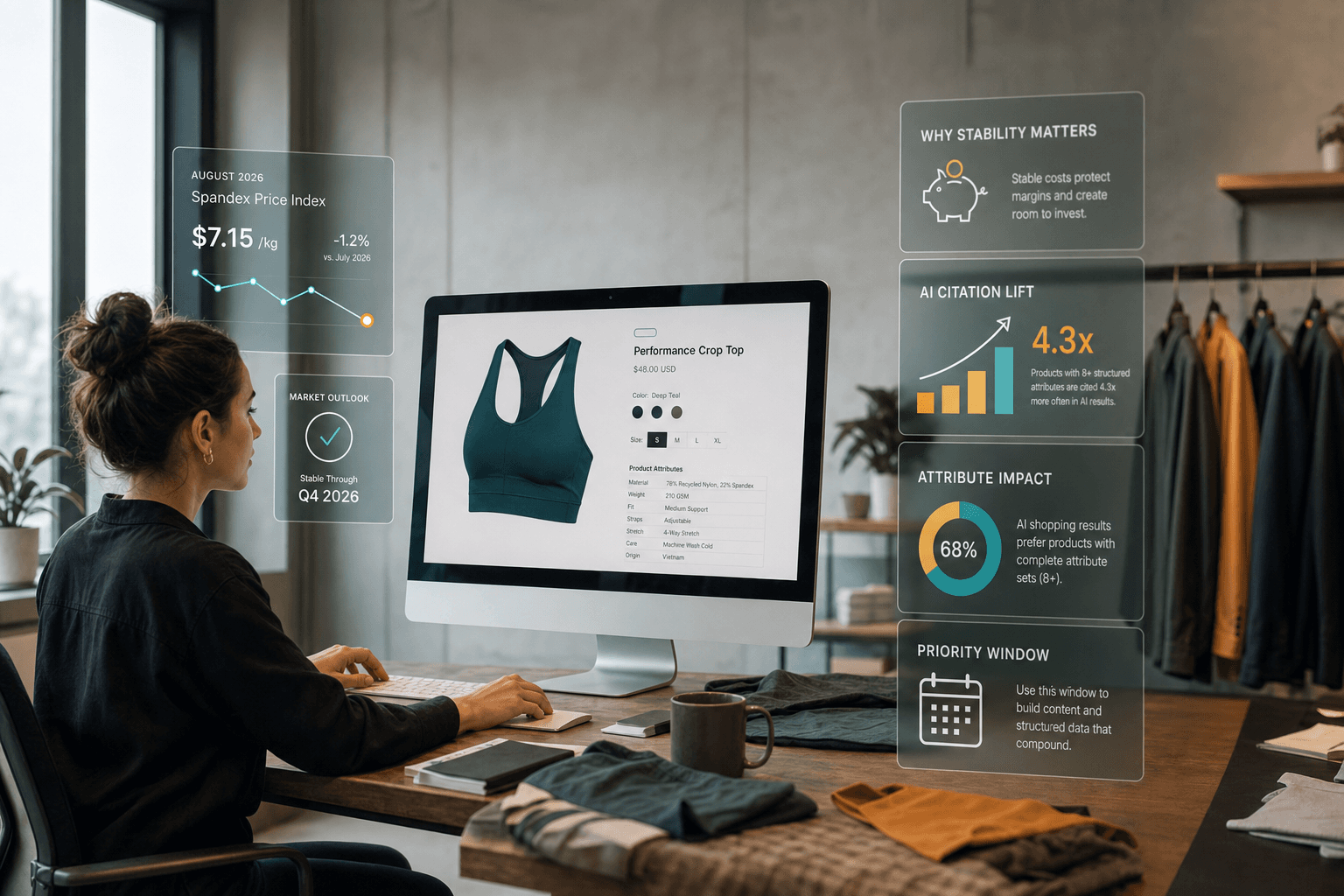
TL;DR: Stable spandex prices in August 2026 give Shopify apparel brands breathing room on margins. Use this window to invest in the work that actually compounds: completing product attributes, implementing structured data, and making your catalog AI-agent ready. Products with 8 or more structured attributes are cited 4.3x more often in AI shopping results than products with fewer than 3.
Spandex prices held steady through August as PTMEG and BDO feedstock costs stabilized, according to Fibre2Fashion. For Shopify merchants selling activewear, athleisure, or any stretch-fabric products, this is a rare moment of predictability in an otherwise volatile supply chain. The strategic question is not whether to celebrate the margin relief but what to do with the operational bandwidth it creates.
The answer for DTC brands in 2026 is clear: structured product data and AI visibility.
Why Does Supply Chain Stability Matter for AI Commerce Readiness?
When raw material costs are volatile, merchandising teams spend their time firefighting—adjusting prices, renegotiating with suppliers, and managing margin compression. Stable input costs free up that bandwidth for strategic work. The brands using this window to complete their product data will be the ones AI shopping agents recommend when a customer asks "best yoga pants under $80" on ChatGPT or Perplexity.
AI-referred traffic to Shopify stores grew 8x year over year by Q1 2026, and AI-attributed orders grew 13x in the same period. ChatGPT Shopping converts at 15.9%, Perplexity at 10.5%, compared to Google organic at 1.76%. The economics are unambiguous: AI-referred visitors convert at 4 to 23 times the rate of traditional organic visitors.
For apparel brands specifically, the opportunity is structural. McKinsey estimates agentic commerce could redirect $3 to $5 trillion in global retail spend by 2030. The brands whose product data AI agents can parse will capture that demand. The brands with incomplete catalogs will not appear in the consideration set at all.
What Product Attributes Do AI Shopping Agents Need From Apparel Listings?
AI agents require complete, structured, and accurate product data to recommend your products. For stretch-fabric apparel, this means going well beyond basic title and price. Products with 8 or more structured attributes are cited 4.3x more often in AI shopping results than products with fewer than 3 attributes.
The critical attributes for apparel include:
- Material composition with percentages (e.g., "87% Nylon, 13% Spandex")
- Size range with fit guidance (true to size, runs small, etc.)
- Color with accurate naming and hex codes for visual search
- Care instructions
- Use case or activity type (yoga, running, everyday wear)
- Rise, inseam, and other fit-specific measurements
- Weight or fabric density
- Sustainability certifications if applicable
- GTIN or barcode
- Minimum 3 images including lifestyle shots
Shopify's Universal Commerce Protocol (UCP) enables AI agents to query live inventory, variants, and pricing directly. But the protocol only works if your data is complete. An agent cannot recommend a product with missing size charts or vague material descriptions.
How Does Structured Data Improve AI Citation Rates for Apparel Brands?
Structured data is no longer optional for AI visibility. Pages with comprehensive schema receive 2.7x more impressions than those without, and products with full Product schema appear 3 to 5 times more often in AI-generated shopping recommendations.
For Shopify apparel merchants, the implementation priority is Product schema with all recommended fields populated. This includes material, color, size, brand, aggregate rating, GTIN, availability, and shipping details. FAQPage schema on product pages drives 3.1x higher answer extraction rates, making it critical for answer engine optimization.
The practical workflow:
- Audit your top 20 products for schema completeness using Google's Rich Results Test
- Add missing material and variant attributes to Product schema
- Implement FAQPage schema with 5 to 8 questions per product page
- Verify your data syncs correctly to the Shopify Catalog for AI agent discovery
Shopify's Summer '26 Edition now shows your ChatGPT and Gemini performance score directly in the admin dashboard. If you are not checking it, your competitors are.
What Is the Connection Between Material Costs and Product Page Content?
Stable spandex prices mean your product descriptions do not need constant updates to reflect margin-driven price changes. This is the moment to invest in durable content that compounds over time.
For stretch-fabric products, material composition is a key decision factor for buyers. AI agents answering queries like "best moisture-wicking leggings for hot yoga" need to parse your material data to make accurate recommendations. A product page that says "stretchy fabric blend" loses to a competitor whose page specifies "78% Recycled Polyester, 22% Spandex with four-way stretch."
Content freshness also matters for AI citation. A 2026 GEO benchmark study found that e-commerce content updated within the last 30 days receives 3.2x more citations across AI platforms than content that has not been refreshed. Use the pricing stability window to update product descriptions with specific material benefits, performance claims, and comparison data.
How Should Shopify Merchants Prioritize AI Visibility Work During Stable Periods?
The prioritization framework is straightforward: fix the data layer first, then optimize content, then monitor and iterate. AI agents cannot recommend what they cannot parse, so data completeness precedes everything else.
Week 1 to 2 priorities:
- Complete all product attributes for your top 50 SKUs by revenue
- Verify material composition percentages are accurate and specific
- Add GTIN or barcode to every product
- Ensure variant data (size, color) is fully specified with no missing options
Week 3 to 4 priorities:
- Implement or audit Product schema on all product pages
- Add FAQPage schema with material, care, and fit questions
- Update product descriptions to lead with "who this is for" statements
- Add comparison content for your bestsellers vs. category alternatives
Ongoing:
- Check your AI visibility score in Shopify admin weekly
- Test your brand in ChatGPT and Perplexity with category queries
- Refresh top product pages with new data points monthly
The Shopify Scripts deadline on June 30 is a reminder that platform infrastructure changes can break checkout logic silently. Use stable periods to audit technical foundations, not just content.
What Does Agentic Commerce Mean for Apparel Brands Selling Stretch Fabrics?
Agentic commerce refers to AI agents autonomously handling shopping transactions on behalf of consumers. The consumer sets preferences once; the agent executes the entire purchase journey from discovery through checkout. For apparel brands, this means your product data must be complete enough for an agent to confidently recommend your leggings over a competitor's without human intervention.
Shopify shipped six AI-facing endpoints to every store in May 2026, including /llms.txt, /.well-known/ucp, and an agentic sitemap. These are auto-enabled, but they only work well if your underlying product data is clean. The Shopify Catalog syndicates your products to AI shopping agents operating on both ACP (OpenAI/Stripe) and UCP (Google/Shopify) protocols.
Merchants implementing both protocols capture 40% more agentic traffic than those using only one. The good news: Shopify abstracts this complexity. Your job is to make the product data agent-ready.
The March 2026 UCP update added multi-item cart capabilities, meaning an AI agent can now build a complete outfit—leggings, sports bra, jacket—in a single session and convert the entire cart. Brands with complete cross-sell data and consistent sizing information will capture these multi-item orders.
How Can Apparel Merchants Turn Material Stability Into Long-Term AI Advantage?
The brands that win in agentic commerce are the ones that treat product data as infrastructure, not as a one-time project. Stable raw material prices create the operational space to build that infrastructure properly.
For spandex-based apparel, this means:
- Documenting material sourcing and sustainability credentials for AI agents that filter on eco-friendly criteria
- Building out size and fit guides that agents can parse programmatically
- Creating comparison content that positions your products against category alternatives
- Ensuring your reviews and ratings are visible and schema-marked for aggregate rating signals
Brand search volume is now the strongest predictor of AI citation, with a correlation of 0.664 compared to 0.218 for backlinks. Every marketing dollar you spend on brand awareness—paid, social, influencer, email—compounds into AI visibility. The brands that are omnipresent in their niche get recommended by AI. The brands that are not get skipped.
The window for first-mover advantage in AI commerce is narrowing. HubSpot just built answer engine optimization directly into its marketing platform, signaling that AEO is shifting from edge tactic to table stakes. Use the margin relief from stable spandex prices to get ahead of the curve.
Frequently Asked Questions
How do stable raw material prices affect AI commerce strategy?
Stable input costs free up operational bandwidth that merchandising teams typically spend on price adjustments and margin management. This creates space to invest in strategic work like completing product attributes, implementing structured data, and optimizing for AI agent discovery—work that compounds over time.
What product attributes matter most for AI shopping agents?
For apparel, AI agents need material composition with percentages, size range with fit guidance, accurate color naming, care instructions, use case or activity type, and GTIN or barcode. Products with 8 or more structured attributes are cited 4.3x more often than products with fewer than 3.
How does structured data improve AI visibility for Shopify stores?
Pages with comprehensive schema receive 2.7x more impressions, and products with full Product schema appear 3 to 5 times more often in AI-generated shopping recommendations. FAQPage schema drives 3.1x higher answer extraction rates.
What is agentic commerce and why does it matter for apparel brands?
Agentic commerce refers to AI agents autonomously handling shopping transactions from discovery through checkout. McKinsey estimates it could redirect $3 to $5 trillion in global retail spend by 2030. Brands with complete, structured product data will be recommended; brands without will not appear in consideration sets.
How often should product content be updated for AI citation?
Content updated within the last 30 days receives 3.2x more AI citations than stale content. Monthly refreshes of top product pages with new data points, comparison information, or updated specifications maintain citation eligibility.
What Shopify features support AI agent discovery?
Shopify auto-generates /llms.txt, /.well-known/ucp, and agentic sitemaps on every store. The Summer '26 Edition added an admin dashboard showing ChatGPT and Gemini performance scores. The Shopify Catalog syndicates products to AI agents on both ACP and UCP protocols.
Does Google ranking still matter for AI visibility?
Google ranking and AI citation are now separate games. Research shows the overlap between top Google results and AI-cited sources collapsed from 70% to below 20%. A brand can rank first on Google and be absent from ChatGPT answers to the same query.
Sources