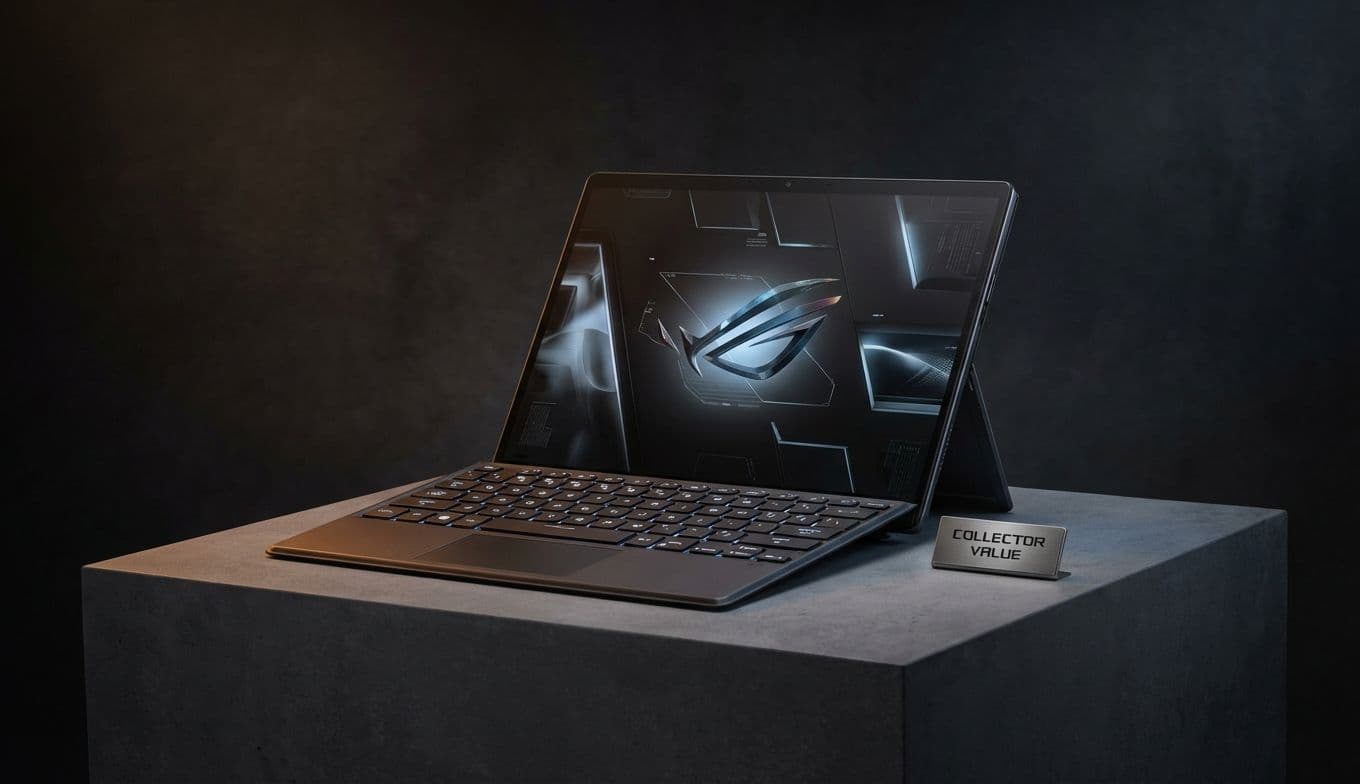
Asus ROG Flow Z13-KJP Review: Kojima Productions Edition Hands-On

Asus ROG Flow Z13-KJP Review: Kojima Productions Edition Hands-On

Team GimmieTeam Gimmie
Published on February 24, 2026

THE COOLEST COMPUTER YOU CAN ACTUALLY TOUCH

There is a specific kind of buzz that happens when a piece of technology stops feeling like a tool and starts feeling like an artifact. Recently, a claim has been circulating among tech circles that the new Asus ROG Flow Z13-KJP is the coolest computer I've ever touched. It is a bold, borderline hyperbolic statement in a world filled with sleek MacBooks and RGB-heavy towers. But when you actually see this thing—when you feel the weight of it and realize it was designed in collaboration with the legendary Kojima Productions—you start to understand why the hype is real.

This isn't just a gaming tablet. It is a collision of high-end engineering and the haunting, high-concept aesthetic of Death Stranding. If you have ever wanted to carry a piece of a Hideo Kojima game into the real world, this is as close as you are going to get. It is a limited-edition masterpiece that manages to be both a work of art and a legitimate powerhouse.

THE TECHWEAR REVOLUTION IN YOUR HANDS

When you first look at the Z13-KJP, you realize this is not meant to live on a sterile office desk. While the standard ROG Flow Z13 is already a standout, this Kojima Productions edition takes things into the realm of techwear. This is a design philosophy that blends utility, fashion, and futuristic ruggedness.

The most striking physical additions are the utility straps and the protective housing. Most tablets are designed to be thin, slippery, and fragile. The KJP edition goes the opposite direction. It feels industrial. The straps aren't just for show; they give the device a tactile, wearable quality that makes it feel like a piece of field equipment. You can literally sling it over your shoulder or secure it in ways that standard tablets simply don't allow.

The aesthetic is heavily inspired by Ludens, the mascot of Kojima Productions, and the work of iconic designer Yoji Shinkawa. If you are familiar with Shinkawa’s work on the Metal Gear series or Death Stranding, you will recognize the bold lines and the moody, atmospheric detailing. It doesn't look like it was made in a factory; it looks like it was recovered from a high-tech bunker in a post-apocalyptic future. The materials feel substantial and premium, moving far away from the plasticky feel of many gaming peripherals.

MORE THAN JUST INTEGRATED GRAPHICS

Under the hood, this tablet is pushing the boundaries of what integrated graphics can actually do. It features the AMD Strix Halo, a chip that has been a topic of intense fascination for hardware nerds over the last year. Typically, if you wanted to play AAA games on a tablet, you had to settle for low settings or carry a bulky external GPU.

The Strix Halo changes that narrative. It provides a level of graphical fidelity that feels impossible for a device this portable. Whether you are traversing the rugged terrain of Death Stranding or tackling modern creative tasks like 4K video editing, the Z13-KJP handles it with a surprising amount of grace.

Of course, because it is packing this much power into a 13-inch frame, it has some heft. It’s chunky. But in the context of this specific design, the thickness actually works in its favor. It feels durable and intentional. It needs that space for cooling, and Asus has engineered a thermal system that keeps the device from throttling even when things get intense. It is a rare example of hardware where the physical bulk actually enhances the overall experience rather than detracting from it.

THE ULTIMATE PRESTIGE GIFT

If you are looking for a gift for a high-end collector or a die-hard Kojima fan, this is the definitive prestige item. A standard gaming laptop is a great tool, but it doesn’t carry the same cultural weight as the Z13-KJP.

Why choose this over a standard high-end laptop? It comes down to exclusivity and storytelling. When you buy this, you aren't just buying a PC; you are buying a limited-edition collaboration that will likely never be repeated. For a Kojima fan, the unboxing experience alone is worth the price of admission. Every detail, from the packaging to the custom interface elements, is a love letter to the studio’s artistic vision.

It serves as a conversation starter in a way that a generic silver laptop never could. It signals a deep appreciation for both cutting-edge technology and gaming culture. It is the kind of item that gains value over time, not just because of the specs, but because of its status as a collector's piece. If you see one available, you should know that these are not mass-produced. The window for grabbing one is small, and once they are gone, they will likely only show up on the secondary market at a massive markup.

WHO IS THIS FOR?

Let’s be honest: this isn't the "everyman" computer. If you are looking for the most frames-per-dollar, you’ll probably look elsewhere. But that’s not the point of this device.

The Z13-KJP is for the early adopter who is bored with the current state of hardware design. It is for the person who sees their technology as an extension of their personal style. It is for the creative professional who wants a drawing tablet that can also run a full-scale game engine. And primarily, it is for the Kojima devotee who wants a functional piece of the universe they’ve spent hundreds of hours exploring.

The versatility of the 2-in-1 design means you can use it as a standalone tablet for sketching with a stylus—which feels incredible on this display—or snap on the keyboard for a more traditional laptop experience. It adapts to how you work, but it never loses that core identity.

A STATEMENT PIECE FOR THE DISCERNING USER

The Asus ROG Flow Z13-KJP is a triumph because it refuses to be boring. In an industry that often prioritizes safe, incremental upgrades, this device is a loud, confident shout. It proves that technology can be evocative and personal.

It is a rare blend of high performance and high art. While it might be a niche product, it serves that niche with incredible precision. It is functional, it is powerful, and most importantly, it is inspiring. If you value unique aesthetics and want a device that feels like it belongs in the year 2050, this is it. It is more than just the coolest computer you’ve ever touched—it’s a glimpse into a future where tech and art are finally indistinguishable.