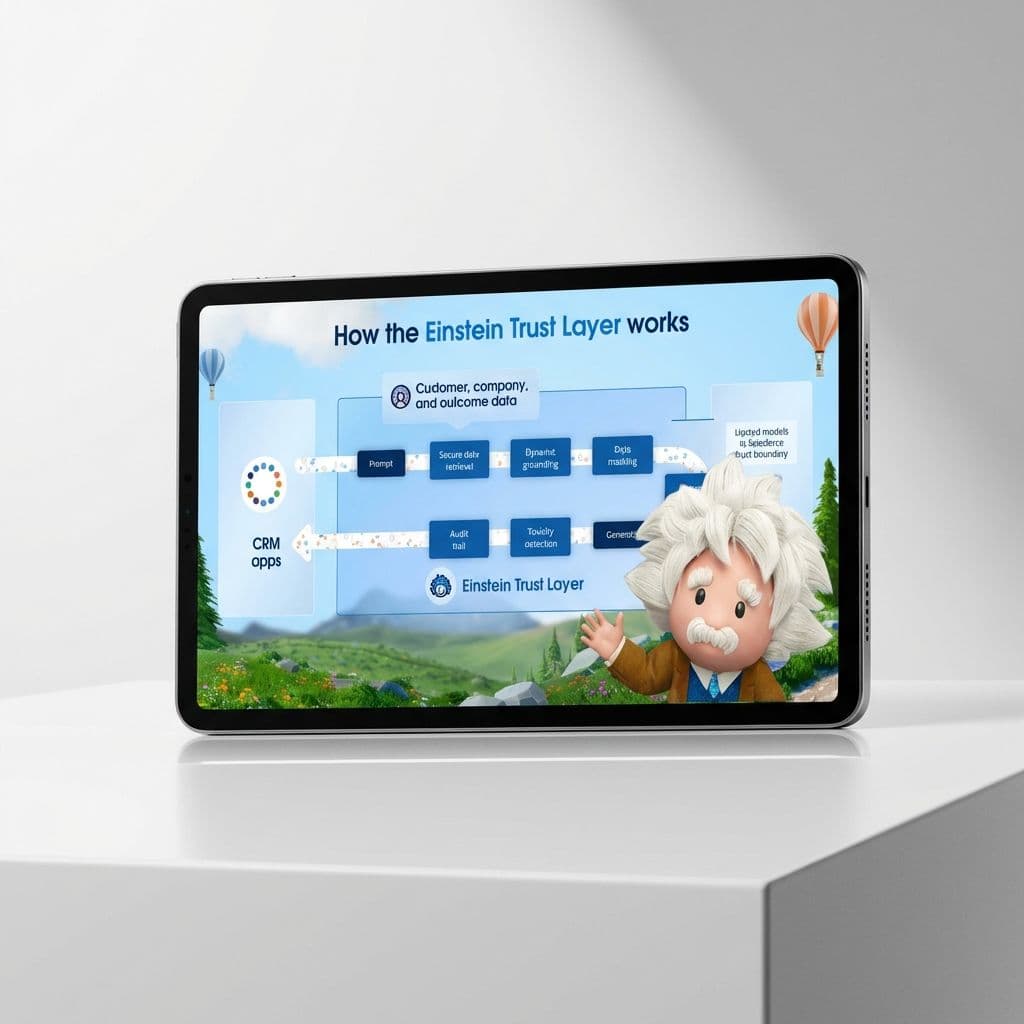
Salesforce Einstein Copilot: The AI Companion for CRM Explained
Team GimmieThe Rise of the Proxy Student: Can AI Really Take Your Classes?
For decades, the promise of educational technology was to make learning more accessible. We went from heavy encyclopedias to Google, and from dusty lecture halls to YouTube and Khan Academy. But we have officially entered a new, more complicated era. We are moving past the age of the AI tutor and into the age of the proxy student.
At the center of this shift is a new wave of tools, most notably Einstein. This isn't just another chatbot that helps you brainstorm a thesis statement or checks your grammar. Einstein is designed to operate as a surrogate. It can watch lecture videos, ingest hundreds of pages of reading material, and produce finished assignments that mimic a student's specific voice.
It is the ultimate academic shortcut. But as these tools become more sophisticated and accessible to parents and students alike, we have to ask: at what point does a productivity tool become an intellectual liability?
The Multi-Modal Engine: How It Actually Works
To understand why Einstein is different from the AI tools of two years ago, you have to look under the hood. Most early AI models were text-in, text-out. If you wanted help with a video lecture, you had to find a transcript, copy it, and paste it into a prompt.
Einstein removes those friction points through multi-modal processing. When a student uploads a recorded lecture, the AI doesn't just listen to the audio; it analyzes the video frames. It uses optical character recognition to read the text on a professor’s PowerPoint slides and combines that with speech-to-text data to create a comprehensive understanding of the lesson.
It then cross-references this lecture data with any provided PDFs or textbooks. The result is a specialized knowledge base for that specific course. When a quiz or essay prompt is entered, the AI isn't pulling from a general pool of internet data; it is pulling from the exact material taught in that specific classroom. This allows it to answer "trick" questions that rely on a professor's specific anecdotes or unique terminology—the kind of things that usually trip up generic AI models.
The Buyer’s Dilemma: Productivity vs. Integrity

For parents, tools like Einstein represent a significant moral and financial crossroads. On one hand, the modern student is under unprecedented pressure. Between extracurriculars, part-time jobs, and a competitive college admissions landscape, many parents see AI as a way to "level the playing field" or manage an overwhelming workload. They view it as a high-tech version of a private tutor.
However, there is a fundamental difference between a tutor who explains a concept and a proxy who performs the task. When you purchase a tool that completes the work, you aren't buying an education; you are buying a credential.
The dilemma is clear: Is the goal to get the grade or to gain the skill? If a student uses a proxy to bypass a foundational writing course, they might save twenty hours of stress this semester, but they are effectively outsourcing the development of their own critical thinking. In a professional world that is increasingly skeptical of degrees and more focused on demonstrated ability, this shortcut could eventually lead to a dead end. For parents, gifting a subscription to an automation tool might feel like a helping hand, but it could actually be an act of intellectual deskilling.
The Educator’s Response: Reclaiming the Classroom
Academic institutions are not sitting idly by as proxy students take over their digital hallways. The rise of tools like Einstein has forced a massive "return to analog" in many high schools and universities.
Educators are increasingly moving away from take-home essays and digital quizzes, which are easily gamed by multi-modal AI. Instead, we are seeing a resurgence of in-class, blue-book exams and oral presentations. Some professors have adopted a "flipped classroom" model where the lecture is watched at home, but the actual work—the writing, the problem-solving, and the debating—happens in person, under the watchful eye of an instructor.
There is also a shift in how assignments are designed. Rather than asking for a summary of a text, which Einstein can do in seconds, teachers are asking for personal reflections that connect course material to a student's specific life experiences or local community events—areas where AI still struggles to be authentic. The goal is to make the process of learning visible, rather than just grading the final product.
Finding Value in the Struggle
There is no doubt that AI will continue to automate the mundane parts of our lives. In a few years, we may look back at manual transcription or basic data entry as relics of a harder time. But learning is not a mundane task; it is a transformative one.
The "struggle" of writing a difficult paper or solving a complex equation is where the actual neural pathways are formed. When we use a proxy to skip that struggle, we miss the point of the exercise. Einstein is a technical marvel, showing us just how far multi-modal AI has come. It can watch, it can listen, and it can write.
But it cannot learn. That part is still up to us. As we integrate these tools into our lives, the challenge won't be finding faster ways to finish our work, but finding the discipline to keep doing the work that matters. The most valuable thing a student can bring to a classroom in 2026 isn't a high-end AI tool—it's their own undivided attention.