Razer Boomslang 20th Anniversary Review: Worth $300?
Team GimmieThe Razer Boomslang 20th Anniversary Mouse: A Collector’s Dream, A Gamer’s Headache
Let’s talk about the Razer Boomslang 20th Anniversary Edition. Before you reach for your wallet, let me be clear: this is not your typical gaming peripheral. Razer has a long-standing reputation for pushing boundaries, but with this release, they’ve stepped out of the laboratory and straight into the museum. If you are a competitive gamer looking for a tool to help you climb the ranks in a high-stakes shooter, you can stop reading right now. This isn't for you.
However, if you are a collector, a gaming historian, or someone who treats their desk setup like a curated gallery, this might be your holy grail. At a staggering $300, it is a statement piece that happens to move a cursor. It is a beautiful, expensive, and deeply flawed tribute to the mouse that started it all.
The Unboxing: A Ritual for the Elite
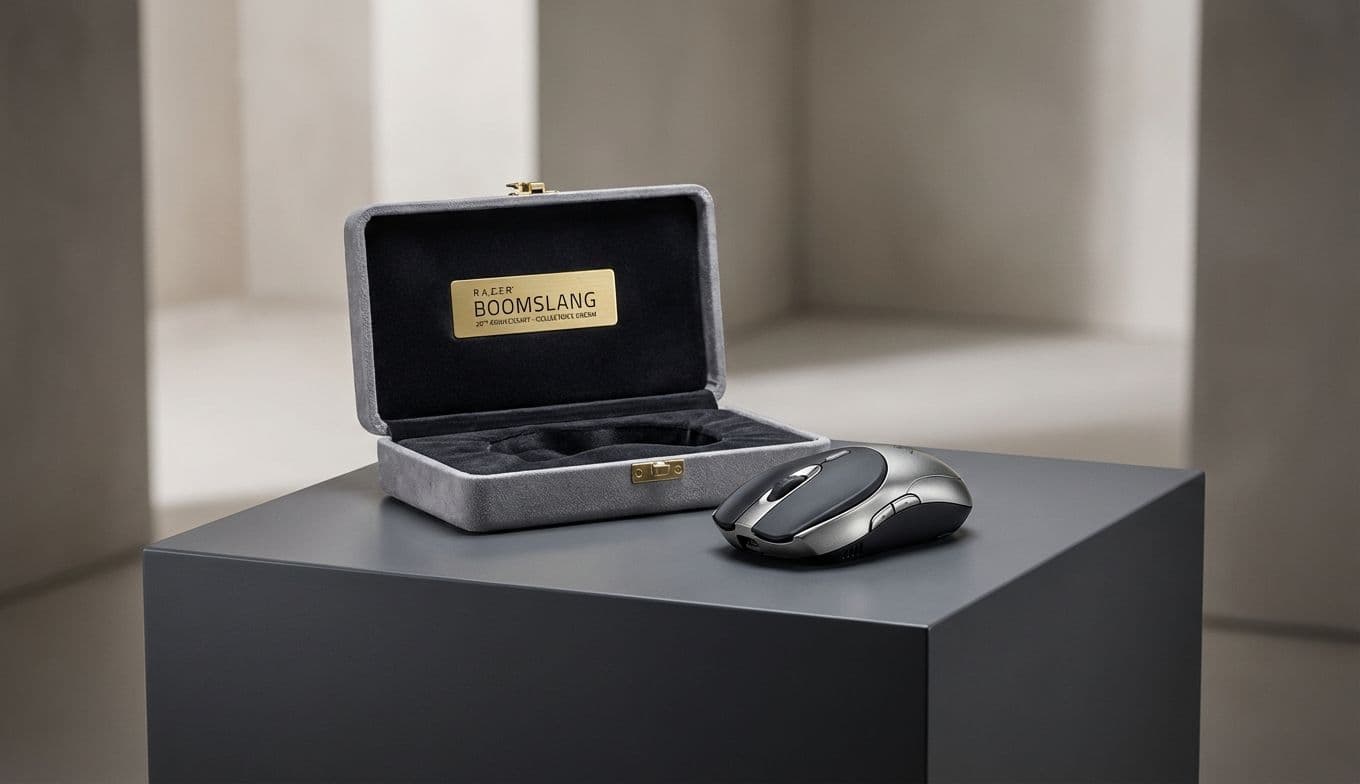
When you spend $300 on a mouse, you aren't just buying a sensor and some switches; you’re buying an experience. Razer understands this, and the presentation of the 20th Anniversary Boomslang is nothing short of theatrical. The box itself feels like something meant to hold a high-end watch or a piece of jewelry. It’s a heavy, matte-black monolith that demands respect before you even break the seal.
Upon lifting the lid, the mouse doesn't just sit in a plastic tray. It is nestled in custom-cut, high-density foam, accompanied by a heavy metal commemorative coin and a certificate of authenticity that lists your unit’s specific number in the limited production run. There is a tactile weight to everything here. The velvet-lined interior and the braided, gold-plated cable scream "luxury artifact." For a collector, this initial sixty seconds of unboxing almost—almost—justifies the price tag. It feels like you’ve acquired a piece of gaming history, preserved in a time capsule.
Luxury Materials Meets Dated Design
Once the mouse is in your hand, the "luxury" angle continues, but the "artifact" reality starts to set in. The build quality is light-years ahead of the 2006 original. While the first Boomslangs were notorious for their somewhat creaky plastic, the Anniversary Edition feels incredibly dense and premium. The shell has a unique metallic finish—cool to the touch and resistant to the oily fingerprints that plague cheaper peripherals. The side grips are textured with a precision that feels intentional, and the scroll wheel has a heavy, mechanical "chunk" to its rotation that feels more like a dial on a piece of high-end audio equipment than a mouse wheel.

But here is the rub: it feels like a $300 mouse that was designed by someone who hasn't looked at a human hand in twenty years. The Boomslang was revolutionary in the early 2000s because it was one of the first mice to offer high DPI, but its shape was always an outlier. It is remarkably flat, exceptionally wide, and has a flared front that feels alien compared to the ergonomic curves of a modern Razer DeathAdder or a Logitech G Pro.
The Ergonomic Headache: Grip Warnings
If you are considering using this for actual gameplay, you need to be very honest about your grip style. For the modern gamer, the Boomslang is an ergonomic puzzle that most will fail to solve.
If you are a Palm Grip user, stay far away. The mouse is so low-profile that your palm will never actually touch the back of the shell. You’ll end up with a cramped, unsupported hand within thirty minutes of a session.
If you are a Claw Grip user, you’re in better territory, but the sheer width of the "wings" at the front of the mouse forces your fingers into an unnaturally wide stance. It’s tiring. It feels like trying to play a violin while wearing oven mitts.
Only Fingertip Grip users will find any semblance of comfort here, and even then, the weight is an issue. In an era where "ultra-light" 60-gram mice are the gold standard, the Boomslang is a heavyweight contender. It’s built for stability and presence, not for the flick-shots required in 2026’s competitive landscape.
Modern Tech in a Vintage Frame
To be fair, Razer didn't just put old guts in a new shell. Under the hood, the Anniversary Boomslang features a 16,000 DPI optical sensor. While we’ve seen higher numbers in the latest flagship models, 16,000 is more than enough for any practical application. The tracking is pixel-perfect, and the buttons utilize Razer’s optical switches, meaning they are lightning-fast and won't suffer from the double-clicking issues of the past.
It also features Chroma RGB lighting, because Razer wouldn't be Razer without it. The glow is subtle, emanating from the scroll wheel and the logo beneath the shell, giving it a ghostly, high-tech aura that looks stunning on a dark desk. But no amount of sensor accuracy or pretty lights can overcome the fact that the shape is a relic. Using this for a five-hour raid or a competitive tournament isn't just difficult—it’s a recipe for carpal tunnel.
The Decision Matrix: Buy It or Skip It?
This mouse is one of the most polarizing products in the industry. To help you decide if this $300 investment makes sense for you or as a gift, here is the breakdown:
Buy it if:
- You are a hardcore Razer enthusiast with a dedicated display shelf.
- You owned the original 1999 or 2006 Boomslang and want to own the ultimate version of your childhood "dream mouse."
- You value the unboxing experience and "shelf presence" over actual in-game performance.
- You are looking for a high-status gift for a gaming historian who "has everything."
Skip it if:
- You are a competitive esports player looking for a performance edge.
- You prefer lightweight, ergonomic mice that mold to your hand.
- You are on a budget—$300 can buy a top-tier GPU upgrade or a full suite of modern peripherals.
- You actually intend to use your mouse for 8+ hours a day for work or play.
The Verdict: A Masterpiece for the Mantle
The Razer Boomslang 20th Anniversary Edition is a fascinating contradiction. As a piece of hardware designed for the year 2026, it is arguably a failure—it’s too heavy, too expensive, and ergonomically outdated. But as a piece of "functional art," it is a triumph.
Razer isn't selling you a mouse; they are selling you a memory of the era when pro-gaming was just beginning to find its feet. They’ve taken a legendary silhouette and rebuilt it with the finest materials available. It’s the "vintage Ferrari" of the tech world. You don’t buy it to commute to work; you buy it to admire the lines, appreciate the history, and occasionally take it for a very short, very careful spin.
If you have the disposable income and a deep love for gaming heritage, the sticker shock will eventually fade, leaving you with a beautiful trophy. But if you're just looking for a way to click on heads more effectively, save your $300. This is a legend that belongs in a glass case, not on a competitive mousepad.