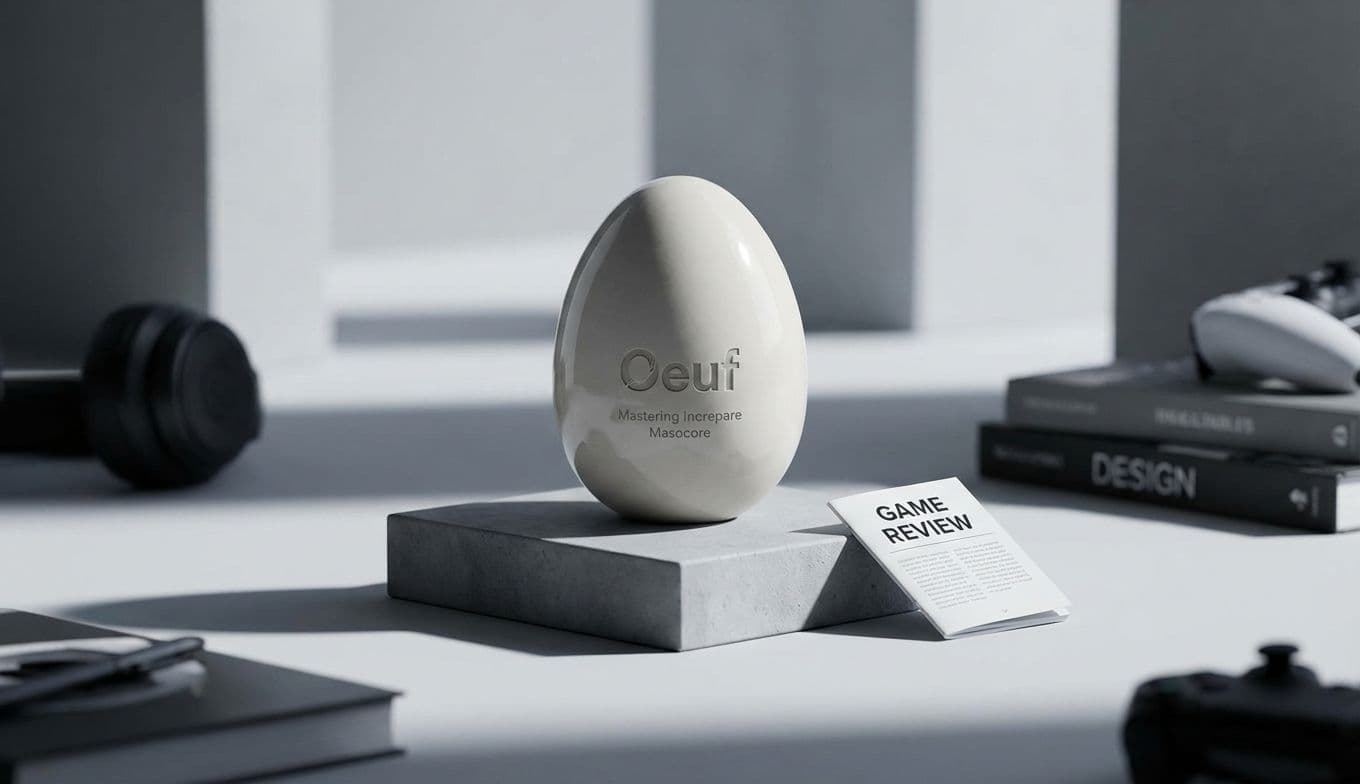
Oeuf Game Review: Mastering Increpare's Masocore Egg Game

Oeuf Game Review: Mastering Increpare's Masocore Egg Game

Team GimmieTeam Gimmie
Published on March 22, 2026

The Funny Shape of Eggs: A Deep Dive into Oeuf

Have you ever really considered the geometry of an egg? It is a geometric nightmare. It is not a sphere; it is an asymmetrical, oblong disaster waiting to tip over. It does not roll in a straight line; it wobbles, it pivots on its wider base, and it reacts to gravity with a chaotic logic all its own. In Oeuf, the latest creation from the prolific developer at Increpare Games, this specific, frustrating physics is the entire point.

In a gaming landscape that is perpetually desperate to be taken seriously as cinema, or to layer complex skill trees over simple concepts, Oeuf is a breath of fresh air. It does not want to tell you a grand story or ask you to manage a dozen different currencies. It only asks that you briefly consider how an egg might move as you roll, slide, and hop your way across a world that seems built specifically to break your shell.

The Beauty of the Wobble

The premise of Oeuf is deceptively simple: you are an egg, and you need to get from point A to point B. But because of that inherent asymmetry I mentioned earlier, every movement is a gamble. There is no simple forward motion here. When you nudge the analog stick, you aren’t just moving a character; you are initiating a physical reaction.

You quickly learn that momentum is your best friend and your worst enemy. If you gain too much speed on a downhill slope, you lose that delicate control required to navigate a narrow bridge. If you move too slowly, the natural wobble of your egg-shaped body might cause you to tip backward just as you reach the crest of a hill. It is a game that demands you understand weight and friction in a way that few triple-A titles ever do.

The world you navigate is realized in a crunchy, mid-90s era 3D style that feels like a long-lost relic from the days of Ultima or Might and Magic. While other games in 2026 are pushing for hyper-realism and ray-traced shadows, Oeuf embraces blocky polygons and low-resolution textures. It is a bold aesthetic choice that makes the world feel handcrafted and tactile. It feels like a place where physics actually matter, precisely because there are no flashy visual effects to hide behind.

The Masocore Paradox: Cozy but Cruel

There is a growing trend in the gaming world toward what players call masocore titles—games that are intentionally difficult, requiring pixel-perfect precision and endless patience. Usually, these games look dark and foreboding. Oeuf takes a different approach, wrapping its punishing difficulty in a cozy, nostalgic shell.

It creates a strange, wonderful dichotomy. The music is often calm, the visuals are charming, and your character is, well, a breakfast staple. But do not let the soft presentation fool you. This is a game that will test your resolve. Because there are no lengthy tutorials or obvious signposting, you are left to learn the rules through failure.

Consider this scenario: You have spent the last five minutes carefully navigating a series of precarious platforms. You are one jump away from the next checkpoint. You line up your roll, calculate the momentum, and tap the jump button. But because of a microscopic bump in the terrain, your egg base pivots just a fraction of a degree. Instead of a clean leap, you perform a pathetic, lopsided hop, catch the edge of the platform, and begin an agonizingly slow slide into the abyss. You watch your egg shatter, and you realize you have to do the entire sequence again.

It is frustrating, yes. But when you finally nail that jump? When you internalize the weird, wobbling rhythm of your character and clear a section that seemed impossible ten minutes ago? That is where the magic happens. It is the pure, unadulterated satisfaction of mastery.

A Worthy Addition to Your Library

For those looking to pick up Oeuf, you won't find it on a physical shelf next to the latest shooters. This is a digital-first experience, available on platforms like Steam and Itch.io. This availability makes it an incredibly easy recommendation for anyone looking for a quick, impactful gaming fix that doesn't cost the price of a full-scale RPG.

The value proposition here is immense. While many big-budget games offer dozens of hours of repetitive tasks, Oeuf offers dozens of hours of genuine skill-building. Every minute you spend playing is a minute spent learning. It is the kind of game that stays with you after you turn off the console, making you look at real-world physics with a slightly more critical eye.

For the gift-givers out there, Oeuf is the perfect choice for the gamer who seemingly has everything. We all know that person who has played every major release and is starting to feel a bit bored with the industry's predictability. Gifting them the egg game is more than just a joke; it is an invitation to experience a unique vision from one of the indie scene's most interesting developers. It is a conversation starter, a challenge, and a charming piece of digital art all rolled into one.

The Verdict on the Egg

Oeuf is a testament to the idea that you don't need a hundred-million-dollar budget to create something memorable. You just need a strong concept and the courage to follow it to its logical, lopsided conclusion. It is a game that respects the player's intelligence by refusing to hold their hand, and it rewards their persistence with a sense of accomplishment that is increasingly hard to find.

It is quirky, it is punishing, and it is undeniably charming. Whether you are looking to test your own reflexes or want to surprise a friend with something truly off the beaten path, Oeuf is a journey worth taking. Just remember: it’s okay to crack a few shells along the way. That is simply the price of progress in a world where eggs are the masters of their own destiny.

If you are ready to embrace the wobble, head over to Steam or Itch.io and give it a roll. You might find that the most rewarding gaming experience of the year is the one that looks the most ridiculous on paper. In the end, Oeuf proves that even the simplest shapes can hide the deepest challenges.