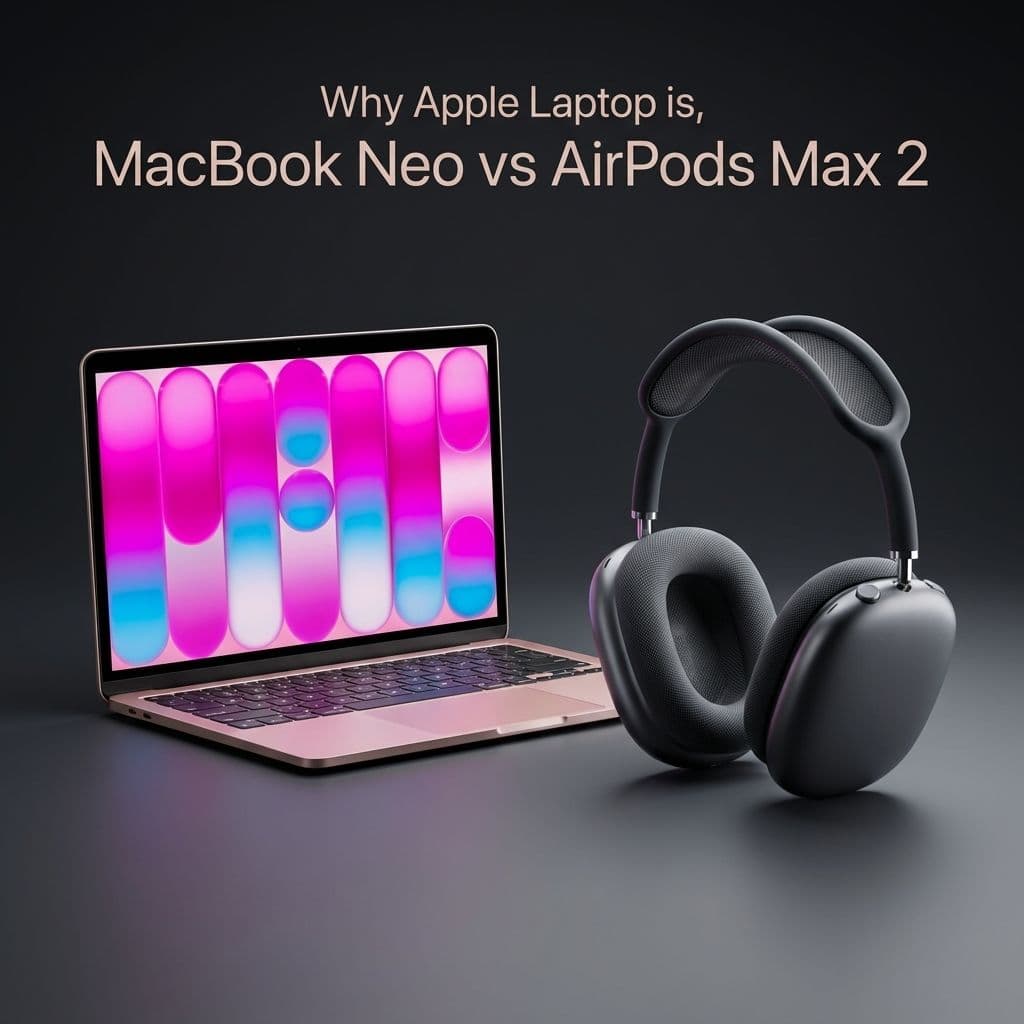
MacBook Neo vs AirPods Max 2: Why Apple's Laptop is Cheaper
Team GimmieThe Price Paradox: Why Apples Newest Laptop Costs Less Than Its Headphones
We have officially crossed a strange threshold in the world of consumer technology. If you walked into an Apple Store a decade ago and told someone that, in the year 2026, they could buy a fully functional, brand-new MacBook for less than a pair of Apple headphones, they would have assumed the economy had collapsed or that laptops had become obsolete.
Yet, here we are. With the launch of the MacBook Neo and the second-generation AirPods Max, the math has done something truly unexpected. The AirPods Max 2 carry a premium price tag of 549 dollars, while the MacBook Neo—Apples streamlined, cloud-focused entry into the laptop world—starts at a surprising 499 dollars.
On the surface, it feels like a glitch in the matrix. How can a device with a screen, a keyboard, a trackpad, and a battery cost less than something you wear on your ears? The answer tells us a lot about where tech is heading and, more importantly, how you should be spending your money this year.
The Tale of Two Chips: Engineering vs. Luxury
To understand this price inversion, we have to look under the hood. The MacBook Neo isnt a powerhouse; it is a surgical strike on the entry-level market. By utilizing a highly efficient, fanless design and leaning heavily on cloud-based storage, Apple has stripped away the expensive redundancies that usually drive laptop prices into the quadruple digits. It is built for the browser-first world—students, remote administrators, and casual creators who live in Google Workspace or Canva.
On the flip side, the AirPods Max 2 is a masterpiece of miniaturized engineering. While the MacBook Neo uses a refined version of older silicon to keep costs down, the Max 2 is powered by the brand-new H3 chip. This isnt just a Bluetooth controller; it is a computational powerhouse dedicated entirely to audio. The H3 chip manages 48,000 adjustments per second to perfect the Active Noise Cancellation and spatial audio mapping.
When you buy the Neo, you are buying a tool that is optimized for efficiency. When you buy the Max 2, you are buying the absolute bleeding edge of acoustic physics. One is a high-value utility; the other is a high-tech luxury.

The Gift-Giver Dilemma: Who Are You Buying For?
If you are looking at these two items as a potential gift, the price tag is the only thing they have in common. To choose the right one, you have to look at the persona of the person unwrapping the box.
The Academic Minimalist: This is the student or the professional who is always on the move. They need a reliable window into the internet that doesn't weigh down their backpack. For them, the MacBook Neo is a life-changer. It represents productivity and possibility. Giving a laptop feels like giving a career tool. It is the big gift that says, I want to help you succeed.
The Escape Artist: This person likely already has a laptop they are happy with, but they spend three hours a day commuting or traveling. They value their personal space and their sensory experience above all else. For them, the AirPods Max 2 is the ultimate indulgence. It is a status symbol, sure, but it is also a functional tool for reclaiming peace in a noisy world. Giving the Max 2 says, I want you to enjoy your downtime.
The Long Game: Value Over the Next Four Years
When we talk about value, we have to talk about longevity. Which of these products will still be a joy to use in March of 2030?
The MacBook Neo, because it is an entry-level device, will likely feel its age first. As web applications become more resource-heavy, a cloud-focused laptop might start to stutter by year four. However, because it is a computer, its utility remains high even as it slows down. It will always be a functional secondary device for the kitchen or a dedicated machine for the kids.
The AirPods Max 2 face a different challenge: the battery. All wireless headphones have a shelf life dictated by their lithium-ion cells. By 2030, you will likely see a dip in playback time. However, audio standards move much slower than computing standards. The H3 chip is so far ahead of the curve right now that the sound quality will likely still be top-tier four years from now.
In terms of resale value, history favors the headphones. High-end audio gear tends to hold its price better on the secondary market than entry-level laptops, which are often viewed as disposable after a few years of heavy use.
The Unboxing Factor: The Psychological Impact
We cannot ignore the emotional weight of a gift. There is a specific psychological high associated with opening a laptop box. It is large, it represents a significant piece of hardware, and there is a ritual to the setup—the initial power-on, the user profile creation, the first time you open the lid. In 2026, even a budget MacBook still carries the weight of a major life upgrade.
The AirPods Max 2 offer a different kind of thrill. The unboxing is sleeker, more tactile, and more immediate. There is no setup process; you put them on, and the world goes silent. It is a moment of instant gratification that a laptop cannot match.
If your goal is to make the biggest splash at a birthday or graduation, the MacBook Neo wins on sheer scale. It looks like a more expensive gift than it actually is. If your goal is to provide a premium, luxury experience that feels like a reward, the AirPods Max 2 are the clear winner.
Final Verdict: Indulgence or Utility?
The fact that these two products have converged at the 500-to-550-dollar price point is a gift to the consumer. It forces us to ask what we actually value.
If you are choosing between them today, don't let the irony of the price tag distract you. The MacBook Neo is arguably the best value-for-money productivity tool Apple has ever released. It is the logical choice. But the AirPods Max 2 are an emotional choice—an investment in your own comfort and a piece of world-class engineering that happens to fit in your bag.
Sometimes, the most sensible thing you can do is buy the laptop. But in a world as loud as ours, nobody would blame you for spending a little extra to drown it all out.