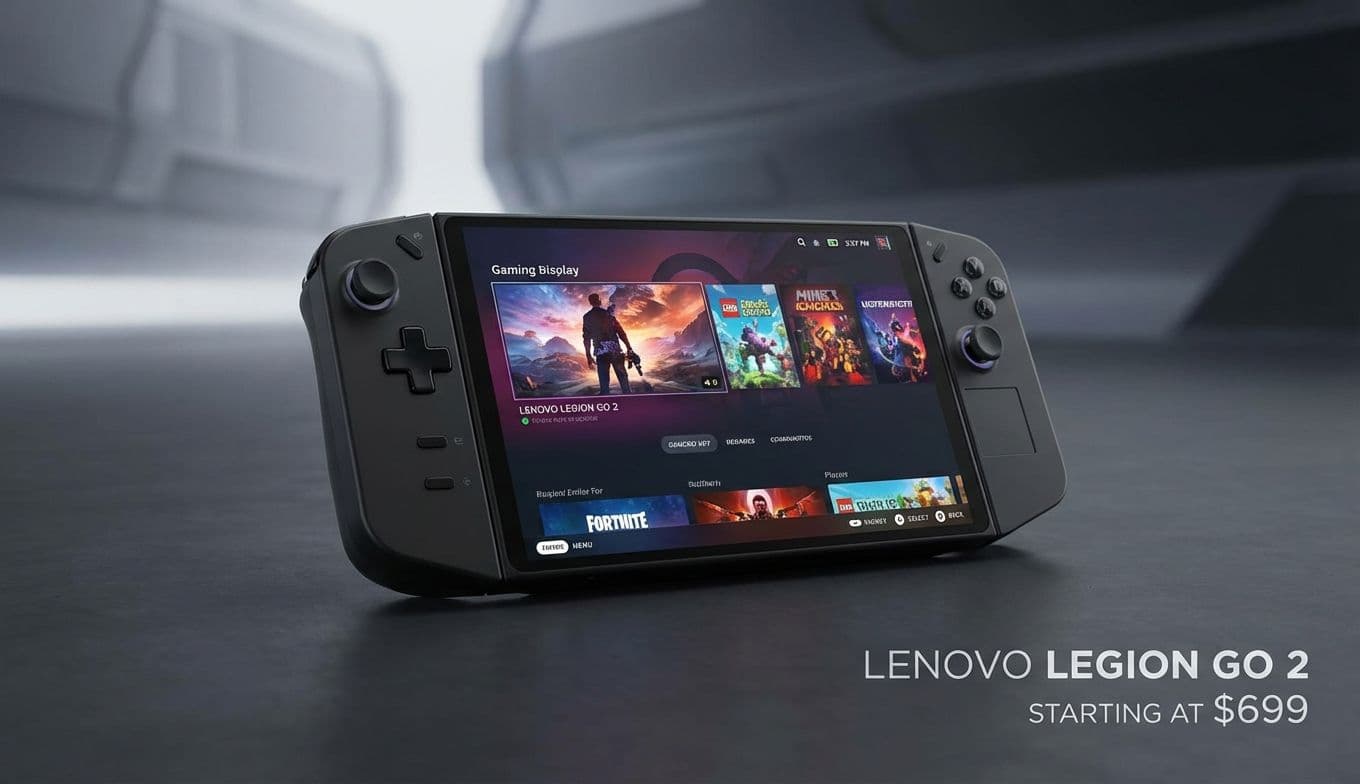
Lenovo Legion Go 2 Price Hike: Why It Costs $1,999 Now
Team GimmieThe Two Thousand Dollar Handheld: Why the Lenovo Legion Go 2 Just Became a Luxury Gamble
Imagine waking up to find that the gadget you’ve been eyeing for months suddenly costs $650 more than it did last week. It’s not a typo, and it’s not a dream. The Lenovo Legion Go 2, which launched with a premium but justifiable price tag, has officially crossed into the realm of the absurd. The Z2 Extreme model is now being listed at a staggering $1,999.
Let that number sit with you for a moment. For two thousand dollars, you aren't just buying a handheld gaming PC; you are paying for the equivalent of a top-tier desktop rig, a high-end MacBook Pro, or even a decent used car. This isn't just a minor price adjustment due to inflation. This is a massive market shift that effectively kills the Legion Go 2 as a recommendation for 99 percent of gamers. If you were planning on picking this up as a gift or a personal treat this season, it’s time to hit the brakes and look at what’s actually happening under the hood.
The Truth Behind RAMageddon
You might have heard the term RAMageddon whispered in tech forums lately. It sounds like a bad sci-fi movie title, but for the hardware industry, it’s a very real nightmare. We are currently in the middle of a global supply chain crisis specifically targeting high-speed, low-power memory (RAM).
The specialized memory chips required to make a handheld like the Legion Go 2 run smoothly—the kind that can handle desktop-level graphics while sipping battery—are in critically short supply. When the supply of these components drops, the price for manufacturers like Lenovo sky-boots. While some companies are eating the cost to keep customers happy, Lenovo has chosen to pass that massive bill directly to you. This explains the jump from $1,349 to $1,999 for the Extreme model, but knowing the "why" doesn't make the "how much" any easier to stomach.
Who Is This Device Even For Now?
At its original price point, the Legion Go 2 was a premium alternative to the Steam Deck. At $1,999, it is a boutique luxury item for a very specific, very small group of people.
We have to be honest: the average person looking to play Hades 2 or Elden Ring on the train should not buy this. However, there is a tiny niche of users where this price hike might not be a dealbreaker. If you are a professional who travels constantly and needs a device that doubles as a legitimate workstation, the Legion Go 2 has one trick the others don't: Mouse Mode.

By detaching the right controller and placing it in a magnetic dock, it transforms into a vertical ergonomic mouse. For FPS enthusiasts who demand precision or creative professionals who need a mouse for editing on a plane, this is a killer feature. But let’s be clear: you are now paying a $1,000 premium for that convenience compared to other devices on the market. Unless your job specifically requires a mouse-integrated handheld, the value proposition has evaporated.
Better Ways to Spend Your Gaming Budget
If you have two thousand dollars burning a hole in your pocket, there are significantly better ways to spend it. If you have one thousand dollars, you can still get a world-class gaming experience. Here is how the landscape looks right now for the savvy shopper:
The Xbox Ally X: The Current King of Value At $999, the Ally X features the same AMD Z2 chip found in the mid-tier Legion Go 2. It offers better battery life, a more comfortable handheld grip, and a seamless Windows 11 experience for half the price of the Lenovo flagship. It lacks the detachable controllers, but for $1,000 in savings, you can buy a very nice dedicated mouse and still have money left for a whole library of games.
The Steam Deck OLED: The Gold Standard If you don’t strictly need Windows for specific productivity apps, the Steam Deck OLED remains the best overall experience in handheld gaming. The screen is gorgeous, the software is purpose-built for the hardware, and it starts at a fraction of the Legion’s new price. It is the most "console-like" experience you can get, and it’s still the one we recommend for most people.
The Pro-Tip: Go Gen 1 or Go Refurbished If you are absolutely dead-set on the Lenovo ecosystem because you love the massive 8.8-inch screen and the detachable controllers, do not buy the Go 2. Instead, look for the original Lenovo Legion Go. Many retailers are clearing out Gen 1 stock, and the refurbished market is flooded with units in excellent condition for under $500. You get 90 percent of the experience for 25 percent of the price. In this economy, that’s the only move that makes sense.
Final Thoughts for Consumers
The tech world moves fast, and prices usually go down over time, not up. The Lenovo Legion Go 2 is a victim of a volatile market, but as a consumer, you shouldn't have to be the one to pay for it.
Until the "RAMageddon" shortages level out and component prices stabilize, the Legion Go 2 has priced itself out of the conversation for mainstream gamers. It is an impressive piece of engineering, but no handheld is worth two thousand dollars when the competition is providing nearly identical performance for half the cost. Our advice is simple: hold onto your wallet, look at the Ally X or a refurbished Gen 1 unit, and let the enthusiasts with deep pockets handle the sticker shock. You’ll have just as much fun playing your games, and you’ll have an extra thousand dollars in the bank.