Lego Smart Bricks Review: Are the Interactive Sets Worth It?

Lego Smart Bricks Review: Are the Interactive Sets Worth It?

Team GimmieTeam Gimmie
Published on March 11, 2026

THE SMART BRICK REVOLUTION: TESTING LEGO’S NEW INTERACTIVE SETS WITH MY KIDS

I was about to be the coolest dad in the history of Tuesday afternoon. I had the magic words prepared, the kind that make any elementary schooler’s eyes go wide: I’m picking you up from school early because we need to test the new Lego Smart Bricks.

It worked. My kids didn't just walk to the car; they practically floated. But behind my "Cool Dad" exterior, I held a healthy dose of professional skepticism. When the Lego Group announced in January that a tiny, programmable computer brick would be the company’s most significant evolution in nearly 50 years, my first thought was: Really? We’re adding batteries and Bluetooth to the world’s most perfect toy? My initial fear was that we’d be paying a premium for bricks that make "pew-pew" sounds that kids are perfectly capable of making with their own mouths.

However, after a week of building the new Star Wars Throne Room and the motorized X-Wing sets, I’ve realized I was looking at this all wrong. These aren’t just toys with sound effects; they are a gateway to a new kind of creative logic.

WHERE BUILDING MEETS THE DIGITAL BRAIN

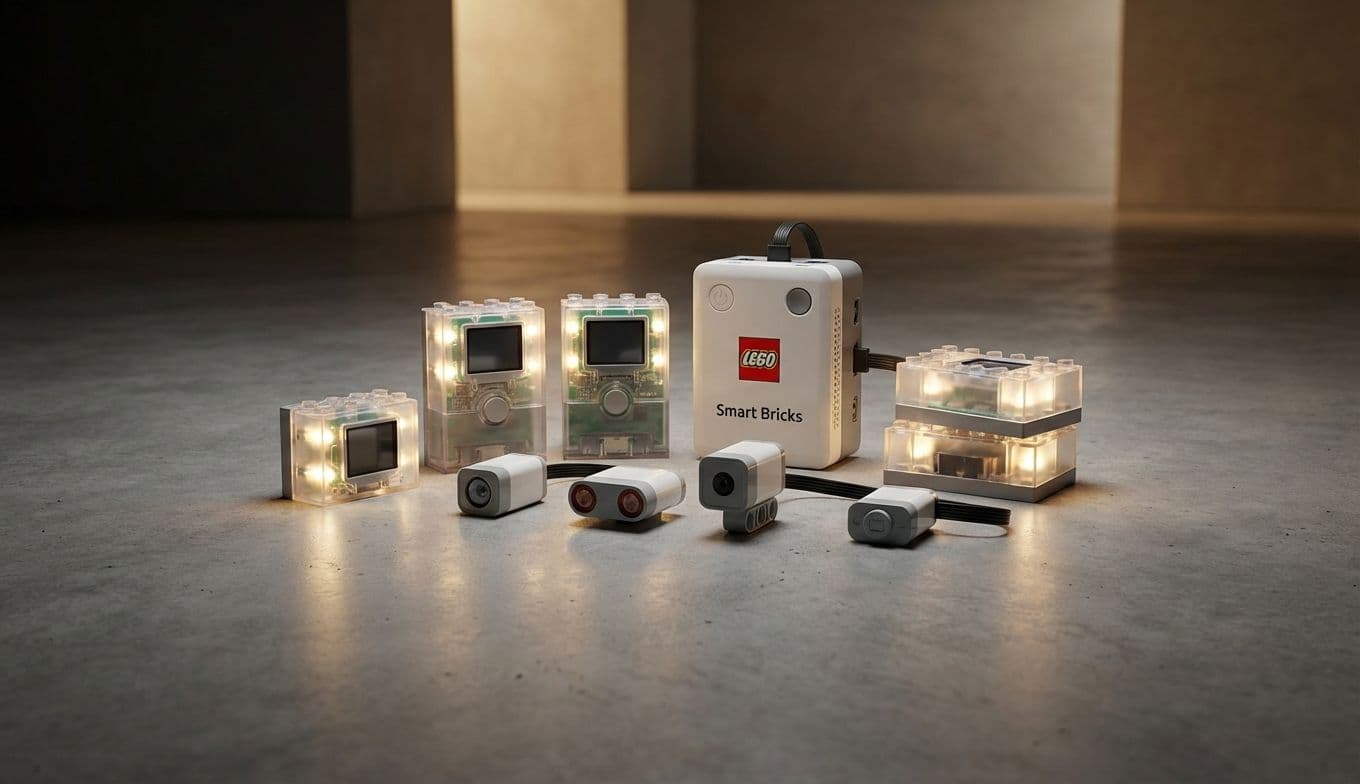
The heart of this new system is the Smart Brick—a compact, studded hub that acts as the "brain" for your creations. Unlike the static sets of our childhood, these bricks allow for active, dynamic interaction. You aren't just building a model to sit on a shelf; you’re building a machine that can perceive its environment.

We started with the new Star Wars X-Wing. On the surface, it looks like the classic silhouette we all know. But tucked inside the fuselage is the Smart Brick, connected to a small motor and a motion sensor. Using the accompanying app, my ten-year-old didn’t just follow building instructions; he started experimenting with logic.

He spent twenty minutes hunched over a tablet, dragging and dropping visual code blocks. He created a sequence where, if the motion sensor detected his hand passing over the cockpit, the motor would engage to open the S-foils into attack position while playing the iconic roar of a T-65 engine. Watching his face light up when the physical plastic responded to his digital command was the moment my skepticism evaporated. It wasn't about the screen; the screen was simply the remote control for his imagination.

A TOOL FOR EVERY AGE: FROM PLAY TO ROBOTICS

One of the most impressive aspects of the Smart Brick system is how it scales with the builder. It’s rare to find a product that genuinely appeals to a seven-year-old and a forty-year-old hobbyist simultaneously, but Lego has found the sweet spot here.

For the younger crowd—the 6 to 8-year-olds—the value is in the immediate cause-and-effect. They can build the Star Wars Throne Room and program a simple sensor to make the lights flicker red when a "Sith" figure approaches the chair. It’s a gentle, intuitive introduction to the world of sensors and automation.

For the older kids, specifically the 9 to 12-plus demographic, the complexity ramps up significantly. They can delve into conditional logic—the "if this, then that" scenarios that form the backbone of all computer science. They are troubleshooting. They are wondering why the motor didn’t fire (usually because they forgot to loop the command) and fixing it. This is problem-solving disguised as play.

Then there is the AFOL (Adult Fan of Lego) community. This is where the Smart Brick evolves from a toy into a legitimate tool. Because these bricks are compatible with the entire Technic ecosystem, adults are already using them to power complex robotics. Imagine a custom-built crane that can actually weigh the load it’s lifting, or a cityscape where the streetlights turn on automatically when the room lights go dim. The Smart Brick provides a relatively affordable, user-friendly entry point into the world of mechanical engineering.

THE COST OF INNOVATION: A REALITY CHECK

As much as I’ve enjoyed being the "Lego Dad," I have to be honest about the hurdles. The most significant barrier is the investment. These sets are not impulse buys. Most kits featuring the Smart Brick technology start around $200 and can easily climb to $400 for the more complex Star Wars collector sets. While you are getting a sophisticated computer for that price, it’s a commitment that requires a conversation about the family budget.

There is also the inevitable discussion about screen time. To program the bricks, your child needs a tablet or a smartphone. If your goal is to get your kids entirely away from digital devices, this might feel like a half-measure. However, I’d argue there is a fundamental difference between "passive" screen time (scrolling through videos) and "active" screen time (coding a robot). In our house, the tablet felt like a tool—a digital screwdriver—rather than a distraction.

Finally, while the block-based coding is intuitive, there is still a learning curve. Your kids might need your help for the first hour or two to understand how to sync the Bluetooth and how to "stack" commands properly. It’s a shared activity, which is a pro for some and a con for parents who just want twenty minutes of quiet.

THE FINAL VERDICT: MORE THAN JUST A GIMMICK

So, is the Smart Brick the evolution Lego promised? After watching my kids turn a pile of plastic into a responsive, "living" Star Wars diorama, I’m inclined to say yes.

This isn't just about adding tech for the sake of tech. It’s about giving kids (and adults) a new set of verbs. Instead of just "building," they are now "programming," "automating," and "engineering." They are learning the language of the future through the most iconic toy of the past.

If you’re looking for a gift that will be played with long after the initial build is finished, the Smart Brick sets are a stellar choice. Whether it’s the thrill of the Star Wars X-Wing or the intricate logic of a custom robotic build, these bricks offer a depth of engagement that standard sets simply can’t match. It might be a significant investment, but for the curious mind, it’s an investment that pays off in every "aha!" moment.

And yes, being the dad who picks them up early for "Lego duty" definitely doesn't hurt your reputation, either.