Lego Smart Brick 2026: Secret Measuring Feature Revealed
Team Gimmie
1/10/2026

The Secret Weapon for Serious Builders: Why Lego’s Smart Brick Is a Game Changer
It isn’t every day that a toy company manages to steal the show at CES, but that is exactly what happened this year in Las Vegas. While the floor was crowded with the usual suspects—curved monitors, AI-powered appliances, and electric vehicles—the Lego Group walked away with a Best In Show award for its new Smart Brick. At first glance, the hype seemed centered on the typical tech upgrades: better motors, faster connectivity, and smoother integration with the Lego Control+ app.
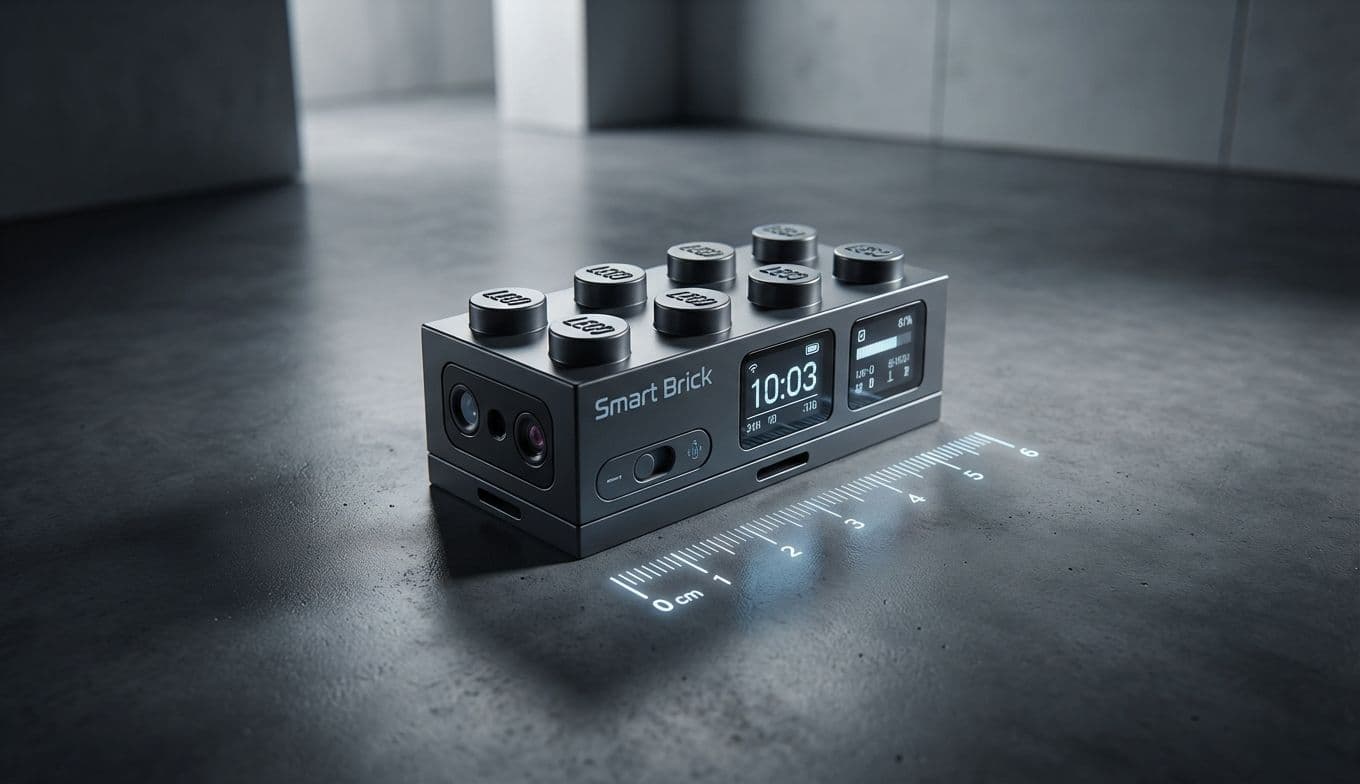
However, tucked away in a private suite, Lego design manager Maarten Simons revealed a feature that hasn't made it into the flashy marketing trailers yet. It’s a feature that will likely matter more to serious builders than any programmable light show or sound effect. The Smart Brick can measure distance with startling precision. This isn’t just a gimmick for kids; it is the "secret weapon" that adult fans of Lego (AFOLs) have been waiting for. It effectively turns the entire Lego system into a digital micrometer.
Understanding the Smart Brick Ecosystem
To appreciate why a measuring tool is such a big deal, we first need to look at what the Smart Brick actually is. For the uninitiated, this isn't just a heavy plastic block. It is the next evolution of the Powered Up system—a centralized hub that contains a microprocessor, Bluetooth connectivity, and internal sensors. Think of it as the "brain" of a build.
Historically, these hubs were used to make things move. You plugged in a motor, connected your phone, and drove your Technic crane around the living room. The 2026 Smart Brick changes the paradigm. By incorporating sophisticated internal encoders and proximity sensors, it doesn't just push power to other parts; it understands its own position in space. This transition from a simple power source to an intelligent sensor hub is what allows for the most practical tool Lego has ever produced: the Lego Ruler.
The Lego Ruler: Precision in Every Stud
The demonstration that caught my attention was deceptively simple. Simons didn't use a specialized, one-off piece of hardware. Instead, he built a "ruler" out of standard, off-the-shelf Lego bricks. He divided it into segments of 10 studs each, which equals roughly 8 centimeters or 3.15 inches. By attaching one Smart Brick to the base and sliding a second Smart Brick along the track, he could get a real-time, digital readout of the exact distance traveled.

For a casual builder, this might seem like overkill. But for anyone who has spent forty hours on a custom scale model, it is a revelation. The Smart Brick uses its internal sensors to track movement along the studs with sub-millimeter accuracy. Because Lego is a modular system with fixed dimensions, the brick "knows" exactly where it is relative to the starting point. It bridges the gap between the creative chaos of building and the rigid requirements of engineering.
The New Power Users: Three Builder Personas
This feature isn't for everyone, and Lego knows it. The Smart Brick is being positioned as a premium tool for specific types of creators. If you are trying to decide if this belongs on a birthday wishlist or in a professional studio, consider these three personas:
The Scale Model Architect This is the AFOL who builds custom skyscrapers, historical landmarks, or massive cityscapes (MOCs). In the past, ensuring a 1:50 scale meant tedious manual calculations and constant double-checking with a physical tape measure that didn't quite fit between the plastic towers. With the Smart Brick, the build becomes its own measuring device. You can verify the wingspan of a Boeing 747 replica or the height of a modular tower in seconds, ensuring every stud aligns with real-world proportions.
The STEM Student and Educator In the classroom, the Smart Brick is a dream for physics and geometry lessons. Instead of abstractly talking about distance and velocity, students can build a vehicle, program it to travel a specific distance, and use the brick to verify the results. It turns a "toy" into a piece of lab equipment that can teach the fundamentals of robotics and spatial awareness in a tactile way.
The Precision Technic Engineer If you’ve ever built a complex Technic gearbox or a functional suspension system, you know that tolerances matter. The Smart Brick allows engineers to test the range of motion in their mechanical creations. Want to know exactly how far a piston travels or how much a bridge span deflects under weight? The measuring feature provides the data necessary to refine those designs.
The Gifting Reality: Price, Release, and Hurdles
If you’re already reaching for your wallet, there are a few practicalities to keep in mind. Lego has not officially announced a retail price, but industry insiders at CES suggest the Smart Brick will likely debut in a "Starter Kit" priced between $150 and $200. This isn't a stocking stuffer; it’s a centerpiece gift for a serious hobbyist.
Rumors point toward a Fall 2026 release, just in time for the holiday season. However, there is a technical barrier to entry. This is not a standalone "plug-and-play" device in the traditional sense. To utilize the distance measuring features, users will need a relatively modern smartphone or tablet capable of running the latest version of the Control+ app. For a grandparent buying for a grandchild, it is worth checking that the recipient has the hardware to actually "drive" the brick.
Furthermore, while the "Lego Ruler" is incredibly precise, it relies on the user building a stable track for it to slide on. It doesn't magically measure the distance to a wall across the room; it measures distance along the bricks. This requires a level of building sophistication that might frustrate younger children but will feel like second nature to the AFOL community.
The Bottom Line: A Tool Disguised as a Toy
For years, the "Smart" in Smart Bricks mostly referred to the ability to remote control a car. By adding precise measurement into the mix, Lego has moved into the realm of functional design. They are acknowledging that their fans aren't just playing; they are prototyping, engineering, and creating.
The Smart Brick represents a shift in how we interact with the system. It’s no longer just about what you can build; it’s about what the build can tell you. For the designer who needs perfection, the student who needs data, or the hobbyist who just wants their custom car to fit on the shelf, this "semi-secret" feature is the most compelling reason to upgrade to the next generation of Lego tech. Keep an eye on the official Lego Shop as we get closer to the end of the year—this is the one release that serious builders won’t want to miss.