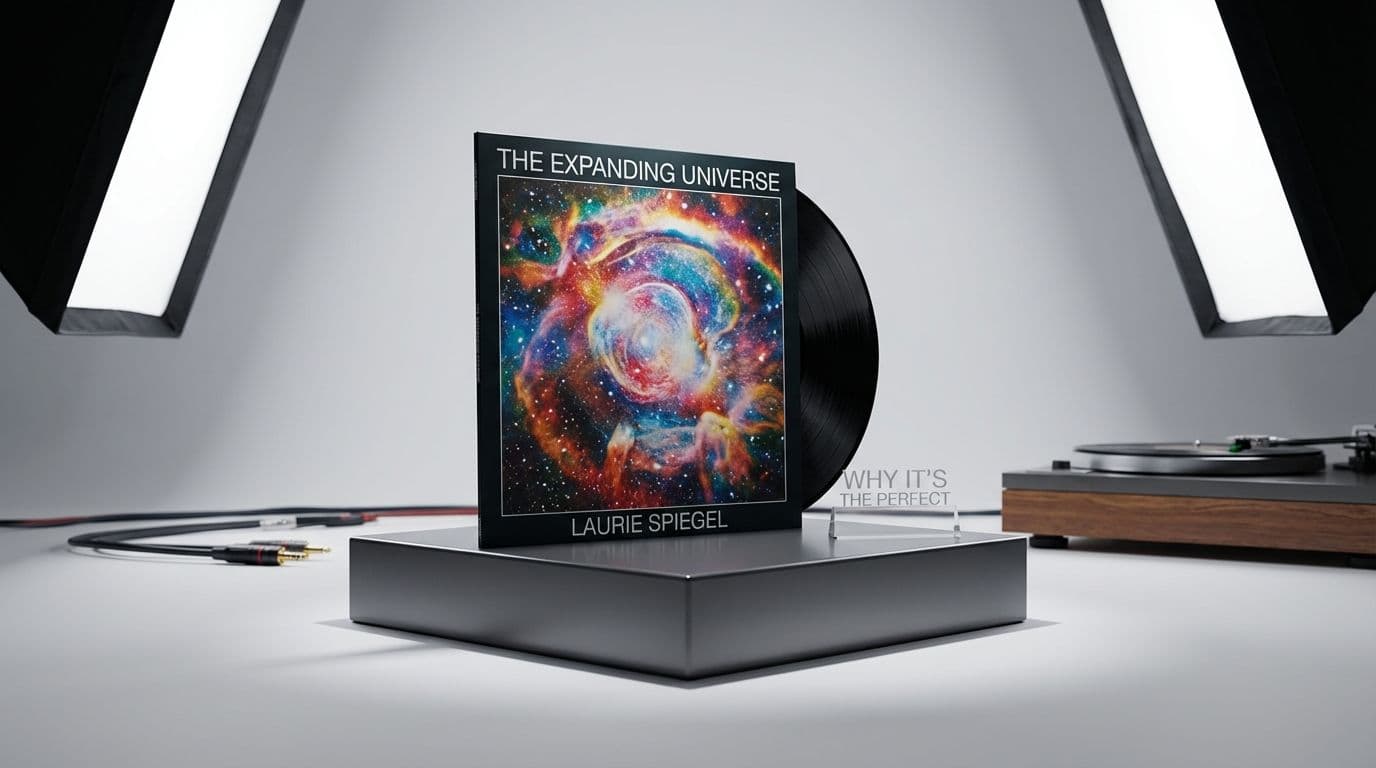
Laurie Spiegel The Expanding Universe Review: An Ambient Masterpiece
Team GimmieREDISCOVERING THE ALGORITHM: WHY LAURIE SPIEGEL STILL MATTERS
While preparing for a recent interview with Laurie Spiegel, I found myself tethered to my desk, headphones clamped tight, losing track of time inside her 1980 landmark, The Expanding Universe. It is a rare experience to sit with a record that is over four decades old and realize it feels more technologically prophetic than half the electronic music currently topping the charts.
As I sifted through my interview notes and revisited her discography, I realized that Spiegel’s work is not just a collection of songs. It is the result of a pioneer wrestling with the very idea of how humans and machines communicate. For any auditory explorer or tech historian, this album is less of a vintage relic and more of a primary source for the digital world we now inhabit. Re-listening to it through the lens of my conversation with her changed how I view the entire genre of ambient music. It is not just about relaxation; it is about the elegant intersection of mathematics and emotion.
BEYOND THE SYNTH: THE TECHNICAL SOUL OF THE EXPANDING UNIVERSE
To understand why The Expanding Universe is a necessary gift for the modern music lover, you have to look past the generic labels of electronic or ambient. Spiegel’s approach in the late 1970s was deeply rooted in her work at Bell Labs, where she utilized the GROOVE system—an acronym for Generated Real-time Output Operations on Voltage-controlled Equipment.
Unlike the plug-and-play digital workstations of today, Spiegel was essentially a composer-programmer. She wrote the code that defined the logic of the music, allowing the computer to generate variations while she manipulated the parameters in real-time. This algorithmic composition is what gives tracks like Patchwork and A Folk Study their distinctive character. They feature bouncy, recursive arpeggios that might remind a casual listener of the synth textures in The Who’s Baba O’Riley, but the complexity here is far more granular. These pieces aren't just looping; they are evolving according to mathematical rules that Spiegel set in motion.
In contrast, longer works like Old Wave and East River Dawn move away from rhythmic precision and into a state of suspension. This is where Spiegel laid the groundwork for what we now call ambient music. By stripping away traditional song structures, she created a space where sound could simply exist. It is a remarkable feat of engineering and artistry that managed to make a massive, room-filling computer sound intimate, human, and deeply contemplative.

THE GIFT OF DEEP FOCUS: WHO SHOULD OWN THIS?
When you give someone a copy of The Expanding Universe, you aren't just giving them background noise. You are giving them a tool for focus and a piece of history. Because this album avoids the predictable peaks and valleys of pop music, it has become a staple for those who need a specific kind of environment to do their best work.
The Tech Historian and Coder: For the friend who lives in a terminal window or collects vintage hardware, this is the ultimate tribute. It represents a time when making music meant understanding signal flow and logic gates. It is the sound of the future as imagined from a 1970s laboratory.
The Deep Listener: If you know someone who treats music as a ritual—someone who sits in a darkened room just to listen—they will find endless details here. The 2018 reissue from the Unseen Worlds label is the definitive version to get, as it expands the original four tracks into a massive, three-record set that fills in the gaps of Spiegel's most productive years.
The Creative Professional: Writers, designers, and architects often struggle with music that has lyrics or aggressive melodies that compete for brain space. Spiegel’s work provides a steady, stimulating pulse that fosters a flow state. It occupies the room without demanding the listener’s constant attention, yet it rewards a close ear with its subtle shifts in texture.
HOW TO BUY AND WHAT TO PAIR IT WITH
If you are looking to purchase this as a gift, skip the major corporate retailers and head straight to Bandcamp. Buying from the Unseen Worlds Bandcamp page is the best way to support the label and the artist directly. You can find the deluxe vinyl edition there, which is a beautiful physical object, or high-quality digital files that include extensive liner notes. These notes are crucial—they offer a look at the technical diagrams and the philosophy behind the GROOVE system that adds a whole new layer to the listening experience.
To turn a digital or vinyl recommendation into a truly tangible gift, consider pairing the album with a high-quality piece of hardware. I recommend a pair of Grado SR80x headphones. These are open-back headphones, which means they don't seal the sound inside a plastic cup. Instead, they allow the music to breathe, creating a wider, more natural soundstage.
For an album titled The Expanding Universe, the open-back design of the Grados is a perfect match. It allows Spiegel’s intricate layers to feel as though they are floating in the space around you, rather than being pumped directly into your skull. It’s a combination that honors the clarity and the "openness" of her original recordings.
A LEGACY THAT CONTINUES TO GROW
In the world of product reviews and music criticism, we often use the word timeless as a shorthand for "still sounds good." But for Laurie Spiegel, the term feels literal. Her work remains relevant because she wasn't chasing a trend; she was exploring the fundamental relationship between human intent and machine logic.
The Expanding Universe is a reminder that technology doesn't have to be cold or alienating. In the right hands, it can be a tool for profound beauty. Whether you are buying this for a lifelong fan of electronic music or a newcomer looking for a way to stay focused in a distracted world, you are providing them with a masterpiece of American innovation. It is a sonic gift that offers something new every time you press play, proving that the universe Spiegel built decades ago is still expanding.