Kobo Bluetooth Remote Review: The Ultimate Hands-Free Page Turner?

Kobo Bluetooth Remote Review: The Ultimate Hands-Free Page Turner?

Team GimmieTeam Gimmie
Published on March 4, 2026

The Ultimate Cozy Reading Hack: Why the Kobo Remote is Worth the Hype

It is 11:30 PM on a Tuesday in the dead of winter. You are perfectly cocooned in three layers of blankets, your pillows are at the precise angle of maximum support, and you have reached the climax of a psychological thriller. There is just one problem: it is freezing outside that duvet. Every time you need to turn the page, you have to stick an arm out into the arctic air, breaking the seal of your warm sanctuary.

It sounds like a minor inconvenience—a "first-world problem" in its purest form—but for the dedicated reader, these small disruptions matter. This is exactly where the Kobo Remote enters the chat. At $30, this tiny Bluetooth clicker isn't just an accessory; it is a lifestyle upgrade for anyone who takes their "cozy reading" seriously. After months of it being sold out, I finally lived the dream of hands-free reading, and it turns out that being a little indulgent is actually quite practical.

The Compatibility Checklist: Will It Work for You?

Before you rush to the checkout, you need to know if your specific e-reader can actually talk to this remote. Unlike universal accessories, the Kobo Remote relies on the device’s internal Bluetooth stack. If your Kobo supports Bluetooth audiobooks, you are likely in the clear.

The remote is officially compatible with:

  • Kobo Libra Colour
  • Kobo Libra 2
  • Kobo Sage
  • Kobo Elipsa 2E
  • Kobo Clara Colour
  • Kobo Clara BW

If you are rocking an older Clara HD or the original Elipsa, you’ll have to keep using your thumbs the old-fashioned way. But for owners of the newer lineup, this is a seamless "native" addition to your ecosystem.

Native Bluetooth vs. The Mechanical Tappers

You might have seen third-party page turners on social media—those clunky gadgets that look like a binder clip with a plastic finger attached. For a long time, those were the only option. They work by physically "tapping" the screen using a mechanical arm or an electromagnetic pulse. They are, frankly, a bit of a headache. They obscure the text, they require their own separate charging cables, and they can be finicky to align.

The Kobo Remote is a different beast entirely. Because it pairs via Bluetooth, there is nothing clipping onto your screen or blocking your view. It sends a digital command directly to the software. It’s cleaner, faster, and much more elegant. You don't have to worry about a plastic clip scratching your screen or the "ghost finger" failing to register a tap. It just works, allowing the hardware to fade into the background so you can focus on the story.

Small Stature, Big Battery Decisions

When you first unbox the remote, you’ll notice it’s surprisingly small—roughly the size of a pack of gum. It’s light enough to hold for hours without fatigue, but Kobo was smart enough to include a wrist lanyard. This isn't just for aesthetics; if you’re the type of reader who frequently nods off mid-chapter, that lanyard ensures the remote stays with you rather than vanishing into the dark abyss between the mattress and the wall.

One design choice that will spark debate is the power source: a single AAA battery. In an era where everything from your toothbrush to your toaster is rechargeable via USB-C, a disposable battery feels a bit retro. However, there is a clear "pro" here: longevity. Kobo claims a single AAA will last for months of daily reading. You don’t have to worry about the remote dying at 2 AM and needing a charge; you just swap the battery and you’re back in action for another half-year. The "con," of course, is the lack of a built-in rechargeable cell, which feels like a missed opportunity to keep things eco-friendly and consistent with Kobo’s USB-C e-readers.

Tactile Simplicity and Missed Opportunities

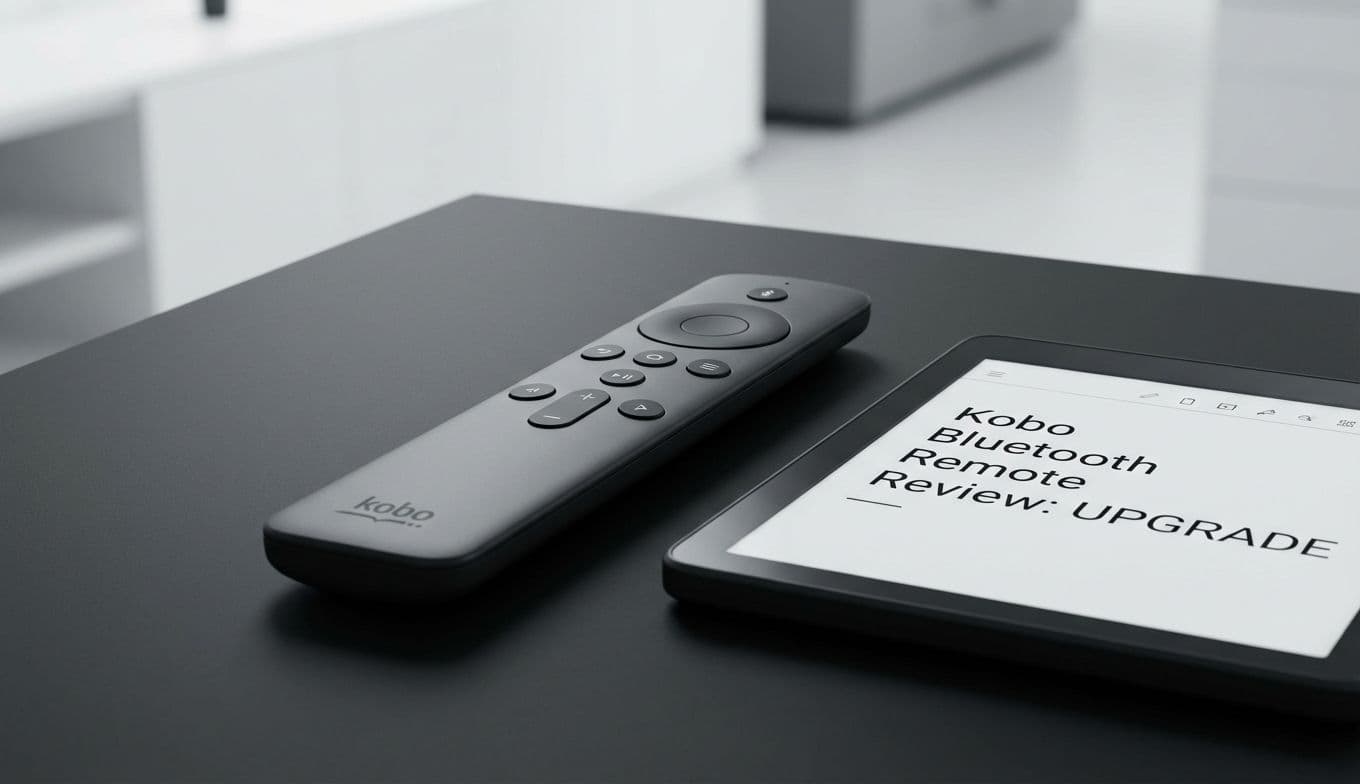
The remote features two primary buttons: a large one for forward and a smaller one for back. Kobo did a great job with the tactile design here. The forward button is concave (curved inward), while the back button is convex (curved outward). This means you can navigate your book entirely by feel without ever looking down at your hand. The click is satisfying and responsive, with almost zero lag between the press and the page turn.

That said, the software side could use a little more ambition. Currently, the buttons are fixed to page-turning. You can’t customize a long-press to adjust the front-light brightness or change font sizes—two things readers do constantly. If you’re an audiobook listener, the limitations are even more apparent. While you can skip forward or back by 30 seconds, you can’t pause the book or adjust the volume from the remote. For a $30 device, a bit more programmable flexibility would have turned this from a "great" gadget into an "essential" one.

Beyond the Bed: The Remote in the Wild

While the "duvet cocoon" is the primary use case, I found the remote surprisingly useful in other scenarios. If you like to read while walking on a treadmill, the remote is a game-changer. Propping your Kobo on the console and holding the remote in your hand is much safer and more comfortable than trying to poke at a moving screen while maintaining your stride.

It’s also a hidden gem for accessibility. For readers with limited hand mobility or conditions like arthritis, the ability to turn pages with a light click rather than a broad swiping motion on a screen can make a world of difference. It’s also the perfect companion for the "side-sleeper" reader. You can prop the e-reader up on a stand on your nightstand, tuck both hands under your pillow, and keep the story moving without moving a muscle.

An Indulgence That Earns Its Keep

Is the Kobo Remote a strictly "necessary" purchase? Of course not. Humans have been turning pages with their fingers for centuries. But this gadget isn't trying to solve a problem that’s broken; it’s trying to optimize an experience for maximum comfort.

It is a specialized tool for a specific kind of person: the reader who views their reading time as a sacred, high-comfort ritual. If you frequently find yourself propping your e-reader up on stands, reading in cold environments, or just wanting a more ergonomic way to consume your library, the Kobo Remote is a stellar investment. It delivers on the promise of effortless convenience, making the act of reading just a little more magical—and a lot more cozy.