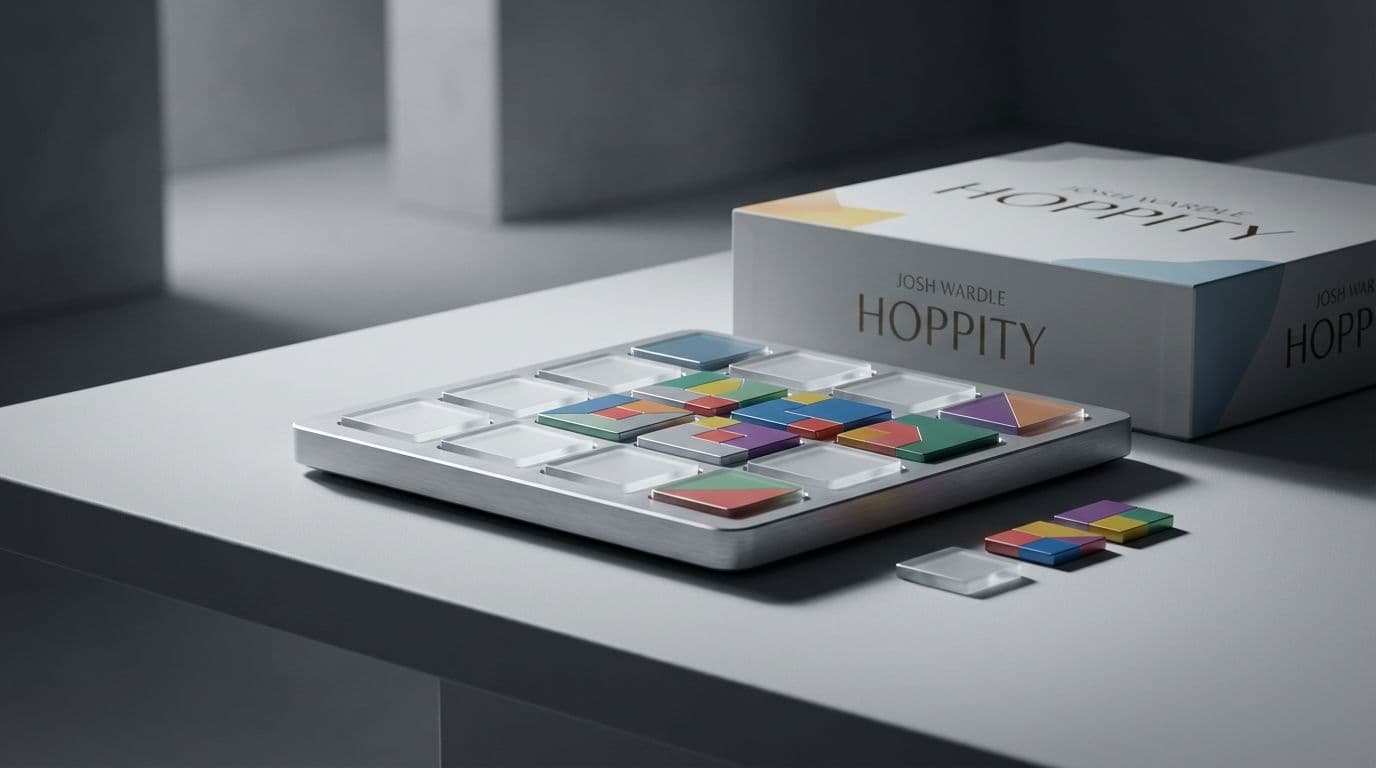
Josh Wardle's Hoppity: The Ultimate Logic Puzzle Game Review
Team GimmieThe Satisfying Snap of Logic: Why Josh Wardle’s Hoppity is the Digital Palette Cleanser We Need
There is a specific, quiet satisfaction in watching a chaotic grid of colored dots snap into a perfect, symmetrical pattern. It is the digital equivalent of a physical click—the feeling of a puzzle piece finally finding its home. This tactile feedback is at the heart of Hoppity, the latest release from Josh Wardle. If that name sounds familiar, it should. Wardle is the creator of Wordle, the daily word game that became a global ritual before being acquired by The New York Times.
But where Wordle was about the mastery of language and the thrill of the social share, Hoppity is something more introspective. It doesn't demand you shout your score to the world. Instead, it invites you into a focused, logic-driven flow state. It is a game of spatial reasoning, asking you to move dots across a grid to match specific templates. It starts with the simplicity of a child’s toy and gradually evolves into a complex mental knot that requires your full, undivided attention.
Quick Specs: Hoppity
Price: Free Platform: Web Browser (Mobile and Desktop) Play Time: 5 to 15 minutes per session Difficulty: Scales from "Toddler Logic" to "Mensas Candidate" Monetization: Zero (No ads, no data tracking, no subscriptions)
The Rise of Slow Tech and Digital Wellness
In 2026, our relationship with technology has shifted. We have moved past the era of the "infinite scroll" and the dopamine-chasing mechanics of early social gaming. We are now firmly in the age of Slow Tech—a movement that prioritizes intentionality, closed-loop experiences, and "single-tasking."
Hoppity is a masterclass in this philosophy. It doesn't use push notifications to drag you back. It doesn't have a "battle pass" or daily login rewards. It exists only when you want it to. In a world where our attention is the most valuable commodity, a game that doesn't try to steal it feels revolutionary. Playing Hoppity for ten minutes between meetings or during a commute acts as a mental reset. It clears the static of a busy day by providing a problem that actually has a solution—something that is increasingly rare in our daily lives.

The Analog Logic Kit: A Gift Guide for the Puzzle Obsessed
If you find yourself refreshed by the clean lines and logical challenges of Hoppity, you’re likely craving that same tactile satisfaction in the physical world. For the gift-givers or the self-care enthusiasts, we’ve curated a "Puzzle Lover’s Starter Kit." These aren’t just generic boredom-busters; they are trend-forward, beautifully designed objects that bridge the gap between digital logic and physical touch.
Areaware Little Puzzle Things If Hoppity is a digital snack, these are the physical equivalent. These puzzles are small—usually about 70 pieces—and can be completed in twenty minutes. They feature hyper-realistic images of everyday objects (a piece of broccoli, a designer sneaker, a box of matches). Like Hoppity, they offer a quick "win" and a high-design aesthetic that looks great on a coffee table or a desk.
Educational Insights Kanoodle Pyramid Don’t let the bright colors fool you; this is a serious spatial reasoning tool. The Kanoodle Pyramid challenges you to fit 2D and 3D pieces into a specific footprint. It mirrors the escalating difficulty of Wardle’s game design perfectly. It’s portable, deeply satisfying to handle, and serves as the perfect "fidget toy" for someone who needs to keep their hands busy while their brain works through a problem.
The Hanayama Cast Puzzle Series For those who appreciate the minimalist aesthetic of Wardle’s work, the Hanayama series is the gold standard. These are intricate, palm-sized metal puzzles that look like modern sculpture. The goal is simple: take it apart and put it back together. There are no instructions, just like Hoppity. It’s pure, wordless logic. We recommend the "Cast Rotor" or "Cast Galaxy" for that same orbital, interconnected feel found in the game’s later levels.
Understanding the Wardle Formula
Why does Josh Wardle keep succeeding where giant gaming studios with billion-dollar budgets fail? It’s because he understands the value of friction. Most modern games try to remove every possible hurdle to keep you playing longer. They make things easier, they give you hints, and they reward you for just showing up.
Wardle does the opposite. Hoppity is stripped back to the bare essentials. There is no tutorial—you learn by doing. There is no "undo" button that solves the puzzle for you. You have to sit with the problem. This "intentional friction" is what makes the eventual solution feel so earned. It respects the player’s intelligence. It’s not just a game; it’s a vote of confidence in your ability to figure things out.
The Verdict: A Worthy Habit
Hoppity isn’t going to change the world. It’s not a cultural reset like Wordle was in 2022. But it is a testament to the power of doing one thing very, very well. It is a reminder that some of the best digital experiences are the ones that know when to end.
If you’re looking for a way to break the cycle of mindless scrolling, or if you’re searching for a thoughtful gift for the person who has everything but needs a little more peace of mind, Hoppity and its analog counterparts are the answer. It’s a small, elegant challenge that rewards you with the one thing we all need more of in 2026: a moment of quiet, focused clarity.
Go play it. Then, when you’re done, put your phone down and try to solve a Kanoodle. Your brain will thank you for the change of pace.