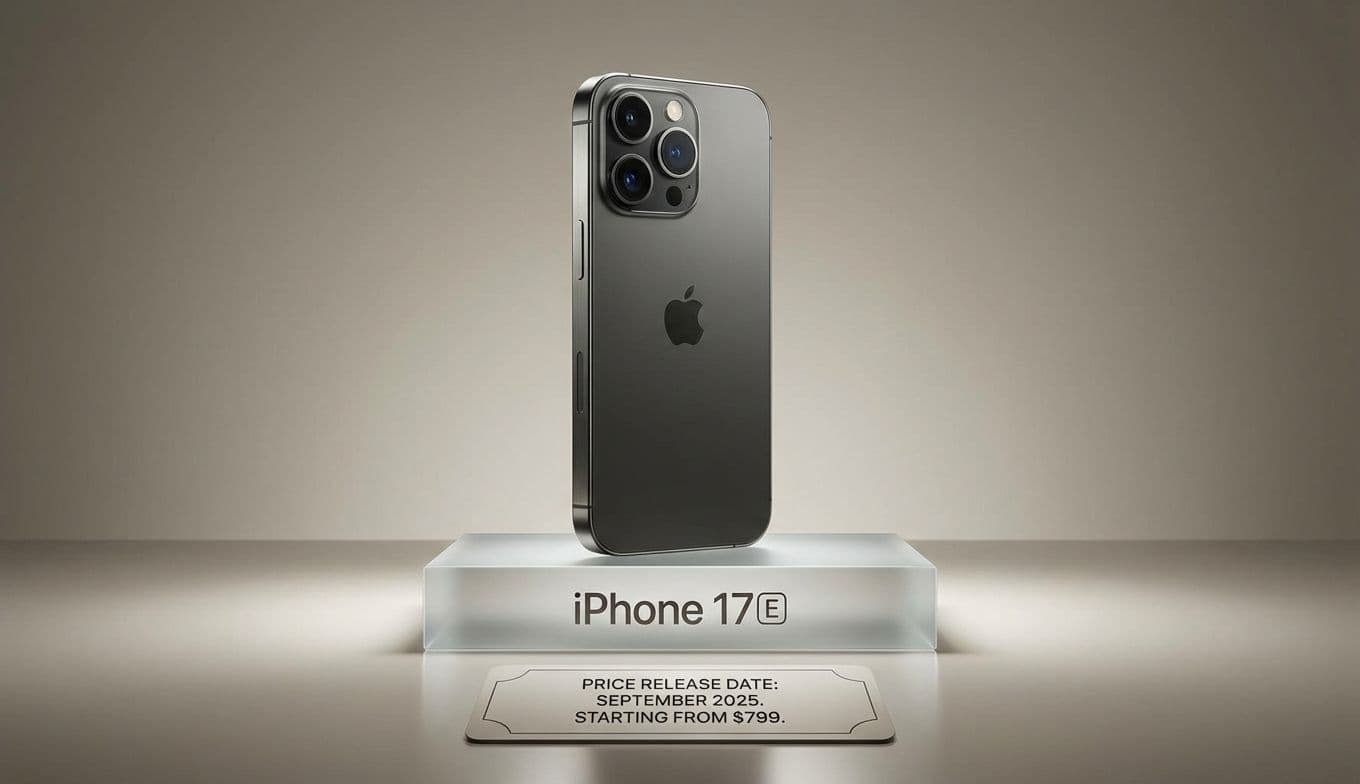
iPhone 17E: Release Date, Price, Specs & Google AI Features

iPhone 17E: Release Date, Price, Specs & Google AI Features

Team GimmieTeam Gimmie
Published on March 3, 2026

THE INTELLIGENCE EQUALIZER: APPLES BIG MOVE THIS WEEK

The tech world moves fast, but this week felt like a sprint. On the heels of the iOS 26 announcement, Apple just pulled the curtain back on the iPhone 17 lineup, and the biggest surprise isn't the ultra-thin iPhone Air or the powerhouse Pro Max. It’s the device that’s supposed to be the budget option: the iPhone 17E.

Announced just a few days ago, the iPhone 17E is set to hit shelves on Wednesday, March 11th, with pre-orders opening tomorrow, March 4th. At a starting price of $599, it’s positioned as the entry-level gateway into the Apple ecosystem. But there is a twist this year that changes the entire value proposition for anyone looking to buy a new phone or gift one this spring. According to a report from The Information, the secret behind the 17Es impressive performance isn't just silicon; it’s a massive behind-the-scenes partnership with Google.

It’s no secret that Apple has been racing to close the gap in the AI landscape. With iOS 26, Siri has finally evolved into the conversational assistant we were promised a decade ago. But processing those complex, natural-language requests requires staggering amounts of data-crunching power. To make sure even the $599 17E can keep up with the $1,199 Pro Max, Apple is reportedly leveraging Google’s server infrastructure to handle the heavy lifting. This collaboration represents a pragmatic shift for a company that usually insists on building everything in-house. For you, it means that the smartest version of Apple Intelligence is no longer a luxury reserved for those who pay four figures.

UNDER THE HOOD: WHY THE IPHONE 17E CHANGES THE MATH

As someone who has spent the last decade reviewing every iteration of the iPhone, I’ve grown used to the budget model being the one that gets the leftovers. Usually, the E or SE models get a two-year-old processor and a screen that feels like a time capsule.

The iPhone 17E breaks that cycle. For the first time, Apple has included the flagship A19 chip across the entire lineup. Whether you buy the 17E or the Pro Max, you’re getting the same cutting-edge Neural Engine. This is crucial because Apple Intelligence—the suite of AI features that now defines the user experience—runs on that chip. By giving the 17E the A19, Apple has ensured that this budget device won't feel obsolete by next year.

The specs for the $599 price point are surprisingly robust. You’re getting 256GB of base storage, which is double what we saw in previous entry-level models. It also finally supports MagSafe and Qi2 wireless charging at 15W. The 6.1-inch display is sharper and more durable than its predecessors, though this is where the trade-offs begin. The 17E sticks with a 60Hz refresh rate and a peak brightness of 1,200 nits. If you’re coming from a Pro model with a 120Hz ProMotion display, you’ll notice the lack of fluid scrolling immediately. But for a student or a first-time smartphone user, it’s a compromise that makes financial sense.

THE GOOGLE PARTNERSHIP: INFRASTRUCTURE MEETS PRIVACY

The most fascinating part of this 2026 launch is the deepening of the Apple-Google AI alliance. While Apple Intelligence runs many tasks on-device using the A19 chip, the more complex queries—like summarizing a fifty-page PDF or generating high-resolution images—often require the cloud.

By utilizing Googles massive server farms, Apple can roll out these features to millions of devices simultaneously without the bottleneck of building out its own global data centers overnight. This is why the iPhone 17E can offer the same Siri intelligence as the Pro models. The hardware is doing the local work, but the Google-powered backend provides the raw muscle for the heavy lifting.

Naturally, this raises questions about privacy. Apple has built its brand on being the anti-Google when it comes to data harvesting. To navigate this, they are using a revamped version of Private Cloud Compute. Essentially, your data is processed in a secure "black box" on those servers; Google provides the electricity and the processors, but they can’t see the data passing through. It’s a win-win: Apple gets the speed, and users (mostly) get to keep their privacy. It’s a pragmatic evolution that makes the 17E a genius-level device for half the price of a Pro.

NAVIGATING THE 2026 LINEUP: WHICH IPHONE IS THE RIGHT GIFT?

If you are looking at the current landscape for a gift—perhaps for a graduation or a spring birthday—the choice between the four models is clearer than it has been in years.

For the Value Hunter: The iPhone 17E. At $599, this is the best value Apple has offered in half a decade. It lacks the Dynamic Island and the dedicated Camera Control button found on the higher-end models, but it retains the 48-megapixel fusion camera. This sensor allows for 2x telephoto shots via clever cropping, meaning you aren’t totally sacrificing zoom capabilities. It is the perfect phone for someone who wants the full AI experience without the Pro price tag.

For the Style-Conscious: The iPhone Air. At $999, this is the ultra-thin model everyone is talking about. It shares the A19 chip and the 25W fast wireless charging of the Pro models, but its selling point is purely aesthetic. It’s remarkably light, though you do trade some battery life for that thinness compared to the Pro Max.

For the Creative Soul: The iPhone 17 Pro or Pro Max. Starting at $1,099, these remain the kings of mobile photography. While the 17E has a 12-megapixel selfie camera, the Pro models feature an 18-megapixel front-facing sensor and a dedicated ultrawide lens for macro photography. If the person you’re buying for is a budding filmmaker or a social media creator, the 120Hz display and the extra camera versatility are worth the extra $500.

THE BOTTOM LINE ON THE 17E

The arrival of the iPhone 17E on March 11th marks a turning point. We are moving away from a world where budget phones are defined by what they can’t do. Thanks to the A19 chip and the strategic use of Google’s AI infrastructure, the 17E is a fully capable participant in the AI revolution.

It isn't perfect—the 60Hz screen is a reminder of its price point, and the lack of a Camera Control button might frustrate some. However, by focusing on what matters most in 2026—intelligence, storage, and processing power—Apple has created a device that feels like a smart investment rather than a compromise.

When you’re picking out a gift this month, remember that the magic of the iPhone 17 lineup isn’t just in the hardware. It’s in the way Apple has finally opened the door for everyone to access a smarter, more intuitive digital life, even if they’re shopping on a budget. The iPhone 17E isn't just a cheaper phone; it’s the most accessible genius Apple has ever built.