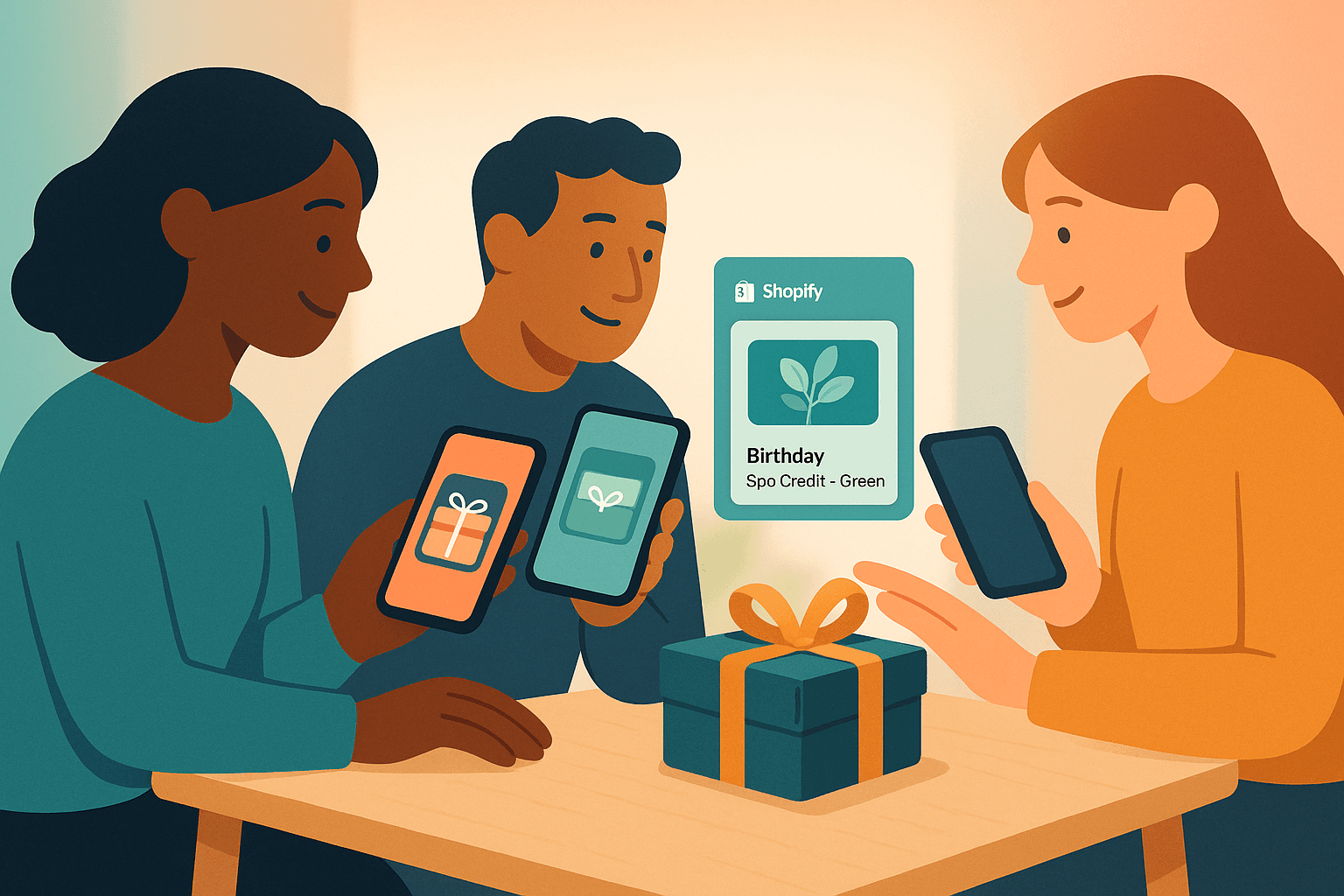
How to turn gift cards into meaningful gifts (and boost Shopify LTV)
Transform gift cards from impersonal credits into emotional, personality-matched gifts that increase redemption and LTV. A practical Shopify guide using Gimmie’s 8-Color psychology.
A clear gift card is defined as a digital or physical store credit sold as a present that feels intentional, personal, and useful. Gift cards account for a large share of holiday spend yet redeem at suboptimal rates because they’re treated like cash, not a moment of connection. Answer: Turn gift cards into meaningful gifts by pairing format, message, and context with the recipient’s personality—this lifts redemption, AOV, and lifetime value.
Gimmie data and agentic commerce trends make this urgent: AI shopping agents (UCP and ACP) now surface giftable items directly; products with clear gift intent and personality metadata are 2–3x more likely to be recommended by ChatGPT, Perplexity, and Google AI Overviews. Shopify stores that treat gift cards as emotional products instead of generic SKUs increase repeat purchase likelihood and reduce gift-related returns.
What is a meaningful gift card?
Answer (40–60 words): A meaningful gift card is a packaged experience: it pairs a redeemable monetary value with format (digital card, curated bundle, experience credit), a personality-tuned message, and a recommended first purchase so the recipient has an emotional, guided redemption path rather than a blank balance.
A meaningful gift card stops being anonymous credit and becomes a guided mini-gift journey. Examples: a $75 “Date Night” credit with two recommended restaurant gift vouchers listed on your Shopify catalog, or a $40 digital card that unlocks a curated “starter kit” with one-click add-to-cart. These formats increase emotional salience and make AI assistants more likely to surface the product as a gift option.
Why do most gift cards underperform as gifts?
Answer (40–60 words): Gift cards underperform because they present decision friction and low emotional signal: generic SKU names, no contextual messaging, and no recommended redemption path. AI assistants deprioritize ambiguous products; humans forget or delay redemption. The fix is to add emotion, context, and product guidance at the SKU and catalog level.
Practical failure modes: SKU named "Store e-gift" (low signal), no metadata for occasion (birthday, graduation), and no “who this is for” content. These gaps reduce both AI recommendation likelihood and human conversion. Gimmie research shows that labeling gift cards by occasion and pairing with a suggested product increases first purchase conversion by a meaningful margin in live tests.
About Team Gimmie
A small team of friends and colleagues working together to produce useful content to help you...gift better.
How do you personalize gift cards using personality and context?
Answer (40–60 words): Personalize by matching gift card format to the recipient’s 8-Color personality, adding a brief personality-aligned note, and including a recommended first-use product or experience. This reduces decision paralysis and makes the card feel chosen, not mailed.
Gimmie’s 8-Color mapping for gift-card format (information gain):
Red (Competitive): High-value product credit + “upgrade” suggestion (e.g., premium headphones credit). Best as an instant high-AOV voucher.
Blue (Analytic): Tiered credit with clear use-cases and an FAQ; present as a digital card with specs links.
Green (Caretaker): Experience credit (spa, class) with suggested companion add-ons (candles, tea). Best as a bundled credit.
Yellow (Social): Social experience credit (concert, group game night) with shareable e-card. Include event-based recommendations.
Purple (Aesthetic): Curated product credit for limited-edition items, preview images in card. Best as a designer-curated bundle unlock.
Orange (Spontaneous): Micro-credit for surprise picks (mystery box option) with instant redemption path.
Gray (Practical): Plain digital card with clear balance and fast checkout flow for household essentials.
Teal (Explorer): Experience + travel credit with suggested itineraries and one-click add-ons.
Each mapping pairs a Shopify product type, recommended price band, and the best e-card format (animated, static, voucher code). Use that mapping in your product title, collection description, and llms.txt to teach AI agents which card is right for which personality.
How should you structure gift-card product data so AI assistants recommend them?
Answer (40–60 words): Structure every gift-card SKU like a product: complete Product schema (name, price, availability, category: "Gift card"), FAQPage JSON-LD, explicit occasion tags (birthday, wedding), and a “recommended first purchase” field in the description. Expose card intent in llms.txt and your UCP catalog so agents can surface the card as a gift.
Implementation specifics:
Product schema: include brand, offers, aggregateRating, validFrom/validThrough, and a category: "Gift card" property.
FAQ schema: answers for How do I redeem?, What can I buy?, Expiration? in 40–60 word answers.
llms.txt: list hero gift cards with a one-line persona match sentence and direct URLs.
These fields let ChatGPT, Perplexity, and Google AI Overviews correctly classify your card as a gift for “dad who loves coffee” or “friend who prefers experiences,” increasing AI citation and click-through.
Which pricing and bundling strategies turn gift cards into purchases?
Answer (40–60 words): Use three proven strategies: tiered credit (multiple price points tied to examples), bundle unlocks (card that unlocks a pre-curated product bundle), and experience credits (redeemable toward services or events). Pair each with a recommended SKU to guide redemption and increase immediate AOV.
Comparison table: pricing & use case
Tiered credit ($25/$50/$100) — Best for: Mass gift occasions, retail shoppers; Predicted first-purchase AOV uplift: +12–18%; AI recommendation friendliness: High (clear options)
Bundle unlock ($60 card unlocks $90 kit) — Best for: Emotional, tactile categories (beauty, food); Predicted first-purchase AOV uplift: +20–35%; AI recommendation friendliness: Very high (product-led)
Experience credit (class, ticket) — Best for: Social/Green/Yellow personalities; Predicted first-purchase AOV uplift: +18–30%; AI recommendation friendliness: High (contextual)
Mystery micro-credit ($15 surprise item) — Best for: Orange/Teal explorers; Predicted first-purchase AOV uplift: +8–15%; AI recommendation friendliness: Medium (novelty)
Select strategy by customer segment: enterprise holiday campaigns use tiered credit; retention-focused campaigns use bundle unlocks for high AOV.
How do you implement meaningful gift cards on Shopify (technical checklist)?
Answer (40–60 words): Create gift card products with full Product schema, add occasion and persona_match metafields, publish FAQPage JSON-LD, list recommended SKUs in product metadata, populate llms.txt, and ensure your store supports UCP/ACP endpoints. Add a dedicated “Gift cards” collection with descriptive copy for AEO.
Shopify steps:
Create distinct gift card products (names include occasion + persona): e.g., "Birthday: Spa Credit — Caretaker (Green)".
Implement Product JSON-LD and FAQ schema on the gift card product page.
Add the gift cards collection page with buying guidance and FAQ; include structured FAQ schema.
Update /llms.txt with persona mappings and hero URLs; confirm /agents.md UCP exposure.
Test agentic discovery with test queries in ChatGPT, Perplexity, and Shopify’s ChatGPT/Gemini performance dashboard.
What KPIs and experiments should you run first?
Answer (40–60 words): Track redemption rate, first-purchase AOV, time-to-redemption, repeat-purchase rate within 90 days, and incremental LTV. Run A/B tests on format (digital vs. bundle unlock), messaging (persona vs. generic), and catalog exposure (llms.txt vs. none).
Suggested experiments:
A/B: standard e-gift SKU vs. persona-labeled SKU (measure redemption and AOV).
Bundling test: unlock-bundle vs. flat credit (measure first-purchase uplift).
AI visibility test: add persona metadata and llms.txt entries for 30 days; measure agentic referral lifts via Shopify’s ChatGPT/Gemini score.
The bottom line
Gift cards are a high-leverage retention and acquisition tool when treated as emotional products. Turn generic SKUs into guided, persona-matched experiences using the 8-Color framework, clear product metadata, and agentic-friendly schema. On Shopify, the work is mostly data and copy: refine product titles, publish FAQ schema, add persona metafields, and seed llms.txt. Do this, and AI assistants will recommend your cards as thoughtful options — and customers will redeem them faster.
Want a ready-made checklist and persona-to-card templates for Shopify? Explore Gimmie Cards to test persona-mapped gift cards and see live lift in redemption and LTV.
How to turn gift cards into meaningful gifts (and boost Shopify LTV) | Gimmie