How to Spot Hidden Cameras in Your Airbnb or Hotel Room

How to Spot Hidden Cameras in Your Airbnb or Hotel Room

Team GimmieTeam Gimmie
Published on March 9, 2026

The Smart Traveler’s Guide to Privacy: How to Spot Hidden Cameras and Reclaim Your Peace of Mind

You’ve finally arrived. After months of planning, three flight connections, and a slightly confusing key-exchange dance with a lockbox, you are inside your vacation rental. The view is perfect, the linens look crisp, and the vibe is exactly what you needed. But then, you notice a digital clock on the bedside table that looks just a little too chunky. Or perhaps there’s a smoke detector in a corner that doesn’t quite match the others.

Suddenly, that relaxing vacation energy shifts into a nagging "what if?"

Privacy concerns in vacation rentals have made plenty of headlines recently, and while the vast majority of hosts are wonderful people just looking to share their space, it’s completely natural to want total certainty in your private sanctuary. In early 2024, Airbnb even updated its global policy to officially ban all indoor security cameras, regardless of their location or purpose. That’s great news for travelers, but it doesn't mean you shouldn't do a quick sweep for your own peace of mind.

Think of this not as a paranoid mission, but as a five-minute ritual—just like checking the stove is off or ensuring the door is locked. Here is how to handle your arrival like a pro.

The 5-Minute Peace of Mind Checklist

If you do nothing else, run through these five steps as soon as you drop your bags. It takes less time than making a pot of coffee and lets you relax for the rest of the trip.

  1. The Eye-Level Sweep: Walk through each room and look for any electronics or gadgets that are pointed directly at the bed, the shower, or the dressing areas.
  2. The Odd-One-Out Test: Does the room have two smoke detectors? Is there a USB wall charger plugged into an outlet that has no reason to be there?
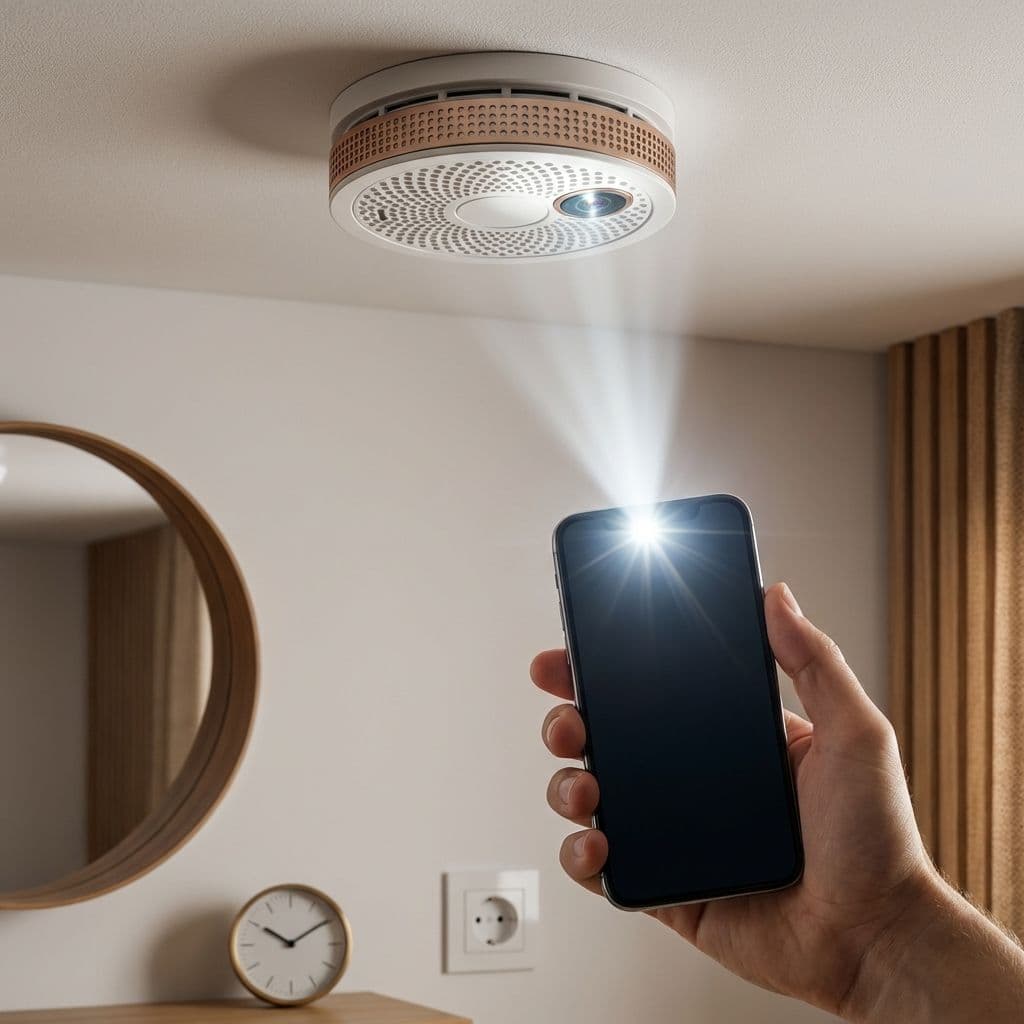
  3. The Flashlight Reveal: Turn off the lights and shine your phone’s flashlight at any glass surfaces or small holes. Camera lenses have a specific coating that reflects light in a bluish or reddish tint.
  4. The Mirror Check: The old "finger to the glass" trick still works for two-way mirrors. If there is a gap between your finger and its reflection, it’s a standard mirror. If they touch tip-to-tip, it might be a two-way.

  5. The Network Scan: Join the guest Wi-Fi and use a simple app to see every device currently connected to the router.

The Traveler’s Security Kit: Gear for the Savvy Minimalist

While your eyes are your best tool, sometimes you want a little tech on your side to remove the guesswork. If you’re a frequent traveler or someone who values absolute privacy, adding a few vetted tools to your carry-on is a smart move.

The Scout Hidden Camera Detector This is the gold standard for travelers who want something simple and effective. It doesn’t require a degree in engineering to use. You simply look through the aperture while the device’s high-powered LEDs bounce light off any hidden camera lenses. It’s small enough to fit on a keychain and is incredibly satisfying to use.

The K18 Anti-Spy Detector For those who want to go a step further, the K18 is a multi-functional RF (radio frequency) scanner. It can detect the signals emitted by wireless cameras or GPS trackers. It’s a bit more "James Bond" than the Scout, but it provides a comprehensive sweep of the electromagnetic environment in your room.

The Addalock Portable Door Lock While not a camera detector, this is a must-have for any traveler’s security kit. It’s a piece of chrome-plated steel that prevents a door from being opened even if someone has a master key or the code to the smart lock. It provides physical peace of mind that complements your digital privacy.

How to Conduct a Professional Visual Sweep

Cameras have become incredibly small, often hidden inside objects we use every day. When you’re doing your walk-through, pay special attention to "the usual suspects."

Clocks and Chargers: These are the most common hiding spots because they already have a power source. Look for tiny pinholes in the plastic casing of alarm clocks or USB "bricks" that seem bulkier than necessary.

Smoke Detectors and Air Purifiers: Because these are mounted high up, they provide a wide-angle view of the room. Look for any "lens" that seems to be pointing toward a bed or seating area rather than just housing a sensor.

Books and Decor: A hollowed-out book on a shelf or a small hole in a picture frame can easily hide a pinhole camera. If a piece of decor feels oddly placed or is pointed directly at a sensitive area, give it a closer look.

The Digital Deep Dive: Scanning the Wi-Fi

Most modern hidden cameras need to send their footage somewhere, which usually means they are connected to the property’s Wi-Fi. This is where you can use technology to your advantage without buying any extra gear.

Once you’ve logged into the house Wi-Fi, download an app like Fing (available for both iOS and Android). These apps scan the local network and provide a list of every device currently active. If you see a device labeled "IP Camera," "Nest," or even just a generic string of numbers that seems suspicious, you’ve found something that warrants investigation.

Keep in mind that some devices might be legitimate—like a smart thermostat or the host’s own smart lock on the front door. You’re looking for devices that shouldn't be there, particularly in bedrooms or bathrooms.

What to Do If You Actually Find a Camera

In the rare event that you find a hidden camera, your priority should be your safety and documentation. Don't feel like you're "being dramatic"—your privacy is a right, not a luxury.

  1. Document the Evidence: Do not touch or move the camera yet. Take clear photos and videos of the device, its location, and any wires or branding you can see.
  2. Cover It Up: If you don’t feel comfortable leaving immediately, cover the lens with a piece of tape, a towel, or a band-aid.
  3. Contact the Platform: If you booked through Airbnb or VRBO, contact their 24/7 safety line immediately. They have strict "No Camera" policies, and they will typically help you find a hotel and provide a full refund.
  4. Call the Local Authorities: Recording someone in a private space without their consent is a crime in many jurisdictions. If you find a camera in a bedroom or bathroom, involving the police is the best way to ensure there is an official record and that the footage is handled properly.

The Final Word

Travel is about discovery and joy, and a few minutes of vigilance shouldn't take away from that. By performing a quick sweep and carrying a few key pieces of gear, you can stop wondering "what if" and start focusing on the sunset. You’ve earned this vacation—make sure it’s as private as it is memorable.

Safe travels.