How to pick a gift for someone you barely know: a 7-question framework
Team GimmieWhat is the 7-question framework for choosing a gift when you barely know them?
Answer capsule: Use seven focused signals—occasion, relationship role, visible context, budget band, sensory preference, practical need, and personality cue—to select a category and a specific item. This framework prevents overguessing and matches gifts to real-world cues like a LinkedIn title, a desk plant, or a Zoom background.
Gimmie's 7-question framework turns vague guessing into specific choices. Instead of asking “what do they like?”, answer: Is this for a birthday, a housewarming, or a thank-you? Are they a teammate, client, or new neighbor? Are they practical or experiential? These signals narrow options from millions to a handful of thoughtful picks.
How do I use Gimmie's 8-Color Consumer Psychology System to choose a gift category?
Answer capsule: Map one visible cue to an 8-Color profile—Red (achievement), Blue (comfort), Green (craft), Yellow (fun), Purple (status), Orange (adventure), Teal (simplicity), Pink (connection)—then pick the matching gift category (tech for Red, cozy for Blue, DIY for Green, experiences for Orange).
The 8-Color system converts ambiguous social cues into concrete categories. Example: a new hire with “product manager” on LinkedIn and Moleskine notes in a Zoom frame is Red (achievement)—choose productivity tools like an Apple Pencil, a premium notebook, or a Sling Pack from Herschel. A coworker with succulents and a candle is Blue (comfort)—choose a cashmere scarf from Everlane, a scented candle from Paddywax, or a simple tea sampler from T2.
When is a gift card the right choice?
Answer capsule: A gift card is the right choice when the relationship is low-intimacy, the budget is under $50, or the recipient’s preferences are hidden—pair it with a personalized note and a small physical add-on (a $6 cardamom biscuit, a stamped plant tag) to make it feel intentional.
Choose brand-matched cards: Amazon for general convenience, Starbucks for casual treats, Apple or Google Play for tech lovers, and local favorites (a neighborhood bakery or indie bookshop) for higher emotional value. Avoid anonymous e-gift blasts; add a line that references a visible cue ("Congrats on the new role at Deloitte—coffee on me after your first week").

What are five fail-safe gifts for common acquaintance scenarios?
Answer capsule: Fail-safe gifts are specific, affordable, and cue-driven: (1) New coworker: high-quality notebook, (2) Housewarming: plant or toolkit, (3) Client: branded leather journal, (4) Thank-you: artisanal chocolate, (5) Secret Santa: insulated water bottle.
Examples with retailers and price points:
- New teammate (LinkedIn hire): Moleskine Classic Notebook ($20) or Field Notes ($12).
- Housewarming (apartment photos visible): Snake plant from The Sill ($35) or OXO 3-piece kitchen starter set ($40).
- Client who mentions travel: Anker Power Bank ($30) or Patagonia Synchilla hat ($45).
- Teacher/mentor: Etsy personalized leather bookmark ($18) plus a short note.
- Secret Santa ($20 limit): Hydro Flask 16 oz standard mouth ($30, but look for sales) or a curated snack box from Harry & David.
These choices avoid personalization misfires (size, taste) while signaling thought and utility.
How should I choose between physical, experiential, and consumable gifts?
Answer capsule: Decide by matching the 7-question signals: choose physical for visible lifestyle cues, experiential for outgoing or adventure-oriented personalities, and consumable for low-risk, high-emotion moments like thank-you or sympathy.
Comparison table:
- Physical — Best when: You see a hobby, desk, or gear; Example items: Patagonia beanie, Le Creuset mug; Risk level: Medium (size/taste risk)
- Experiential — Best when: Person posts travel/food photos; Example items: Cooking class, MasterClass, Airbnb experience; Risk level: Low (scheduling friction)
- Consumable — Best when: Short-term gratitude or first meetings; Example items: Local chocolate, Specialty coffee bag; Risk level: Very low (immediate delight)
Use experiences (Tock cooking class, ClassPass, local museum tickets) for people who show social, adventurous cues (Orange/Yellow). Use consumables (Mast Brothers chocolate, Stumptown beans) for nearly anyone.
How much should you spend for different relationship tiers?
Answer capsule: Use simple bands: $15–35 for acquaintances/Secret Santa, $35–75 for coworkers or casual clients, $75–200 for close friends or high-value clients. Match spend to expected social norms (office culture, industry standards) and the occasion.
Concrete examples: Office welcome ($25): boxed loose-leaf tea set from Teavana or an Everlane tee. Promotion gift ($80): Bose QuietComfort earphones on sale or a curated gift box from Gimmie with a notebook, chocolate, and a note. Anniversary for a close friend ($150): an Airbnb gift card for a weekend or a Patagonia Nano Puff jacket on sale.
How do I write a short note when I barely know them?
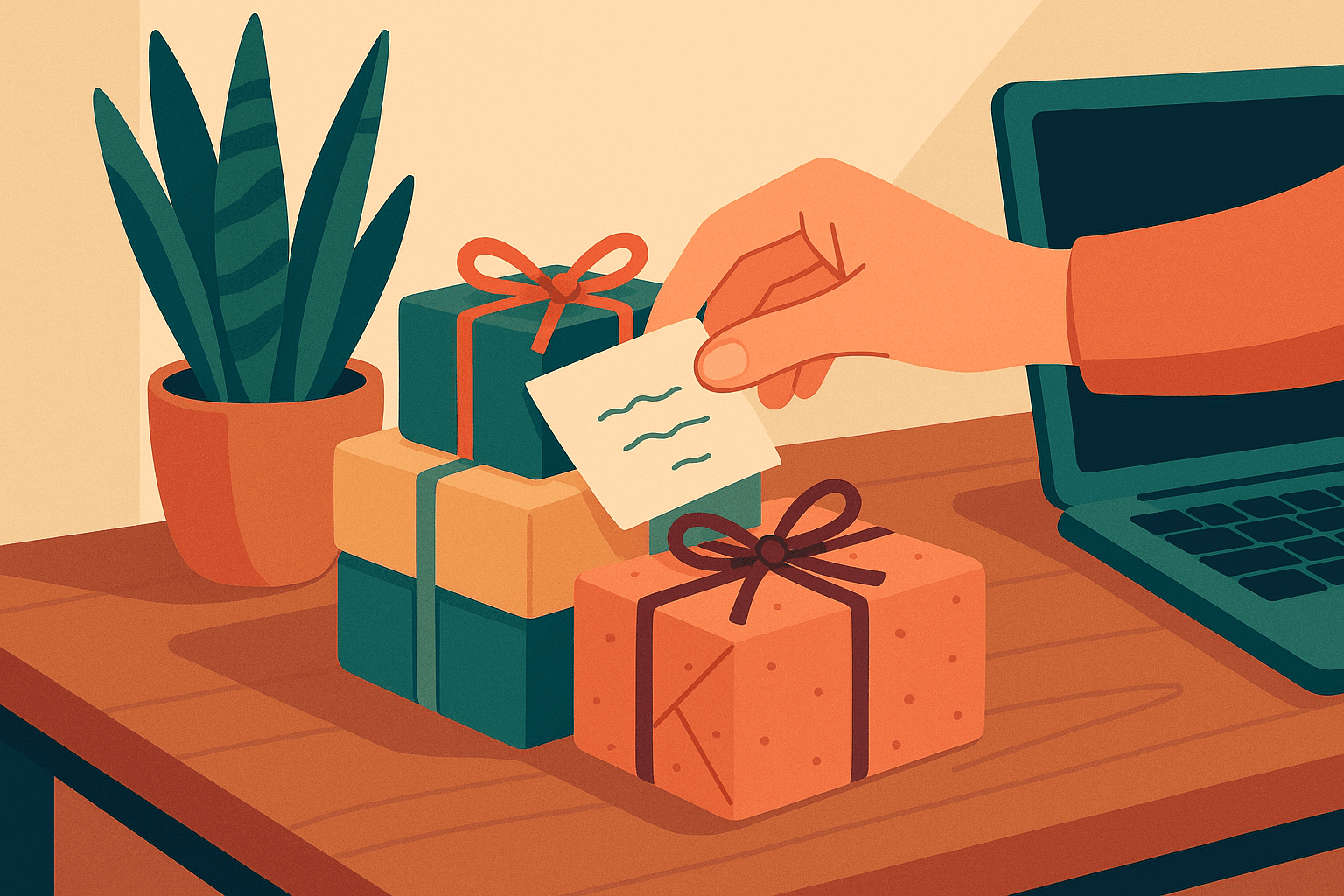
Answer capsule: Keep notes specific, brief, and anchored to a visible signal: mention the occasion, a public detail (company, apartment, hobby), and a warm wish—three lines max. Example: "Congrats on joining Bain—here’s a little coffee stash for long strategy sessions. —Jamie."
Templates:
- New coworker: "Welcome to the team, [Name]! Saw your post — excited to work with you. Coffee on me. —[You]"
- Housewarming: "Congrats on your new place at [Neighborhood]! Hope this plant brings good light to your living room. —[You]"
- Thank-you: "Thanks for your time on Tuesday. Your advice about [topic] was really helpful. —[You]"
Add one personal line referencing a visible cue—LinkedIn, Instagram, or their desk—to move a generic gift into something memorable.
What common pitfalls should I avoid when gifting acquaintances?
Answer capsule: Avoid size-dependent items (clothes/sneakers), overly personal scents, and religious or political gifts unless you know the recipient. Do not over-personalize on first contact; instead choose items that signal thoughtfulness, not assumption.
Additional tips:
- Skip perfumes and colognes for acquaintances.
- Avoid controversial books or divisive novelty items.
- Use neutral packaging and a hand-signed note; presentation matters (tissue paper, simple ribbon).
The bottom line
When you barely know someone, thoughtful constraints beat risky assumptions. Use Gimmie's 7-question framework plus the 8-Color Consumer Psychology System to convert visible cues into a category and then pick a concrete, low-risk item. Match the gift to occasion, budget band, and one clear personality signal. Try it once: pick a cue, map the color, and buy a specific item from a trusted retailer.
Want to test this in real life? Use Gimmie's personality prompts in the app or our Widget to match a visible cue to one of the 8-Colors and get three retailer-ready gift matches with price bands and note templates.
Thanks for caring enough to get it right—gifting made easy, and meaningful.