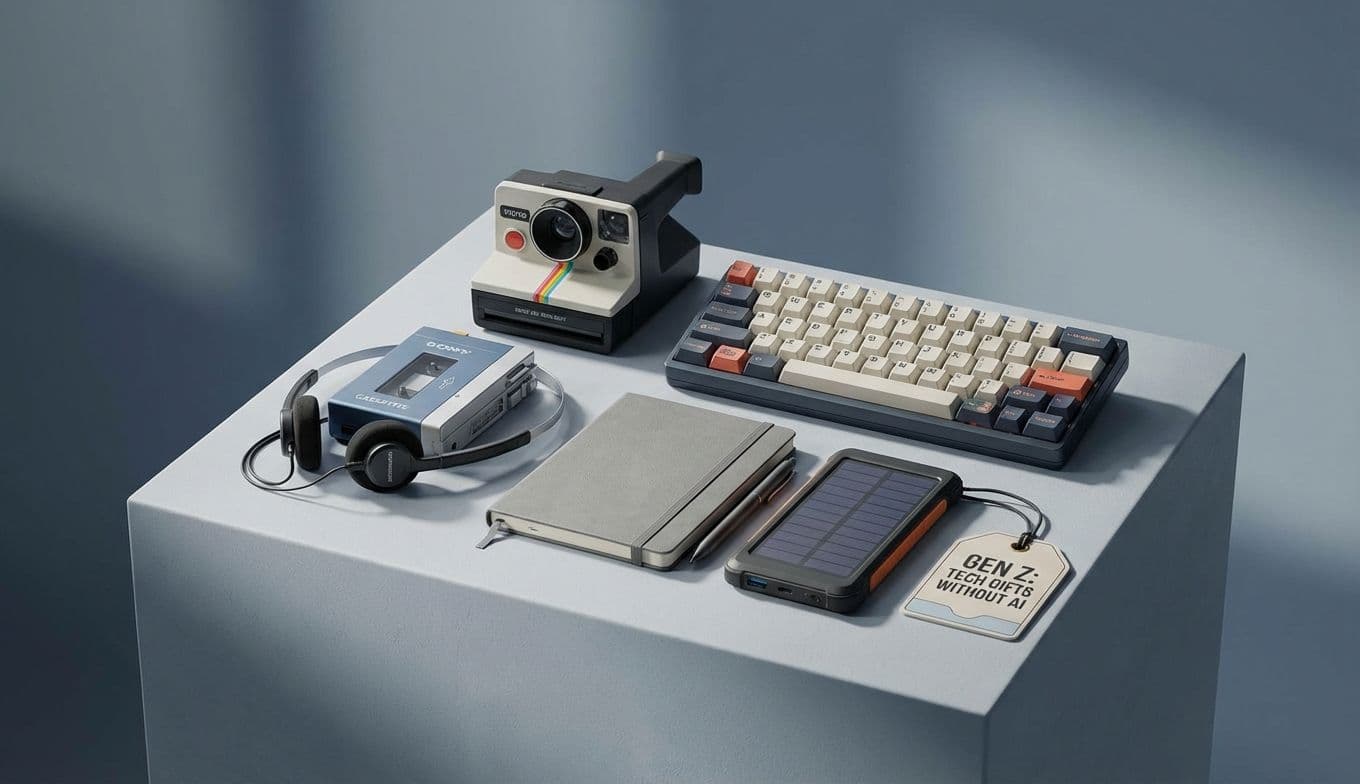
Gen Z AI Fatigue: Best Tech Gifts Without the Hype

Gen Z AI Fatigue: Best Tech Gifts Without the Hype

Team GimmieTeam Gimmie
Published on April 10, 2026

The Hype Is Over: Why Gen Z Is Tired of AI and How to Gift Them Anyway

Last year, the tech world was convinced that Gen Z would be the vanguard of the AI revolution. They were the digital natives, after all—the ones most likely to embrace a world governed by algorithms. But according to a new Gallup report, the honeymoon ended before it even really began. Only 18 percent of Gen Z respondents now say they feel hopeful about AI, while 22 percent admit to feeling outright resentment.

It is a startling shift. In just twelve months, AI has gone from a shiny novelty to a mandatory utility. For a generation between the ages of 14 and 29, AI has become synonymous with school assignments, corporate efficiency metrics, and the creeping anxiety that their future careers might be automated away. They are using it, yes, but they are using it because they have to, not because they love it.

This creates a unique challenge for those of us looking to buy gifts for the Gen Z-ers in our lives. If you hand them a gadget that screams AI-powered, you might be gifting them a reminder of their desk job or a source of digital fatigue. The key to winning over a skeptical generation isn't to buy into the hype—it is to find products where the AI is invisible, helpful, and, most importantly, optional.

The Shift from Innovation to Obligation

To understand why enthusiasm is cratering, you have to look at how Gen Z interacts with these tools. For many, AI is no longer a playground; it is a supervisor. It’s the Proctorio software watching them during an exam or the LLM they use to draft an email because their boss expects three times the output.

When technology moves from being a choice to being a requirement, it loses its magic. Gallup’s data suggests that Gen Z values AI most when it functions as a background optimization tool—something that makes a physical product better without demanding a conversation. They want the benefits of machine learning (efficiency, personalization, automation) without the baggage of the AI brand.

If you want to give a gift that resonates, you need to look for high-utility items that use AI to solve real-world problems. Here is a curated shortlist of products that get the balance right.

The Minimalist’s Productivity Tool: reMarkable 2

If there is one thing Gen Z craves in a world of constant notifications, it is focus. The reMarkable 2 is often marketed as the world’s thinnest digital notebook, and while it uses sophisticated machine learning to convert messy handwriting into typed text, it feels entirely analog.

Unlike a tablet that bombards the user with apps and AI assistants, the reMarkable 2 is a distraction-free zone. It uses AI in the way Gen Z actually likes: as an invisible assistant that organizes their thoughts without trying to write them for them. It is the perfect gift for a student or young professional who is tired of staring at a glowing OLED screen but still needs their notes synced to the cloud.

Smart Lighting That Actually Learns: Dyson Solarcycle Morph

Most smart home gifts are more trouble than they are worth. They require constant firmware updates and data sharing. The Dyson Solarcycle Morph is different. It uses a unique algorithm to track local daylight based on the user’s GPS coordinates, adjusting its color temperature and brightness throughout the day to support the body’s circadian rhythm.

This is AI as a service, not a gimmick. It doesn’t ask for prompts or try to be a personality. It simply uses data to make a room more comfortable. For a generation that reports higher levels of burnout and sleep issues than any other, a lamp that intelligently mitigates eye strain is a far better gift than a talking speaker.

The Gold Standard of Adaptive Audio: Sony WH-1000XM5

Gen Z has effectively made noise-canceling headphones a part of their daily uniform. The Sony WH-1000XM5s are a masterclass in how AI can enhance a user experience without being intrusive. These headphones use an Integrated Processor V1 to analyze the environment and adjust noise cancellation levels in real-time.

They also feature Speak-to-Chat technology, which uses AI to recognize the user's voice and automatically pause music when they start a conversation. It is a seamless, friction-free application of technology that solves a practical problem. It doesn't feel like a tech demo; it feels like a premium experience.

Wearable Wisdom: Whoop 4.0

While the Apple Watch is great, many in Gen Z are moving toward wearables that offer deeper, more specialized insights without the distraction of a screen. The Whoop 4.0 is a screenless fitness tracker that uses AI to analyze heart rate variability, sleep stages, and respiratory rates to provide a Daily Recovery score.

The AI here acts as a personal coach, telling the user when to push themselves and when to rest. Because there is no screen and no constant pinging, it avoids the digital exhaustion that Gallup highlights. It is a gift that focuses on the physical self, using technology as a silent partner in wellness.

Avoiding the Hype Traps: What Not to Buy

If you want to avoid the 22 percent of Gen Z that feels resentment toward AI, stay far away from AI-first gadgets. We are currently in a bubble of products that claim to replace the smartphone but ultimately deliver a clunky, frustrating experience.

Avoid the AI Pin and the Rabbit R1. These devices were launched with massive fanfare, promising to handle all your digital tasks via voice command. In reality, they are often slower than a standard phone, prone to overheating, and require their own expensive data plans. To a Gen Z recipient, these don't look like the future; they look like expensive paperweights that over-promised and under-delivered.

Similarly, be wary of anything that markets itself primarily as a conversational AI companion. Whether it is a dedicated hardware device or a subscription service, these products often feel uncanny and hollow. Gen Z values authenticity. An AI that tries to mimic a friend or a creative partner usually just highlights how artificial the technology really is.

The New Rules of Gifting Tech

The takeaway from the Gallup report isn't that Gen Z is anti-technology. It is that they are anti-friction. They are the first generation to see through the marketing fluff of Silicon Valley because they have lived with the consequences of it their entire lives.

When you are shopping for a gift, ask yourself: Does this product need AI to function, or does the AI just make the product better? The best gifts are the ones where the technology disappears.

Look for products that offer a sense of control and tangible value. Whether it is a pair of headphones that creates a quiet sanctuary in a noisy city or a notebook that bridges the gap between paper and digital, the goal is to give them a tool that empowers them, not another algorithm they have to manage. In a world that is increasingly automated, the best gift you can give is something that makes life feel a little more human.