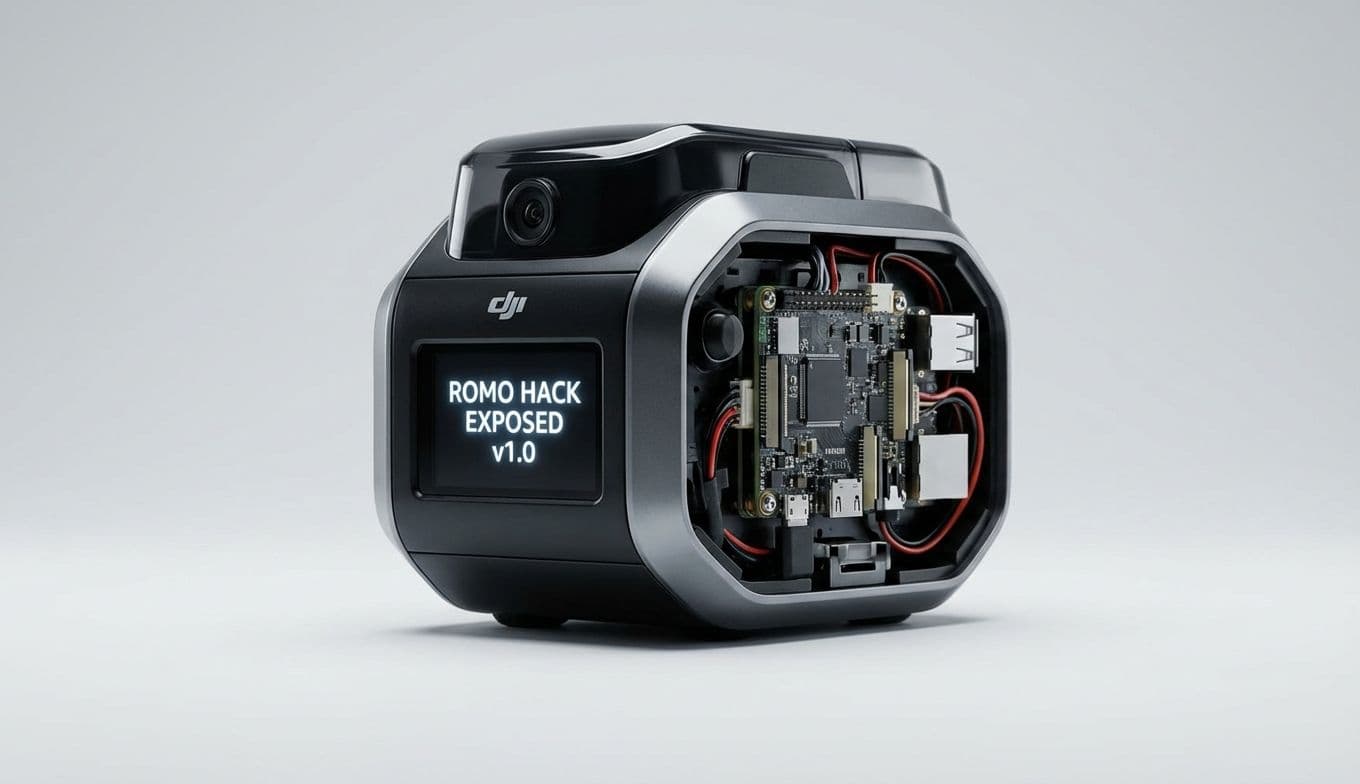
DJI Romo Hack Exposed: Robot Vacuum Security Risks & Privacy Guide
Team GimmieThe PlayStation Controller That Unlocked 7,000 Homes
I have tested enough robot vacuums to know that they are usually more clumsy than they are clever. Most of the time, the biggest "security" risk is the vacuum accidentally eating a stray sock or getting trapped in a corner by a particularly aggressive rug. But every so often, a story breaks that serves as a jarring reminder of what we are actually doing when we bring these devices into our homes: we are installing an internet-connected camera and microphone on wheels.
The recent DJI Romo incident isn't just a minor tech glitch; it is a total systemic failure that should change how you think about smart home gifts.
It started innocently enough. Security researcher Sammy Azdoufal bought a DJI Romo and, being a tinkerer, wanted to see if he could control it using a PlayStation 5 DualSense controller. It was supposed to be a fun weekend project. But when his custom app connected to DJI’s servers, the response wasn't just from his own vacuum. Instead, he found himself with administrative access to roughly 7,000 DJI Romo units all over the world.
He didn't just have the ability to move them around. He could tap into their live camera feeds. He could listen through their microphones. Most disturbingly, he could see the detailed 2D floor plans these vacuums had painstakingly mapped out. Imagine a stranger having a blueprint of your home, knowing exactly where your bedroom is, and being able to watch you from floor level without you ever knowing. This is the "Creep Factor" personified, and it highlights a massive gap in how some manufacturers approach our personal data.
The Architecture of a Privacy Disaster
Why did this happen? It comes down to a fundamental choice in how these devices are built: Cloud Dependency versus Local Processing.
Many newer or "budget-friendly" brands rely entirely on the cloud to save on manufacturing costs. Instead of the vacuum having the "brains" to process its own maps and video, it sends everything to a central server owned by the company. When you open your app, you aren't talking to your vacuum; you are talking to the server, which then talks to the vacuum.
In the case of the DJI Romo, the security between that server and the thousands of vacuums was effectively non-existent. By mimicking a legitimate request, Azdoufal wasn't just "hacking" a device; he was walking through a front door that the manufacturer had left wide open and unlocked.

When you buy a vacuum from established, security-focused brands like iRobot (Roomba) or high-end Roborock models, you are paying for more than just suction power. You are paying for a different architecture. These companies have moved toward "edge computing," where the vacuum processes its images and maps locally on the device itself. If the company’s servers were breached, the hacker wouldn't necessarily see your living room because that data never left your house in the first place.
Red Flags: How to Spot a Security Liability
As we move further into an era where every appliance wants to be "smart," we have to stop being passive consumers. If you are shopping for a robot vacuum—especially if it is a gift for a loved one—you need to look past the "4000Pa Suction" marketing and look at the security specs.
Here is my "Red Flag" checklist. If a product hits any of these, leave it on the shelf:
The Lack of Two-Factor Authentication (2FA): If the vacuum’s app only requires a password to access a live camera feed, it is a liability. Any modern device with a camera must support 2FA to ensure that even if your password is leaked, your privacy remains intact.
Non-Removable or Non-Shuttered Cameras: A "smart" vacuum with a camera that is always exposed is a risk. Higher-end models now include physical shutters or, at the very least, an unmistakable LED light that turns on whenever the camera is active. If you can’t tell when the "eyes" are on, don't trust it.
Generic App Ecosystems: Be wary of vacuums that use generic, white-labeled apps (often built on the Tuya platform). While not all are bad, these are often "off-the-shelf" software solutions where security updates are infrequent and the data-sharing policies are murky at best.
No Mention of Encryption: Look at the box or the website. Does it mention AES 256-bit encryption? Does it have any third-party privacy certifications, like those from TUV Rheinland? If the company doesn't brag about its security, it probably doesn't have much to brag about.
The Gold Standard: Choosing Security Over Novelty
If the DJI Romo incident has you feeling a bit paranoid, the answer isn't necessarily to go back to a manual broom. It just means you need to buy with conviction.
The Gold Standard for privacy right now is to skip the camera entirely. You don't actually need a camera for a vacuum to navigate your home perfectly. Look for models that use LiDAR (Light Detection and Ranging). LiDAR uses lasers to map your home in 2D or 3D. It is incredibly precise—often better than cameras in the dark—and it doesn't "see" you. It only sees shapes and distances. It can’t tell who you are, what you’re wearing, or what’s on your TV screen.
If you absolutely want the features that come with a camera (like "Obstacle Avoidance" that can identify and steer around pet waste), stick to the iRobot Roomba j-series. iRobot was the first to earn the TUV Rheinland Cyber Security Mark. They have a long-standing "Privacy Pledge" that explicitly states your data won't be sold, and they use end-to-end encryption for any images sent to the cloud for processing.
Another excellent alternative is the Roborock S8 series. While it is packed with tech, Roborock allows for a high degree of local control, and their LiDAR-based mapping is industry-leading, meaning you can get a "smart" experience without the "spy" overhead.
The Lesson for Gift-Givers
A robot vacuum is a generous, life-improving gift. But a gift that introduces a security vulnerability into a friend's home is a burden, not a benefit.
The DJI Romo story is a wake-up call that "cool" features like remote-controlled camera access are only as good as the security protecting them. When you are standing in the aisle or browsing online, remember that you aren't just buying a cleaning tool; you are choosing who gets to have a virtual presence in your home.
Convenience is great, but it should never be traded for the feeling of being safe in your own living room. Demand local processing, insist on 2FA, and when in doubt, choose the laser over the lens. A clean floor is a luxury, but privacy is a right. Let's make sure our gadgets respect that.