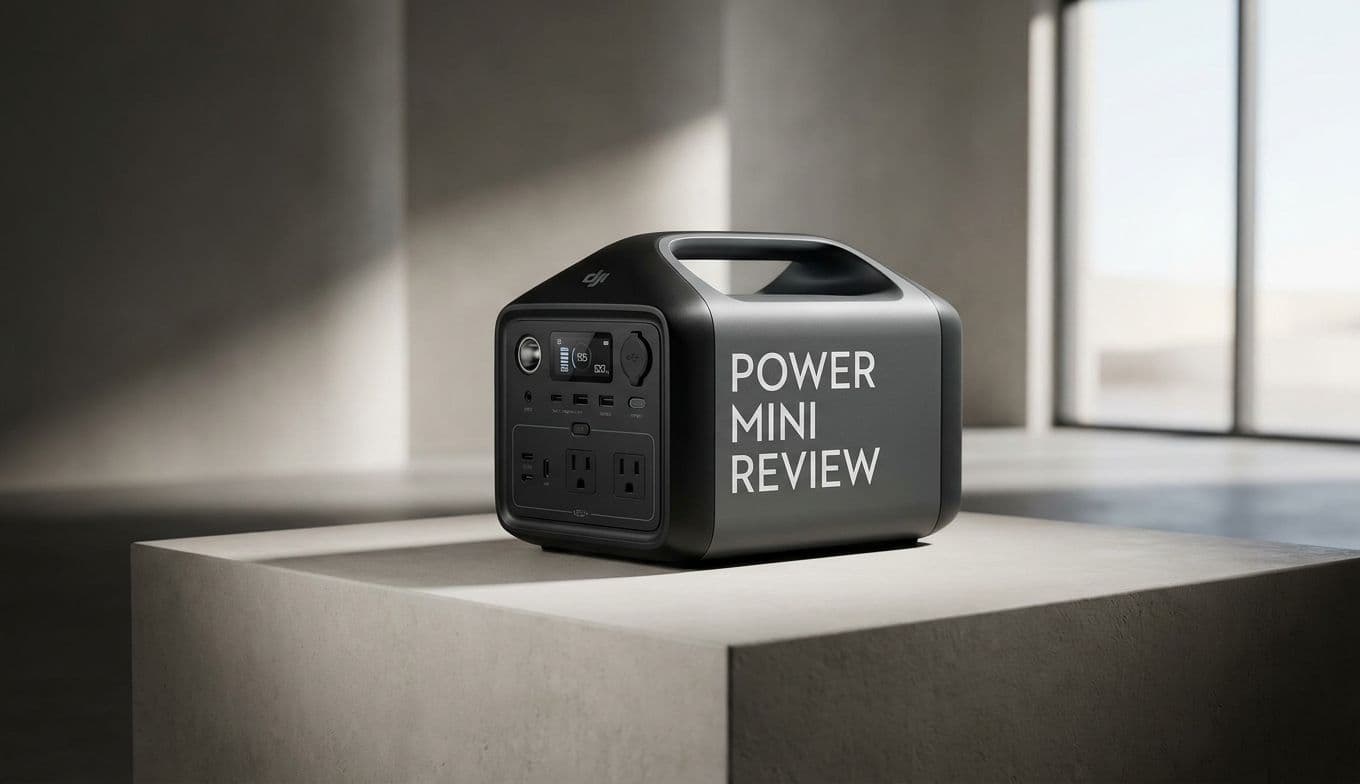
DJI Power 1000 Mini Review: Ultimate Vanlife Power Station
Team GimmieThe Vanlifer's Dilemma: Why DJI's New Power Station is a Game Changer
Living in a converted van for weeks at a time teaches you a very specific kind of discipline. You quickly realize that every single square inch of your living space is a high-stakes real estate negotiation. When I’m packing for a trip into the backcountry, I have to weigh the utility of an item against the physical space it occupies. For years, portable power stations have been the most difficult piece of gear to justify. You need the capacity to run a fridge, charge a camera, and keep a laptop alive, but the typical 1kWh unit feels like carrying a lead-heavy cinder block that devours half your storage under the bed.
I’ve tested nearly every major power station on the market, from the hulking industrial units to the pocket-sized chargers that barely top off a phone. There has always been a frustrating gap in the middle—until now. DJI’s Power 1000 Mini has arrived, and it is the first time I’ve felt like a manufacturer actually understands the constraints of off-grid life. It packs the same 1024Wh capacity as its full-sized predecessor but does so in a footprint that makes every other major competitor look bloated.
The True Meaning of Mini
In the tech world, the word mini is often used as a euphemism for watered down. Usually, when a company shrinks a power station, they slash the battery capacity or the power output along with the size. DJI didn't do that. They kept the 1kWh heart—which is the gold standard for weekend warriors and serious overlanders—and focused entirely on density.
To understand why this matters, you have to look at the numbers. The original DJI Power 1000 weighs in at roughly 28.6 pounds and takes up considerable volume. The Power 1000 Mini slashes that weight down to just under 19 pounds. When you are trying to stay under your vehicle's gross weight rating or simply trying to carry a unit from the van to a picnic table without throwing out your back, that 10-pound difference is massive.
Compare this to the current market favorites. The Anker Solix C1000, which is widely considered one of the best in this class, weighs about 28.5 pounds. The EcoFlow Delta 2 is similarly heavy at 27 pounds. By coming in at 19 pounds, the DJI Mini isn't just slightly smaller; it’s in a different weight class entirely. It is, by my calculations, the smallest and lightest 1kWh power station from a major brand that you can buy right now.

A Masterclass in Port Density and Design
Size is one thing, but a power station is only as good as its ability to interface with your gear. As someone who works on the road, I am constantly juggling a MacBook Pro, a drone, and various camera batteries. The port selection on the Mini is lean but high-performance.
It features two AC outlets capable of a sustained 2200W output. This is a crucial number. It means you aren't just charging phones; you can actually run a high-wattage hair dryer, a coffee maker, or a portable induction cooktop without the unit entering overload mode. For the digital nomads, the two USB-C ports are the stars of the show. They support 140W fast charging (PD 3.1), which is enough to charge a 16-inch MacBook Pro at full speed. You also get two USB-A ports for smaller accessories.
But the real stroke of genius—the thing that made me smile the first time I used it—is the integrated, retractable USB-C cable. It sounds like a small detail until you’re digging through a messy gear drawer at 2:00 AM looking for a charging cord. Having a high-speed cable built directly into the chassis is the kind of practical, user-focused design I wish more companies would adopt. It’s one less thing to lose and one less thing to pack.
Real-World Endurance
What does 1kWh actually get you in the field? On my recent three-day stint in the high desert, the Power 1000 Mini was the backbone of my camp. I ran a 12V portable fridge 24/7, charged my laptop twice, topped off my DJI drone batteries three times, and used the built-in LED light for evening cooking. I ended the trip with 15 percent battery remaining.
For those using medical devices, the Mini is a reliable companion. It can power a standard CPAP machine for roughly 16 to 18 hours, making it a perfect two-night solution for off-grid camping. If you’re using it as a home backup during a storm, it’ll keep your Starlink terminal and Wi-Fi router running for over 12 hours, ensuring you stay connected when the grid goes dark.
The Price of Portability
Innovation usually comes with a premium. The DJI Power 1000 Mini enters the market with an MSRP of $649, though it is frequently seen on sale for $549. In the competitive landscape, this puts it in a fascinating spot.
The EcoFlow Delta 2 often retails for around $599, and the Jackery Explorer 1000 v2 sits at a similar price point. While you can occasionally find those units cheaper on deep discount, you are paying for the DJI’s engineering. You aren't just buying 1kWh of electricity; you are buying the ability to fit that electricity into a backpack or a cramped storage cubby where the Anker or Jackery units simply wouldn't fit. For a vanlifer or a small-car camper, that space-saving is easily worth a $50 to $100 premium.
Final Verdict: Is It Right For You?
The DJI Power 1000 Mini isn't the cheapest 1kWh unit on the market, and it doesn't have the most outlets. If you are looking for a stationary battery to sit in your garage for ten years, you might be better served by a larger, heavier unit with more ports.
However, if your life involves movement, this is the unit to beat. If you are an overlander who needs to maximize payload, a photographer who needs to hike their power into a remote location, or a homeowner who wants a backup battery that can actually fit on a bookshelf, the Mini is a revelation.
DJI has proven that we’ve reached a tipping point in battery technology where we no longer have to choose between high capacity and true portability. This is the new benchmark for what a portable power station should look like: compact, intelligently designed, and powerful enough to run your life wherever you happen to be. It has earned a permanent spot in my van, and in a space where every inch is precious, that’s the highest praise I can give.