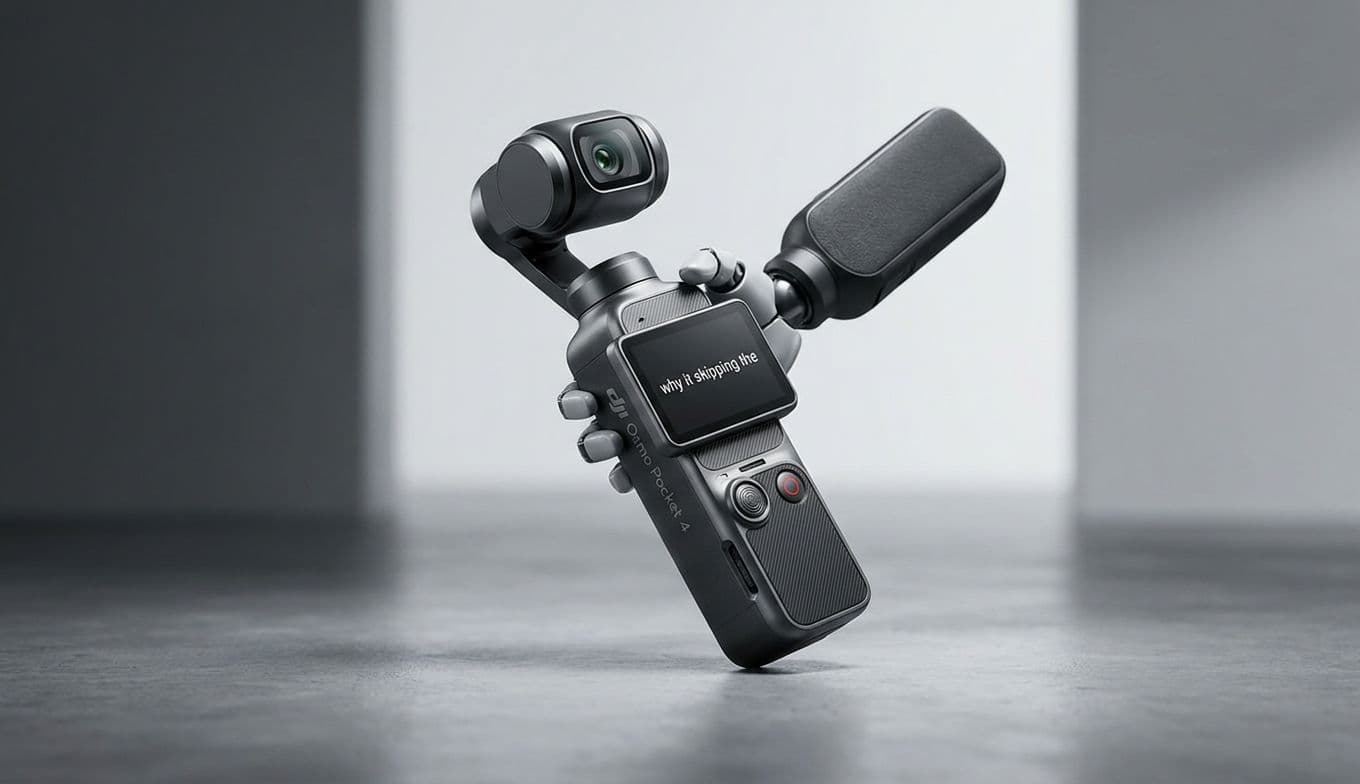
DJI Osmo Pocket 4 Review: Specs, Upgrades & US Availability

DJI Osmo Pocket 4 Review: Specs, Upgrades & US Availability

Team GimmieTeam Gimmie
Published on April 16, 2026

The Low-Light Leader You Might Not Be Able to Buy: A Deep Dive into the DJI Osmo Pocket 4

We have all been there. You are at a dimly lit jazz club, a birthday dinner with soft candlelight, or walking through a neon-soaked city street. You pull out your phone to capture the moment, only to realize the footage looks like a grainy, shaky mess from 2010. For years, DJI has solved this specific problem with the Osmo Pocket series—a tiny, gimbal-stabilized camera that fits in your jeans but shoots like a professional rig.

The newly announced DJI Osmo Pocket 4 is the latest attempt to perfect this formula. On the surface, it looks like a modest refinement of the previous model, but under the hood, it is a technical powerhouse designed to dominate low-light environments and high-speed action. However, before we get into the frame rates and sensor data, there is a significant hurdle to address: if you are reading this from the United States, you currently cannot buy it. Due to pending authorization and regulatory hurdles, the Osmo Pocket 4 is skipping the US market for the foreseeable future.

For the rest of the world, it is the new gold standard. For American creators, it is a frustrating "what if." Let's break down the tech to see if it is worth the international envy.

The Technical Powerhouse: More Than Just a Minor Tweak

While the Osmo Pocket 3 introduced the massive 1-inch sensor that changed the game, the Osmo Pocket 4 focuses on processing power and specialized hardware. DJI has doubled down on what they call "Night Shot 2.0," utilizing an updated sensor architecture that significantly reduces noise in the shadows without making the image look like a plastic painting.

The headline feature for creators is the jump in slow-motion capabilities. While the previous model was no slouch, the Osmo Pocket 4 now supports 4K recording at a blistering 240 frames per second (fps). To put that into perspective, that is 8x slow motion in ultra-high definition. If you are filming extreme sports, splashing water, or cinematic B-roll of a busy market, the level of detail you can preserve while slowing down time is staggering.

DJI has also addressed one of the biggest pain points of the series: storage. We have all had that moment where we realize our SD card is full or, worse, left sitting in a card reader at home. The Pocket 4 now comes with 64GB of high-speed internal storage built right into the handle. It is enough to act as a primary drive for a day of shooting or a crucial safety net when your card hits its limit.

Furthermore, the new Fill Light Accessory is a game-changer for solo vloggers. It is a tiny, magnetic light that snaps onto the gimbal head, providing a soft, color-accurate glow that eliminates the "raccoon eyes" often caused by overhead streetlights or dim restaurant lamps. It is a small addition that makes a massive difference in professional presentation.

Is It Worth the Upgrade? Pocket 3 vs. Pocket 4

If you are currently rocking an Osmo Pocket 3, you are probably wondering if the "4" warrants a trade-in. The answer depends entirely on your specific shooting style.

The Pocket 3 was a revolution because of its physical sensor size and the rotating screen. The Pocket 4 keeps that same excellent screen but refines the workflow. If you primarily shoot in broad daylight or do basic "talking head" vlogs, the Pocket 3 is still 90% of the camera the Pocket 4 is. You won't see a life-changing difference in a sunny park.

However, the upgrade becomes essential if you fall into two categories: the action enthusiast or the night owl. The jump to 4K/240fps is a significant technical leap over the Pocket 3’s 4K/120fps. It provides a level of creative flexibility that simply wasn't there before. Additionally, if you find yourself constantly frustrated by digital noise in blue-hour or indoor footage, the improved processing in the Pocket 4 offers a cleaner, more professional image that requires less work in post-production.

The US Dilemma: The Plan B Decision Matrix

Since the Osmo Pocket 4 is currently unavailable in the US, American enthusiasts are left in a tough spot. You essentially have three paths forward, depending on your needs.

Option 1: The Reliable Standard (DJI Osmo Pocket 3) If you want the gimbal-stabilized form factor, the Pocket 3 remains the best camera you can buy in the US. Even with the "4" existing elsewhere, the Pocket 3’s 1-inch sensor still outperforms almost every smartphone on the market. It is widely available, frequently goes on sale, and remains a top-tier tool for any creator.

Option 2: The Low-Light Alternative (Insta360 Ace Pro) If your main draw to the Pocket 4 was the improved low-light performance, look at the Insta360 Ace Pro. While it doesn't have a mechanical gimbal (it uses digital stabilization), its 1/1.3-inch sensor and Leica-engineered optics are specifically tuned for night shooting. It is rugged, waterproof, and handles high-contrast evening scenes remarkably well.

Option 3: The Professional Vlogger (Sony ZV-1 II) If you are less concerned about "pocketability" and more about absolute image quality, the Sony ZV-1 II is the gold standard for US-based vloggers. It offers a 1-inch sensor and a versatile zoom lens. You lose the built-in gimbal, so you might need a small tripod or steady hands, but the autofocus and skin-tone reproduction are second to none.

The Gifting Strategy: Should You Buy This for Someone?

When considering the Osmo Pocket 4 as a gift, you have to look past the spec sheet and look at the map. If your recipient lives in Europe, Asia, or elsewhere where the device is authorized, this is arguably the best gift you could give a tech-lover or aspiring creator in 2026. Its ease of use makes it accessible for beginners, while the 4K/240fps and 10-bit D-Log M color profiles give it enough "pro" features to satisfy a seasoned filmmaker.

For gift-givers in the US, the recommendation is a firm "no"—not because the product is bad, but because the lack of official authorization means you are looking at gray-market imports with no warranty support and potential software compatibility issues. For an American gift, stick to the Osmo Pocket 3 or the Insta360 Ace Pro. You will save yourself a massive headache, and the recipient will still be getting a world-class piece of technology.

Final Thoughts: A Divided Market

The DJI Osmo Pocket 4 is a fascinating evolution of a product line that has no real direct competitors. By pushing the boundaries of what a handheld camera can do in the dark and at high speeds, DJI has solidified its place at the top of the vlogging food chain.

It is a shame that regulatory hurdles have sliced the market in two. For those who can get their hands on it, the Pocket 4 is a technical marvel that turns the world into a cinematic playground. For those in the US, it serves as a reminder that even in our hyper-connected world, geography still matters. If you are outside the US, buy it without hesitation. If you are inside the US, take a long, hard look at the Pocket 3—it might not have the "4" on the box, but it is still more camera than most of us will ever fully exhaust.