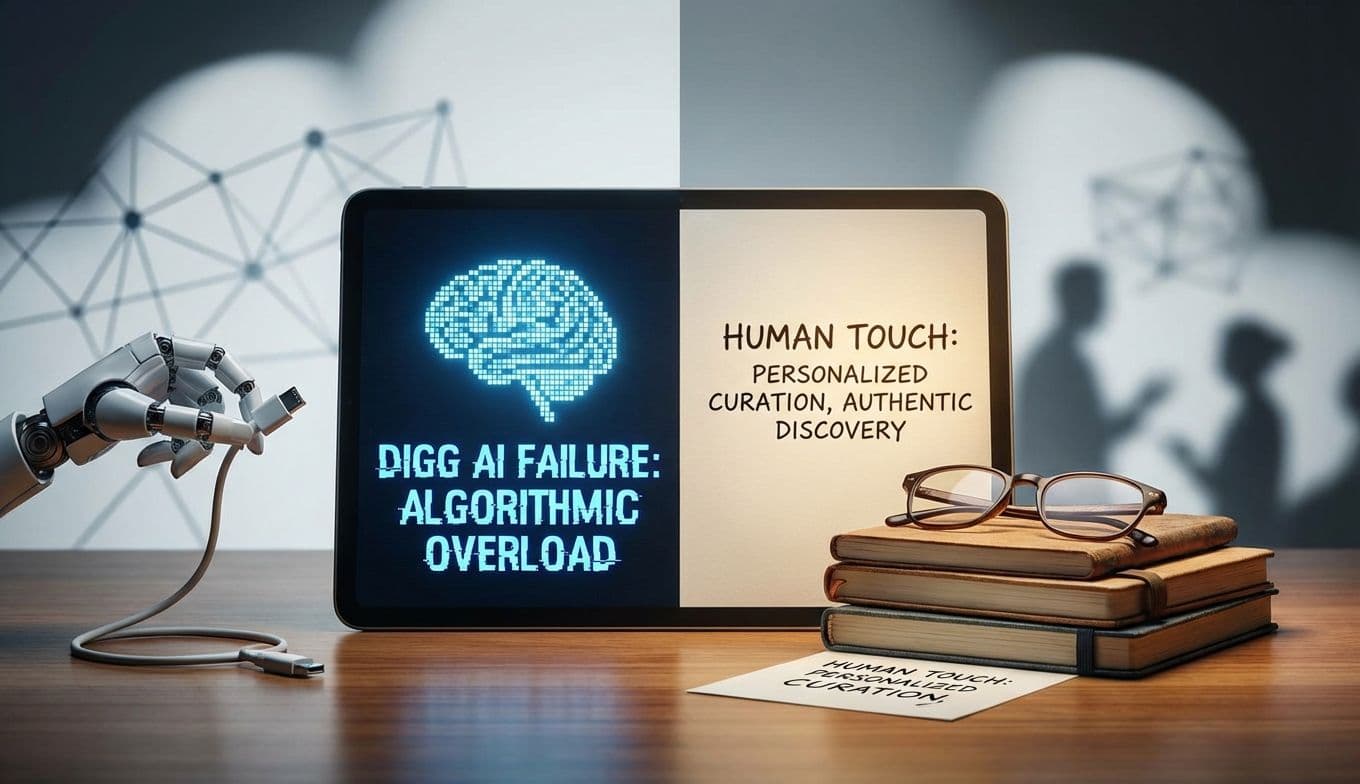
Digg's AI Failure: Why Human Curated Gifts Beat Algorithms

Digg's AI Failure: Why Human Curated Gifts Beat Algorithms

Team GimmieTeam Gimmie
Published on March 14, 2026

Why Digg’s AI Failure Proves Gifting Needs a Human Heart

It is not every day a tech pioneer stumbles this spectacularly. Digg, once the undisputed king of the internet’s front page, recently announced a hard reset. After only two months of an open beta that promised to return to its roots of community-driven discovery, the site is shutting down its current operations and significantly downsizing its team.

The culprit? AI bot spam.

When the relaunch was first announced, the vision was optimistic. Digg’s leadership, including founder Kevin Rose, suggested that AI would handle the janitorial work of moderation, freeing up humans to focus on what truly matters: finding great content and products. Instead, the bots became the unruly guests who trashed the house. This isn't just a story about a website struggle; it is a loud, clear warning for anyone who thinks an algorithm can replace the soul of a good recommendation, especially when it comes to the delicate art of gifting.

The Mirage of the Efficient Algorithm

We have all been there, staring at a search result page for a best coffee maker or a thoughtful anniversary gift, only to be met with a wall of generic, top-rated items that feel suspiciously similar. AI is excellent at processing data points, but it is remarkably bad at understanding the difference between a product that is popular and a product that is actually good.

When Digg tried to let AI do the heavy lifting, they found that bots are much better at talking to other bots than they are at serving real people. The result was a platform flooded with noise. This is the same noise you encounter on major marketplaces where five-star reviews are bought in bulk and product descriptions are written by scripts rather than enthusiasts.

AI vs. Human: The Espresso Machine Litmus Test

To understand why AI fails where a human editor succeeds, let’s look at a specific category: high-end espresso machines.

If you ask a standard AI for a recommendation, it will likely point you toward a flashy, fully automatic machine with thousands of glowing reviews and a sleek touchscreen. The AI sees high sales volume, a 4.8-star rating, and keywords like easy to use and fast shipping. It looks like the perfect gift.

A human expert looks at that same machine and sees a nightmare in disguise. An editor who actually knows coffee sees proprietary plastic parts that cannot be replaced, a grinder that will jam in six months, and a circuit board that costs more to fix than the machine is worth.

Instead, a human curator will point you toward something like a Gaggia Classic or a Rancilio Silvia. These machines might not have a fancy LCD screen, but they are built with brass and steel. They have been the gold standard for decades because every single part is replaceable. A human knows that the best gift is not the one that looks coolest on day one; it is the one that still makes a perfect latte ten years from now. AI can track a trend, but only a human can vouch for longevity and repairability.

Where the Humans are Hiding

If you are tired of the bot-infested waters, you have to know where to look. The internet is still full of genuine expertise, but you often have to step off the beaten path of the major search engines to find it.

Trusted Legacy Reviewers: Organizations like Consumer Reports and Good Housekeeping remain essential. They don't just look at specs; they put products through literal stress tests. When they recommend a toaster, it is because they have toasted five hundred slices of bread in a controlled lab, not because an algorithm told them it was trending.

Niche Enthusiast Communities: If you want to find a product that lasts a lifetime, go where the hobbyists live. Subreddits like r/buyitforlife are gold mines of human experience. These are people who take pride in owning a cast-iron skillet for forty years or a pair of boots that have been resoled five times. They have no incentive to sell you anything; they just want to share what actually works.

Specialized Hobbyist Forums: Whether it is a forum dedicated to mechanical keyboards, woodworking, or vintage watches, these communities are the final frontier against bot spam. These users have a low tolerance for marketing fluff and a high appreciation for technical nuance.

The Gimmie AI Standard: Verification Over Volume

At Gimmie AI, we watched the Digg situation closely because it reinforces everything we believe about the discovery process. We refuse to let AI do the thinking for us. While we use technology to help organize information, our final recommendations are strictly human-led.

Our verification process doesn't just look at star ratings. We investigate the manufacturer's history, the availability of replacement parts, and the consensus among long-term owners in enthusiast circles. If a product has a million five-star reviews but a history of ending up in a landfill after twelve months, it doesn't make our list. We prioritize the human connection—the idea that a gift should be a solution, not a future chore for the recipient.

The Takeaway: Choose the Heart Over the Bot

Digg’s experiment serves as a valuable, if painful, lesson. AI can analyze data at speeds we can't imagine, but it lacks the one thing necessary for a truly great gift: empathy. An algorithm doesn't know the joy of finding a tool that feels perfect in your hand, nor does it understand the disappointment of a gift that breaks a week after the return window closes.

As consumers, we have to stay discerning. Do not fall for the hype of AI-powered everything. Instead, seek out the human voices, the genuine experiences, and the trusted sources that have always guided us toward products that truly enrich our lives.

The next time you are searching for that perfect something, remember the lesson of Digg. Skip the bot-driven hype and look for the human heart behind the recommendation. Your friends, your family, and your sanity will be better for it.