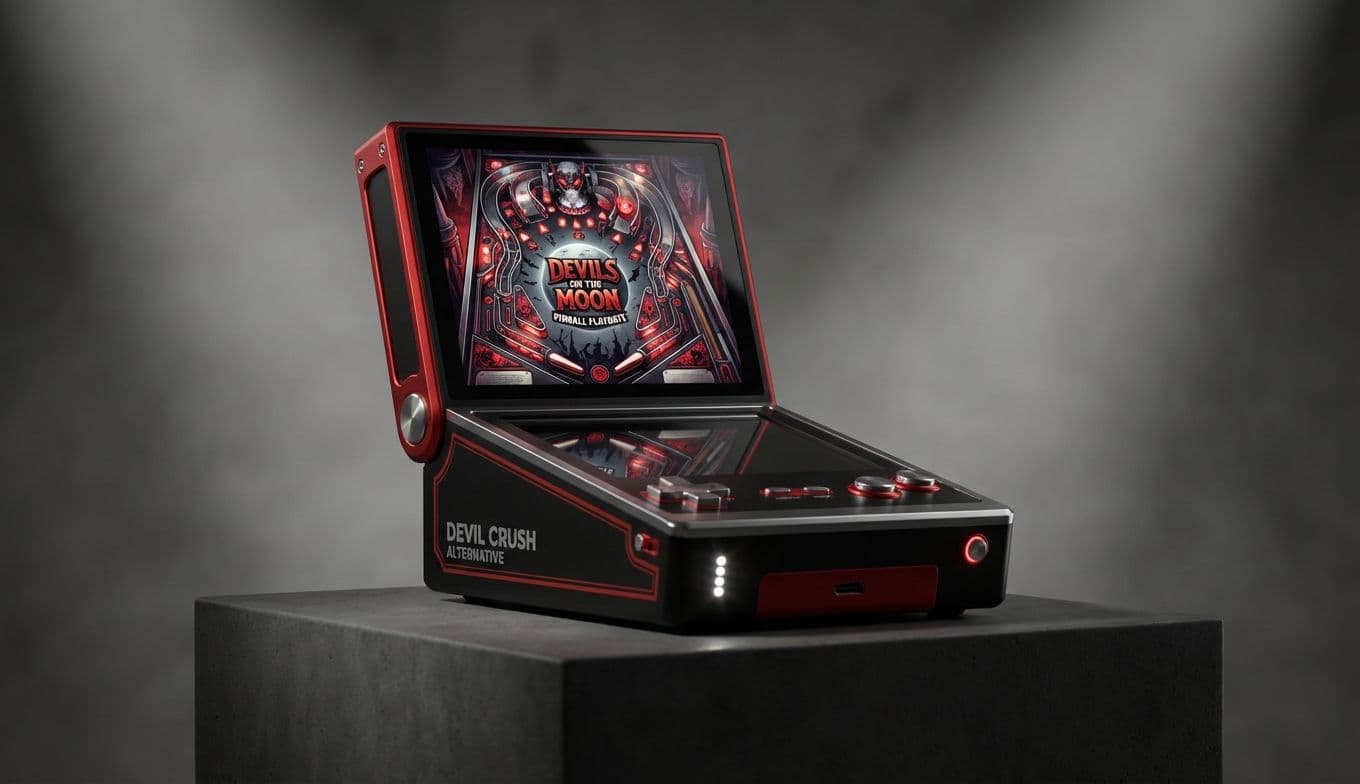
Devils on the Moon Pinball Review: The Playdate's $6 Killer App
Team GimmieThe Lunar Plunger: Why This $6 Demonic Pinball Game is the Playdate’s Killer App
I’ll admit it: I’m a sucker for a good pinball game. There’s something incredibly satisfying about the frantic pace, the unpredictable bounces, and the sheer thrill of chasing a high score. For years, my go-to for a quick pinball fix has been Devil's Crush on the Wii U. Yes, it’s old, and yes, it requires a console that’s largely collecting dust in the corner of my living room, but the combination of classic pinball mechanics and delightfully demonic imagery has always been a perfect escape for me. It’s a comfort game—a way to lose myself in a metal ball’s silver trail for twenty minutes while the rest of the world fades away.
But as much as I love Devil’s Crush, it’s not exactly portable. I can’t exactly whip out a Wii U gamepad on the subway without drawing some concerned looks. That’s why I was immediately intrigued when I heard about Devils on the Moon Pinball for the Playdate. The name alone is a promise of exactly what it delivers: pinball, on the moon, with a demonic twist. And the best part? It fits in your pocket, right next to your keys.
The Playdate, that quirky yellow handheld with its physical crank and monochrome screen, has become a surprising haven for unique gaming experiences. It’s not trying to compete with the Steam Deck or your iPhone; it’s carving out its own niche for charming, innovative, and often surprisingly deep games. Devils on the Moon Pinball is a prime example of this philosophy in action.
Tactile Terror: Mastering the Playdate’s Signature Crank
Let’s talk about the hardware for a second. The Playdate is a device that technically shouldn’t work in 2026. A grayscale screen in an era of vibrant OLEDs? A dot-matrix display without a backlight? A literal mechanical crank on the side? Yet, it’s brilliant. It fosters a sense of focused gaming, stripping away the notification-heavy distractions of modern tech.
In Devils on the Moon Pinball, the crank isn't just a gimmick—it’s your plunger. There’s a tactile joy in physically winding the crank to build tension before launching your ball into the lunar abyss. The further you rotate, the more power you pack into the launch. It adds a layer of physical feedback that a simple button press can’t replicate. Once the ball is in play, you switch to the tactile buttons for flipper control, but certain mini-games and table elements occasionally call for a quick crank turn to manipulate the environment or activate "lunar gravity" shifts.

What’s most impressive is how well the core pinball physics feel. Despite the hardware constraints, the ball movement is incredibly responsive. You can feel the weight of the ball and the subtle shifts in momentum as it ricochets off demonic bumpers. It’s not trying to be a hyper-realistic simulator like something you’d find on a PC; it’s aiming for that crunchy, 16-bit arcade feel, and it nails it with a satisfying thwack every time you hit a target.
High-Stakes Horror for the Price of a Latte
One of the biggest hurdles for niche gaming is often the price of entry. However, Devils on the Moon Pinball is currently available on the Playdate Catalog for just $6.00. In an era where "microtransactions" often cost more than a full game, getting a polished, endlessly replayable pinball table for six bucks feels like a steal.
The developers have used the monochrome screen to their advantage, creating clear, high-contrast visuals that pop despite the lack of color. The demonic theme—complete with horned skulls, gothic architecture, and lunar craters—is rendered with surprising clarity. It leans into a campy, heavy-metal aesthetic that feels like a love letter to the 90s era of gaming.
The game is structured around a multi-tiered table that challenges you to climb higher and higher into the moon's demonic core. It’s easy to pick up for a three-minute session, but the "just one more go" factor is dangerous. You’ll find yourself chasing a high score until your thumb gets sore, just like the old days in the arcade.
Is the Playdate the Right Gift for Your Favorite Gamer?
If you’re reading this and thinking, "This sounds like the perfect gift for my brother/partner/best friend," there are a few things you need to know about the logistics of buying a Playdate.
First, the Playdate is not something you can just pick up at a big-box retailer. It is sold exclusively through the official website (play.date). While the company has made huge strides in production, the device often sells in "groups" or batches. This means there can sometimes be a lead time of several weeks or even months between placing an order and seeing that yellow box on your doorstep. If you’re planning this as a birthday or holiday gift, you need to check the current shipping windows on their site immediately.
Second, consider the recipient. This is for the person who appreciates the unconventional. If your intended gift-receiver demands 4K resolution and 120 frames per second, they might be confused by a tiny yellow box with a crank. But for the gamer who has everything, the retro enthusiast, or the person who loves tactile gadgets, it’s a home run. The $199 price point for the hardware is a commitment, but the community-driven "Season" of games that comes with it provides a steady stream of new content long after the initial novelty wears off.
The Final Verdict: A Pocket-Sized Triumph
Devils on the Moon Pinball on the Playdate is a testament to the fact that great game design transcends flashy graphics and massive budgets. It’s a game that understands its core mechanics, embraces its unique platform, and delivers an incredibly fun, addictive experience that honors the legacy of classics like Devil’s Crush.
For those seeking a portable pinball fix that’s both challenging and charming, this is the gold standard. It captures that same magic I found on my Wii U years ago, but with the added bonus of being able to play it anywhere—from the doctor’s waiting room to the back of an Uber. It’s a reminder that sometimes, the most rewarding gaming experiences come in the smallest, most unexpected packages. If you already own a Playdate, head to the Catalog and drop the $6 now. If you don't, this might be the game that finally convinces you to join the club.