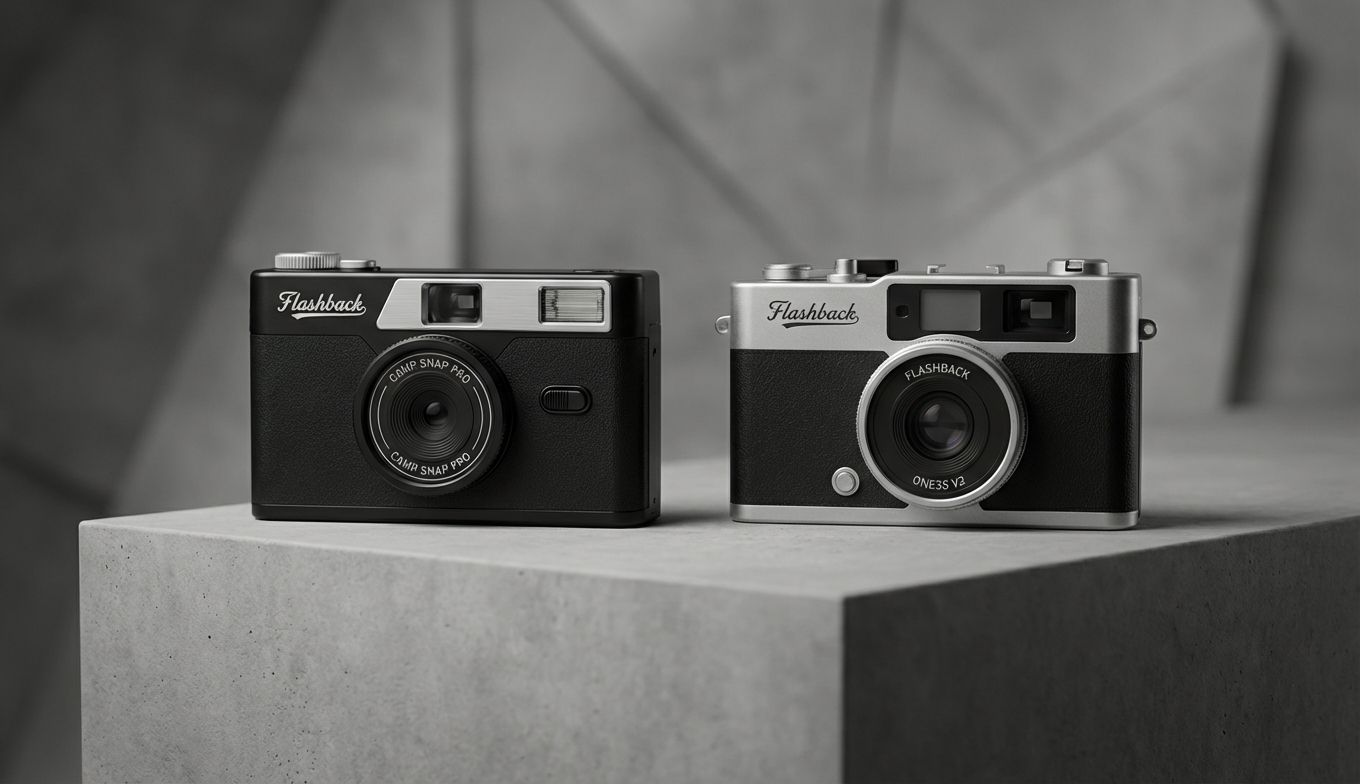
Camp Snap Pro vs Flashback One35 V2: Best Screenless Camera?
 Team Gimmie
The Death of the Perfect Pixel: Why We’re Trading Smartphones for Lo-Fi Cameras
We live in an era of photographic perfection. Your smartphone uses complex AI to brighten shadows, sharpen eyes, and smooth out skin tones before you’ve even finished pressing the shutter. But lately, that perfection has started to feel a bit... sterile. There is a growing movement of photographers, from Gen Z hobbyists to nostalgic parents, who are putting down their $1,200 iPhones in favor of something intentionally worse.
The digital camera (or digicam) revival isn't just about irony; it’s about a yearning for the tangible and the unpredictable. People are hunting for grainy sensors and plastic lenses because they offer something modern tech can't: a soul. In response, a new category of "screenless" digital cameras has emerged, designed to replicate the delayed gratification of film without the escalating cost of $20-a-roll Kodak Portra.
I recently spent time with the two heavy hitters in this space: the $99 Camp Snap Pro and the $125 Flashback One35 V2. Both promise to help you stay in the moment by removing the temptation to "chimp" (stare at the screen after every shot), but they go about it in very different ways.
The Allure of the Imperfect
Before diving into the hardware, it’s worth asking why anyone would pay for a camera that is technically inferior to the one in their pocket. It’s the same reason people still buy vinyl records or type on mechanical keyboards. There’s a tactile joy in the limitation.
These cameras force you to look at the world, not a screen. You take a photo and you’re done. You don't spend the next five minutes editing it in Lightroom or worrying about the crop. There is a sense of "happy accidents"—a light leak, a bit of motion blur, or a color shift—that feels more authentic than a digital filter.
Camp Snap Pro: The Rugged Minimalist ($99)
The Camp Snap Pro is the spiritual successor to the disposable cameras of the 90s. It’s a brick of a device, built with a sturdy plastic shell that feels like it could survive a drop onto a hiking trail or a tumble from a kitchen counter. This durability is its superpower; it’s designed to be tossed into a backpack and forgotten until the moment arises.
The experience is as simple as it gets. There is a shutter button, a flash switch, and... that’s it. There is no screen on the back, just a small digital counter showing you how many shots you’ve taken. The "Pro" version adds a vintage-style speaker that emits a satisfying mechanical shutter click and a slightly improved sensor over the original model.
The image quality is purposefully lo-fi. The photos have a soft, hazy quality with muted colors that scream "summer camp in 1994." Because the lens is fixed-focus, everything from about three feet to infinity stays relatively sharp, making it a perfect point-and-shoot for candid moments.
Flashback One35 V2: The Digital Film Experience ($125)
If the Camp Snap is a modern disposable, the Flashback One35 V2 is a digital Leica for the nostalgia-obsessed. It’s a bit more expensive at roughly $125, but it feels more like a "tool" and less like a toy. It even features a physical rewind lever that you have to flick before you can take your next shot—a completely unnecessary but delightful haptic touch.
The Flashback takes the "delayed gratification" concept a step further. While it does have a tiny, basic LCD on the back to help you navigate settings, you can’t actually see your photos on the device. Instead, the camera connects to a proprietary smartphone app.
Here’s the catch (and the charm): once you "upload" your roll to the app, you have to wait 24 hours for the photos to "develop." You get a notification when they’re ready, mimicking the experience of waiting for the pharmacy to call you about your prints. The Flashback’s output is generally punchier and more "filmic" than the Camp Snap, with better contrast and a grain structure that looks remarkably like 35mm film.
Logistics: Getting Your Photos
The biggest hurdle with screenless cameras is the transfer process. If you’re buying these as a gift, this is the most important factor to consider.
Camp Snap Pro: This is a traditional hardware-first approach. The camera comes with an internal microSD card (pre-installed). To get your photos, you simply plug the camera into your computer using the included USB-C cable. Your computer recognizes it as a flash drive, and you drag and drop your files. It’s fast, reliable, and requires no accounts or apps.
Flashback One35 V2: This is a software-integrated approach. You pair the camera to your phone via Wi-Fi/Bluetooth through the Flashback app. You "send" your digital rolls to the app to be developed. Once the 24-hour wait is over, the photos appear in the app, and you can save them to your camera roll. It’s a more modern workflow, but it does mean you are tethered to their ecosystem.
Specs at a Glance
Camp Snap Pro Price: $99 Screen: None (Digital counter only) Build: Rugged, thick plastic Transfer: USB-C to Computer Vibe: 90s disposable, soft and hazy Best For: Kids, hiking, and total digital detox
Flashback One35 V2 Price: Approx. $125 Screen: Small LCD for settings only Build: Sleek, retro-styled with rewind lever Transfer: Wi-Fi to Smartphone App Vibe: Authentic 35mm film aesthetic Best For: Content creators and "aesthetic" enthusiasts
Who Should You Buy For?
The Creative Explorer: If you’re looking for a new way to see the world, the Flashback One35 V2 is the winner. The "developing" process in the app adds a layer of excitement to photography that a standard digital camera just can't match. The images look genuinely like film, making it great for Instagram or physical prints.
The Parent or "Camp" Goer: The Camp Snap Pro is the clear choice here. Its durability makes it kid-proof, and the lack of an app means you don't have to hand a child a smartphone just to see their photos. It’s the perfect "first camera" for a summer trip where you want them looking at the scenery, not a screen.
The Minimalist: If you want to completely disconnect, the Camp Snap Pro wins again. There is something liberating about a device that doesn't require an app, a login, or a Wi-Fi connection. You shoot, you plug it in later, and you're done.
The Final Verdict
Both cameras succeed in making photography feel like a hobby again rather than a chore. If you value the "wait" and want the best looking retro photos, spend the extra $25 on the Flashback One35 V2. If you want a rugged, simple device that you can hand to a toddler or take on a muddy hike without a second thought, the Camp Snap Pro is the most fun you can have for $99.
Whichever you choose, remember: the point isn't to get the perfect shot. The point is to remember how it felt to be there.
