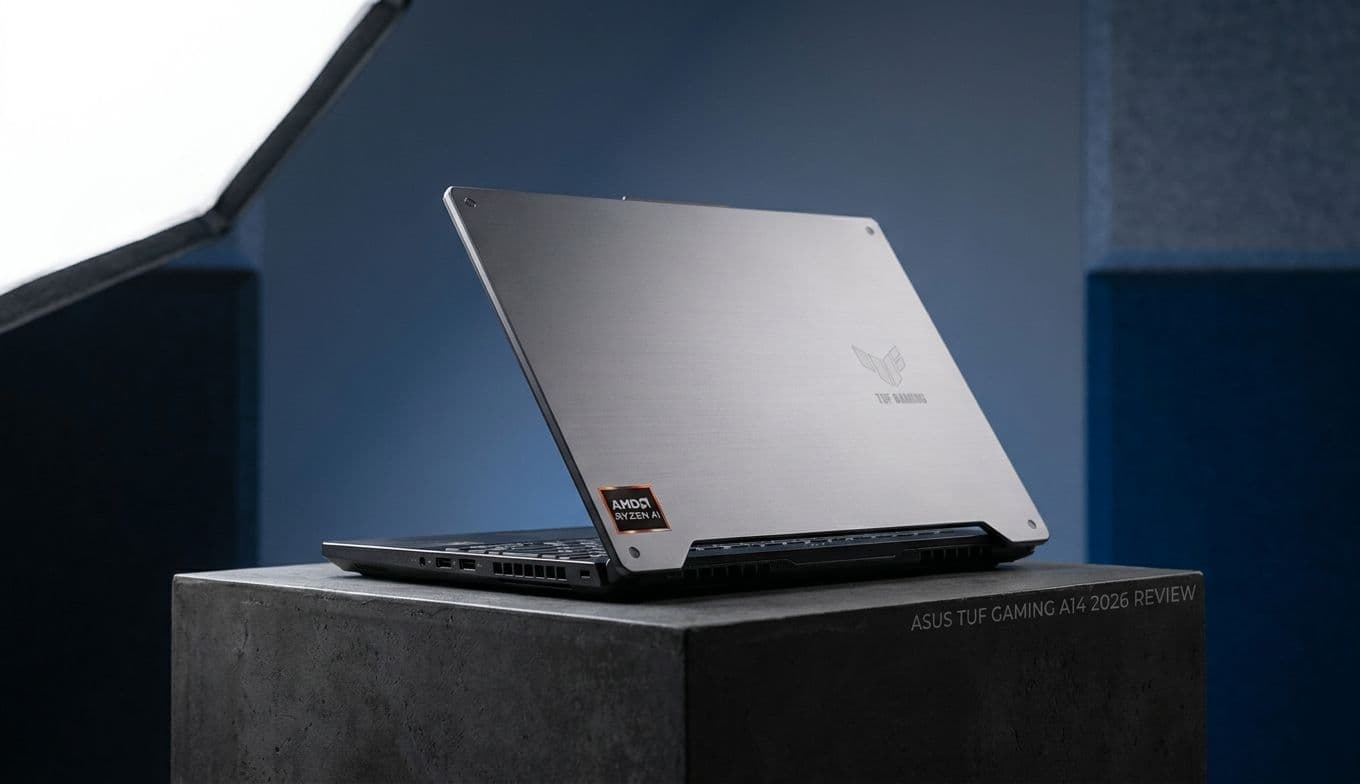
Asus TUF Gaming A14 2026 Review: GPU-Less Gaming Tested
Team GimmieThe Asus TUF Gaming A14 (2026) Review: Does a GPU-Less Gaming Laptop Actually Work?
Imagine opening a sports car's hood only to find the engine missing. That is the immediate, gut-level reaction many of us have to the Asus TUF Gaming A14. In a category defined by the brute force of dedicated graphics cards—those massive, power-hungry chips from Nvidia or AMD that do the heavy lifting—Asus has done the unthinkable. They’ve stripped it out.
The 2026 edition of the TUF Gaming A14 is a bold experiment in minimalist power. Instead of a discrete GPU, it relies entirely on AMD’s latest Ryzen AI silicon and its integrated XDNA graphics architecture. It is a move that promises a lighter chassis, cooler temperatures, and legendary battery life. But for a brand that literally has Gaming in its name, the question isn't just whether it’s innovative. The question is whether it can actually play the games you care about without turning into a glorified slideshow.
Quick Specs and Pricing
Before we dive into the performance, let’s look at what is actually inside this machine. The A14 is positioned as a premium mid-range ultraportable that happens to have gaming DNA.
Model: Asus TUF Gaming A14 (2026) Processor: AMD Ryzen AI 9 HX 370 with integrated Radeon 890M Graphics Memory: 32GB LPDDR5X (Soldered) Storage: 1TB NVMe PCIe 4.0 SSD Display: 14-inch 2.5K (2560 x 1600) IPS, 165Hz refresh rate Weight: 3.2 lbs (1.45 kg) MSRP: $1,199
The Silicon Gamble: Can Integrated Graphics Truly Compete?
For years, the term integrated graphics was shorthand for "can barely run Excel." That changed with the 2026 wave of AMD Ryzen AI chips. By merging the Neural Processing Unit (NPU) with more powerful graphical cores, Asus is betting that local AI upscaling and improved architecture can bridge the gap.
In practice, the results are a fascinating mixed bag. To understand this laptop, you have to redefine what gaming means to you. If you are a competitive esports player, the A14 is a revelation. Because the laptop doesn’t have to power a massive RTX 50-series card, it stays remarkably quiet and thin.
During our testing, Valorant at 1080p on High settings soared at a consistent 135 frames per second (FPS). League of Legends was even smoother, often hovering around 170 FPS. For the millions of people who spend their time in these titles, the TUF A14 provides a flawless experience in a frame that’s half the weight of a traditional gaming rig.

However, the "GPU-less" dream hits a wall when you move into the world of AAA blockbusters. We fired up Cyberpunk 2077 at 1080p, and even on Low settings with AMD’s FSR (FidelityFX Super Resolution) set to Balanced, we averaged just 32 FPS. It’s playable, but it isn’t pretty. Similarly, Shadow of the Tomb Raider on Medium settings managed about 46 FPS. You aren't getting the cinematic, high-fidelity experience here. You are getting "just enough" to get by.
The Silver Lining: Battery Life and Portability
If the gaming performance is a compromise, the "lifestyle" performance is a victory. This is where the removal of the dedicated GPU pays its biggest dividends.
Most gaming laptops are tethered to a wall. If you get four hours of unplugged work time, you’re lucky. Because the TUF A14 doesn't have a secondary power-hungry chip to feed, its endurance is staggering for a machine in this class. In our productivity loop—which involves web browsing, document editing, and occasional video streaming—the A14 lasted a full 11.5 hours.
This effectively transforms the TUF from a "gaming laptop" into a "work laptop that can game." It fits easily onto an airplane tray table or a cramped coffee shop desk. At just 3.2 pounds, you genuinely forget it’s in your backpack. For a student who needs to go from a six-hour day of lectures to a couple of hours of Overwatch in the dorm, this balance is actually quite brilliant.
Who Is This Laptop For? A Gifting Guide
Buying a laptop as a gift is always a high-stakes endeavor. Because the TUF A14 is such a niche product, it is easy to get it wrong. Before you hit the checkout button for a friend or family member, run through this three-point checklist:
-
Does the recipient play modern, high-fidelity titles? If they are constantly talking about the latest Ray-Tracing effects in games like Alan Wake 2 or the newest Call of Duty, skip this. They will be disappointed by the frame rates.
-
Is portability more important than power? This is the perfect gift for a college student or a digital nomad. If they need one device that handles a full day of classes or meetings but still lets them play indie hits like Hades II or Minecraft at night, this is a home run.
-
Are they tech-curious? The TUF A14 is a conversation starter. For the enthusiast who loves being on the bleeding edge of new categories—like the first wave of foldable phones or AI-integrated hardware—this is a fascinating piece of kit.
The Verdict: A Bold Step Toward the Future
The Asus TUF Gaming A14 (2026) is not the best gaming laptop on the market, but it might be one of the most important. It represents a shift in how we think about mobile computing. Asus is acknowledging that not every gamer needs a four-pound brick that burns a hole in their lap.
By ditching the dedicated GPU, they’ve created a machine that is durable, exceptionally long-lived, and perfectly capable of handling the most popular games in the world (the esports and indie titles).
However, the $1,199 price point is a tough pill to swallow when you realize that for the same price, you could buy a traditional laptop with a dedicated RTX 4060 or 5060 that would lap this machine in raw performance. You are paying a premium for the engineering required to make a GPU-less system work this well.
If you value the freedom of an 11-hour battery and a light bag over the ability to crank your graphics settings to Ultra, the TUF A14 is a glimpse into a very bright, very portable future. Just don't expect it to slay dragons at 4K.