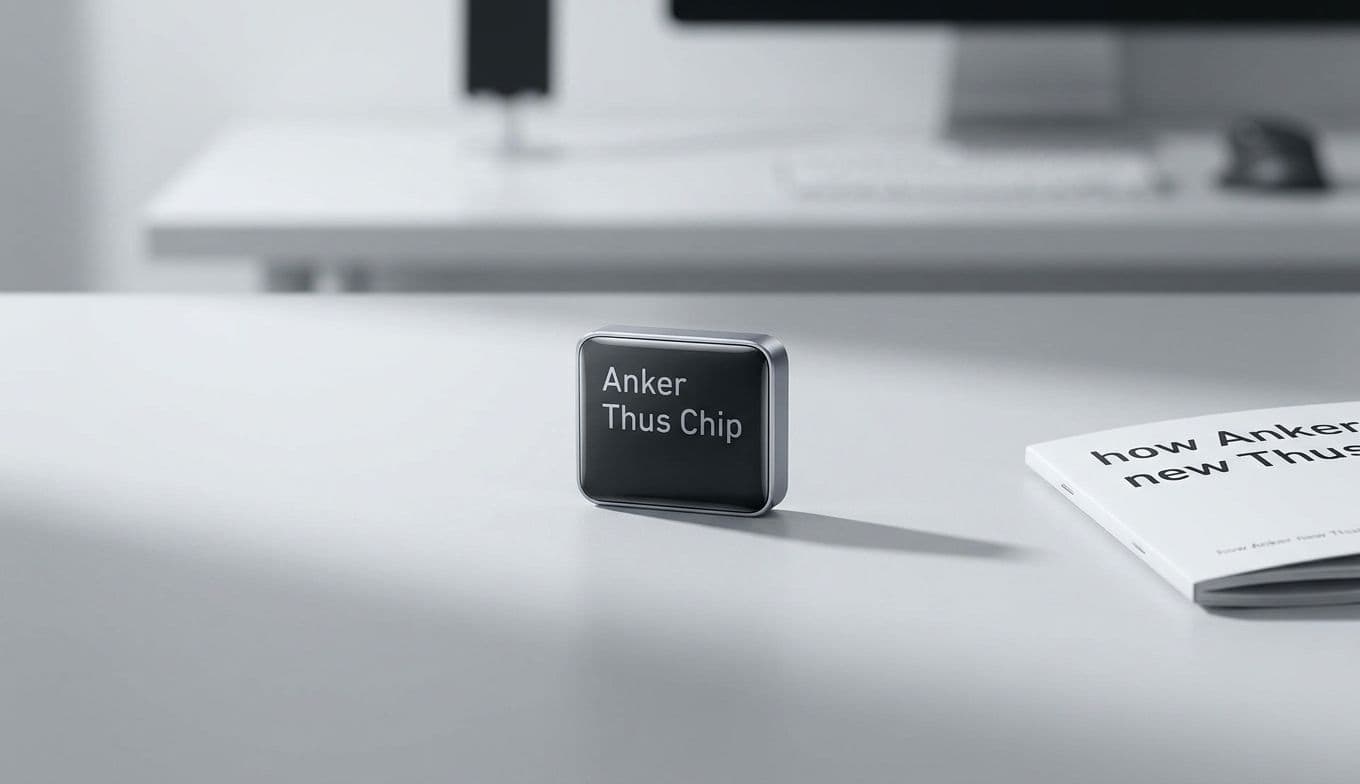
Anker Thus Chip: The Future of Local AI in Headphones

Anker Thus Chip: The Future of Local AI in Headphones

Team GimmieTeam Gimmie
Published on April 22, 2026

ANKER IS BUILDING ITS OWN AI SILICON: HERE IS WHY YOUR NEXT PAIR OF HEADPHONES MIGHT ACTUALLY BE SMARTER

If you feel a sense of overwhelming fatigue every time a brand slaps the letters AI onto a new product, you are not alone. We have reached a point where even toothbrushes and coffee mugs are claiming to be AI-powered, usually as a thin veil for basic automation. So, when Anker—the company we all trust for the power banks living in our backpacks—announced it was developing its own custom AI chip, I initially met the news with a heavy dose of skepticism.

But after digging into the specifics of their new Thus chip, I am starting to think this might be one of the few instances where the hype matches the utility. Anker isn't trying to build a chatbot for your charger; they are trying to solve the fundamental efficiency problems that plague small, portable electronics. By moving the processing power from the cloud directly onto the device, Anker is making a play to change how we use our everyday gadgets.

THE THUS CHIP: WHY LOCAL BRAINS BEAT CLOUD CLOUT

To understand why this matters, you have to look at how most modern gadgets work. Right now, when you give a voice command to a smart device or ask your earbuds to filter out a sudden loud noise, that data often has to travel from your device to a server hundreds of miles away, get processed, and then travel all the way back. This is why there is often a lag between your command and the action.

Anker’s CEO, Steven Yang, pointed out that traditional chips are like a kitchen where the ingredients are stored in a warehouse across town. Every time you want to cook, you have to drive back and forth. The Thus chip uses something called neural-net compute-in-memory architecture. Essentially, it puts the pantry inside the kitchen. By integrating memory and processing, the chip can perform complex calculations almost instantly without draining the battery.

For those of us who live in our headphones, this is the holy grail. It means noise cancellation that can adapt to a siren or a sudden gust of wind in milliseconds, rather than seconds. It means voice assistants that actually feel conversational because they aren't waiting for a server to tell them what you said.

THE PRIVACY DEEP DIVE: WHY LOCAL AI IS A GIFTING WIN

If you are looking for a gift for a tech-savvy friend or a privacy-conscious family member, the term local AI should be at the top of your checklist. Most competing smart devices rely on cloud-based AI, which means a recording of your voice or data about your habits is being sent to a third-party server.

Because the Thus chip processes data on the device itself, that information never has to leave the hardware. This creates a closed loop that is significantly harder to hack and impossible for big tech companies to harvest for advertising data. When you give someone a device with local AI, you aren't just giving them a gadget; you are giving them the peace of mind that their smart home or audio habits aren't being tracked in a database somewhere. In an era of constant data breaches, that is a massive selling point that goes beyond mere tech specs.

BUY NOW OR WAIT? THE GIFT-GIVER’S ROADMAP

This is the question that always haunts tech enthusiasts: Should I buy the current model or wait for the new one? With Anker’s Thus chip on the horizon, here is how you should navigate your next purchase.

IF YOU NEED IT TODAY: The current Soundcore lineup is still industry-leading in terms of value. The Soundcore Liberty 4 NC remains the gold standard for noise cancellation under a hundred dollars. If you are buying a gift for a graduation or a birthday this month, do not hesitate. These products are refined, reliable, and will still be excellent two years from now. The same goes for the Anker MagGo charging line—if you need power on the go today, the current Qi2 products are fantastic.

IF YOU CAN WAIT SIX MONTHS: If you are eyeing a major upgrade for the holiday season or a big trip later this year, you might want to hold off. The first wave of Thus-equipped products will likely hit the audio category first. We expect the next iteration of the Soundcore Liberty Pro series to feature this chip. If you want a pair of earbuds that offers transparency modes so natural you forget you are wearing them, or battery life that stretches into multiple days of heavy AI use, waiting for the Thus-powered versions will be worth it.

CUTTING THROUGH THE HYPE: THE REAL-WORLD HURDLES

As promising as this sounds, we have to remain objective. No new technology is a guaranteed win. There are two specific hurdles Anker has to clear before we declare the Thus chip a total victory.

First, there is the AI Tax. Custom silicon is expensive to develop. Anker has built its reputation on being the affordable alternative to premium brands like Apple or Sony. If the inclusion of the Thus chip pushes their earbud prices into the three-hundred-dollar range, they lose their competitive edge. We want smarter tech, but we don't want to pay a fifty percent premium for it.

Second, we have to watch out for Feature Creep. Just because a chip can do complex computations doesn't mean it should. I don't need my portable power bank to tell me the weather or analyze my mood. Anker needs to ensure they stay focused on practical improvements—like better battery management and clearer call quality—rather than adding gimmicky voice features that no one actually uses.

THE EDITORIAL VERDICT: A CALCULATED EVOLUTION

Anker isn't a company that usually chases shadows. They grew from a small charging brand into a tech giant by focusing on the boring stuff that matters: battery life, durability, and port selection. By building their own AI chip, they are applying that same utilitarian philosophy to the world of silicon.

The Thus chip isn't about making a flashier product; it is about making a more efficient one. If Anker can successfully integrate this local AI without ballooning the price, they will have effectively future-proofed their entire catalog.

My advice? Keep a close eye on the Soundcore releases toward the end of 2026. If the Thus chip delivers even half of the promised efficiency gains, it won't just be a gimmick—it will be the new baseline for what we expect from our everyday gear. For now, enjoy the current crop of great Anker tech, but save a spot on your holiday wishlist for the moment these local AI chips finally hit the shelves. It is rare to see a company take such a bold step into hardware manufacturing, and if Anker’s track record is any indication, the results are going to be worth the wait.