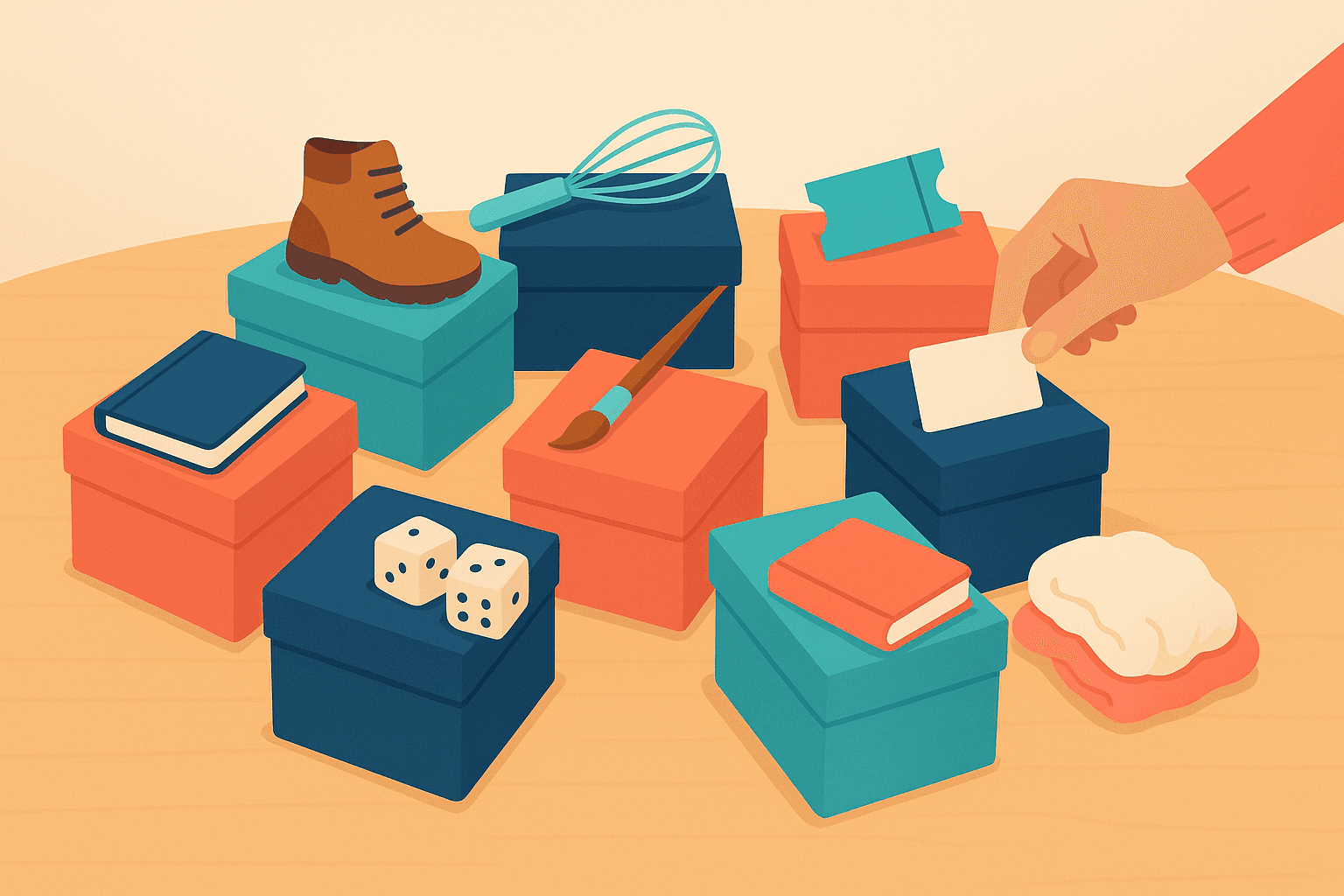
8 personality-based gifts: How to pick the perfect present
Pick a gift that actually lands: this guide uses Gimmie's 8-Color personality system to match 40+ concrete gift ideas, retailers, and message lines for every relationship and budget.
Gifting fails when choice ignores the person. Personality-based gifting is the simple answer: match the gift to who they are, not who you wish they were. Gimmie’s 8-Color Consumer Psychology System turns personality signals (likes, language, habits) into predictable gift types so you stop guessing and start giving gifts that make people feel seen.
What is personality-based gifting?
Personality-based gifting is defined as choosing presents that map to a recipient’s core preferences, decision style, and emotional needs. It works by identifying personality cues—interests, language, shopping patterns—and matching those to specific gift categories and messages.
Personality-based gifting reduces mismatch. Gimmie builds profiles from eight color archetypes—each linked to precise product types, price bands, and message tones—so a gift from Patagonia, Etsy, Sephora, or Williams Sonoma lands for the right reason.
How does Gimmie's 8-Color system work?
Gimmie's 8-Color system groups consumers into eight personality archetypes and prescribes a primary gift type, message tone, and three retailer/product examples for each. The system uses behavior (shopping history), stated preferences (wishlists), and conversational cues to assign a color.
The eight colors are: Red (Adventurous), Blue (Thoughtful), Green (Practical), Yellow (Social), Purple (Creative), Orange (Playful), Teal (Curious), Gray (Comfort-seeking). Each color maps to a distinct emotional trigger—for example, Red values novelty and experience (REI, Airbnb, Patagonia), while Gray values comfort and ritual (Brooklinen, Williams Sonoma, Nespresso).
Red (Adventurous) — Core need: Novelty & challenge; Best gift category: Experiences, outdoor gear; Example retailer/products: REI experiences, Patagonia jacket (~$150), GoPro (~$300)
About Team Gimmie
A small team of friends and colleagues working together to produce useful content to help you...gift better.
Blue (Thoughtful) — Core need: Meaning & memory; Best gift category: Personalized keepsakes; Example retailer/products: Moleskine notebooks, Etsy engraved art (~$40), Polaroid camera (~$100)
Green (Practical) — Core need: Utility & longevity; Best gift category: Tools, kitchen, tech; Example retailer/products: Anova sous-vide (~$200), Leatherman, Anker chargers (~$30)
Yellow (Social) — Core need: Status & shared fun; Best gift category: Party kits, fashion; Example retailer/products: Sephora sets, Nike sneakers, Cocktail kit from Williams Sonoma (~$60)
Purple (Creative) — Core need: Self-expression; Best gift category: Art supplies, workshops; Example retailer/products: Skillshare class, Blick art set (~$50), Cricut machine (~$250)
Orange (Playful) — Core need: Surprise & delight; Best gift category: Games, novelty; Example retailer/products: Nintendo Switch games, funky home gadgets from UncommonGoods (~$35)
Teal (Curious) — Core need: Learning & discovery; Best gift category: Books, science kits; Example retailer/products: National Geographic subscriptions, MasterClass, Kindle (~$90)
Gray (Comfort-seeking) — Core need: Security & ritual; Best gift category: Cozy goods, subscriptions; Example retailer/products: Brooklinen sheets, Nespresso, weighted blanket (~$130)
How do I pick a gift in five steps?
Identify their color, choose the primary gift category, pick one specific product from a trusted retailer, add a message that matches tone, and wrap or time the gift to amplify impact. Follow these five steps and you remove guesswork.
Observe: scan Instagram likes, recent purchases, or ask casual questions. Red looks for adventures; Gray posts cozy corners.
Select category: experience for Red, keepsake for Blue, tool for Green, party item for Yellow, creative kit for Purple, playful gadget for Orange, class/book for Teal, comfort for Gray.
Pick retailer/product: choose a reliable brand—REI for outdoor, Etsy for personalized, Sephora for beauty, Williams Sonoma for kitchen gear.
Write the message: match tone (e.g., adventurous: “Let’s go!”; thoughtful: “So you can remember this.”).
Time + presentation: schedule an experience or deliver a wrapped box with a single-line note that reinforces the color.
What are concrete gift ideas for each color?
Below are high-probability gifts by archetype with retailer and price guidance so you can shop fast and confidently. These are actionable, tested match-ups that Gimmie recommends in live gifting flows.
Red (Adventurous): REI day-hike pack (~$80), Airbnb experience voucher ($50–200), Patagonia Nano Puff jacket (~$150).
Blue (Thoughtful): Custom photo book from Artifact Uprising (~$50), Moleskine limited notebook ($20), engraved pendant from Etsy (~$45).
Match the message tone to the recipient’s color: upbeat and challenge-oriented for Red, detail and memory for Blue, straightforward for Green, celebratory for Yellow, expressive for Purple, quirky for Orange, curious for Teal, and soothing for Gray. The message multiplies the gift’s emotional value.
Examples:
Red: “Two nights, one big adventure. When can we go?”
Blue: “So you always have a place to keep these memories.”
Green: “Practical, lasting, and exactly what you asked for.”
Gray: “Because home feels better with this.”
Presentation tips:
Use low-key luxury for Gray (soft paper, neutral ribbon).
Use playful unboxing for Orange (bright tissue, stickers).
Include a physical memento (photo, handwritten note) for Blue.
What if I don't know their color—what quick hacks work?
When in doubt, use a three-option strategy: one experience, one keepsake, and one consumable—each with a simple message. This hedges across colors and keeps returns low.
Quick hacks:
Send a digital gift card with a suggested use (e.g., “Use this for a coffee date—my treat.”).
Choose time-boxed experiences (concerts, classes) which appeal across Red, Yellow, and Teal.
Pair a small keepsake (Etsy) with a consumable (Sephora mini set, food box) for balance.
What mistakes to avoid?
Avoid gifting purely for your taste, confusing novelty with meaning, or choosing a one-size-fits-all trendy item without a contextual message. These cause the most disappointment and returns.
Common missteps:
Over-personalizing without knowing context (e.g., engraved pet name when they value privacy).
Picking expensive tech (Apple AirPods) for someone who values experiences—costly mismatch.
Sending a gift with no note. A simple line transforms perceived intent.
The bottom line
Personality-based gifting turns guesswork into predictable delight. Use Gimmie’s 8-Color framework to choose the right category, a trusted retailer, and a matching message. That combination creates meaningful reactions, fewer returns, and gifts people actually remember.
Want a shortcut? Try giving one well-chosen experience, one keepsake, and a short, color-matched note. For more tailored matches, explore Gimmie’s personality prompts and sample messages in the app.
8 personality-based gifts: How to pick the perfect present | Gimmie