
NIMA Gluten Sensor Review 2026: Accuracy, Cost & Safety Guide
Is the NIMA Gluten Sensor worth the investment in 2026? We review its accuracy, $5-per-test cost, and pros/cons for celiac safety. Read the full guide.

By Team Gimmie
Updated August 27, 2026
The Gluten-Free Guessing Game: Why the NIMA Sensor is the Ultimate 2026 Peace-of-Mind Gift
For anyone living with celiac disease or a severe gluten intolerance, the simple act of dining out often feels less like a social pleasure and more like a high-stakes tactical mission. You cross-examine the server, you double-check the menu, and you pray that the kitchen staff takes cross-contamination as seriously as you do. Despite your best efforts, that lingering anxiety—the "gluten-free guessing game"—remains.
In the rapidly evolving landscape of 2026 health technology, we are seeing a shift toward personalized safety gadgets that empower individuals to take health monitoring into their own hands. Leading this charge for the gluten-sensitive community is the NIMA Gluten Sensor. It is a device that promises to replace "I hope this is safe" with "I know this is safe."
The Science of a Smile
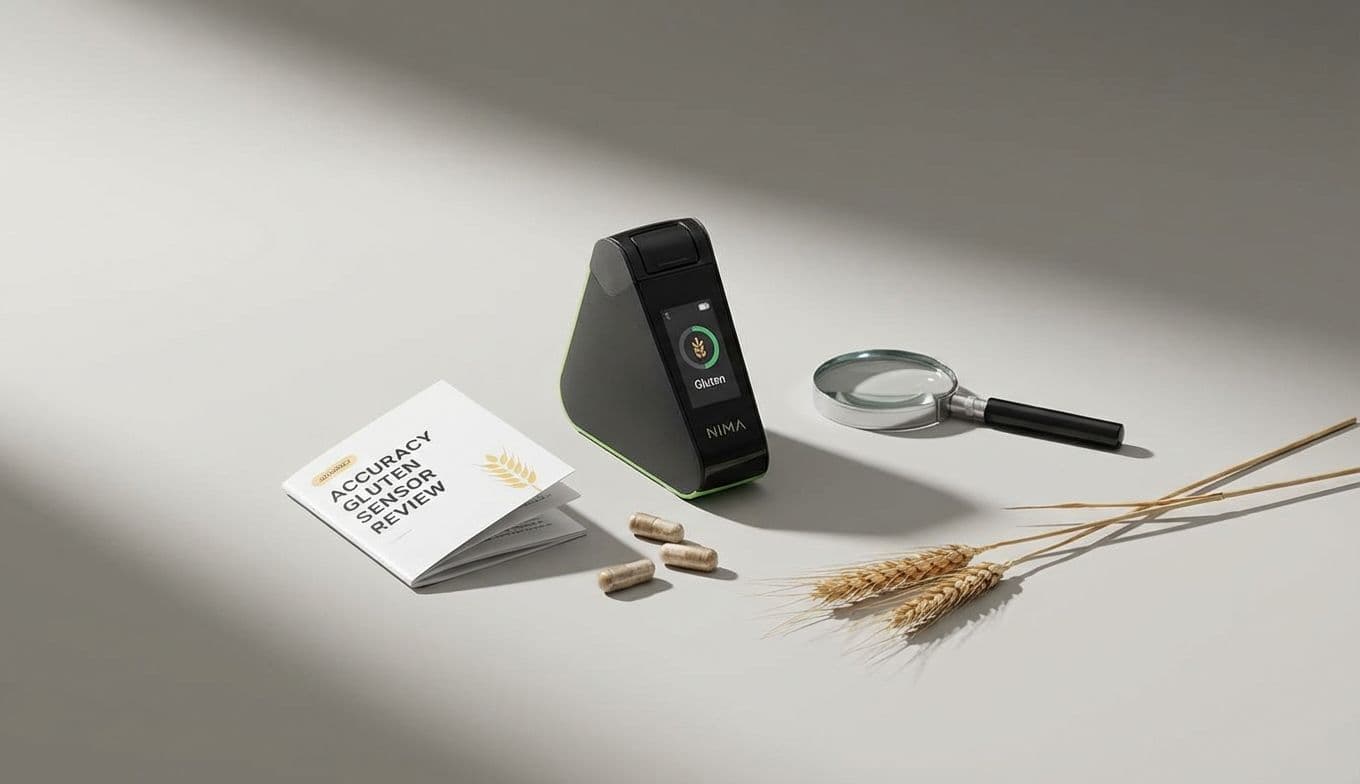
The NIMA sensor is a sleek, triangular device that fits easily into a pocket or evening bag. But beneath its minimalist exterior is a sophisticated chemistry-based test designed to detect gluten down to 20 parts per million (ppm). For context, 20 ppm is the international standard and the FDA threshold for labeling a product gluten-free. It is the level at which most medical professionals agree food is safe for those with celiac disease.
The process is remarkably simple, though it requires a bit of ritual. You take a pea-sized sample of your food, place it in a single-use disposable capsule, and screw the cap down to grind the sample. Once you insert the capsule into the sensor, it begins an automated lateral flow immunoassay—the same type of technology used in rapid medical tests. Within about two to three minutes, the screen displays a result. A smile means no gluten was detected; a wheat icon with a frown means you should probably put the fork down.
Mastering the Sample: More Than Just a Bite
One of the biggest hurdles for new users is understanding that a single test only reflects the sample provided. If you are testing a complex dish, like a chicken stir-fry or a loaded pizza, the "pea-sized sample" rule requires some strategy.
To get an accurate reading, you must be a bit of a culinary detective. Do not just test the protein. If you are suspicious of a sauce, ensure the sample is saturated with it. If you are testing a salad that might have been contaminated by croutons, grab a bit of the dressing and a small piece of the greens. The most effective way to use NIMA in a restaurant setting is to take a tiny bit from several different areas of the dish, mix them slightly, and use that composite as your test sample. This "multi-component" approach is the best defense against hidden pockets of flour or contaminated kitchen utensils.
