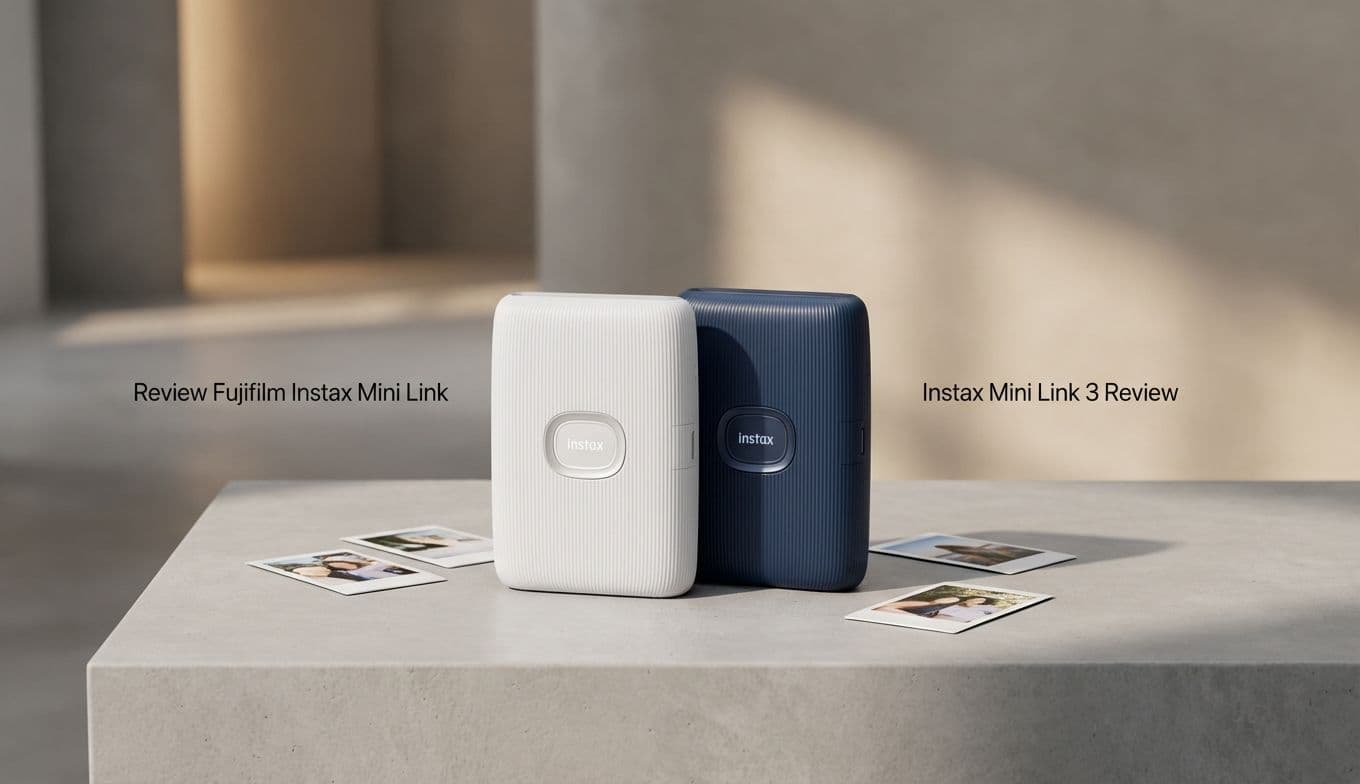
Fujifilm Instax Mini Link 3 Review: Is the Upgrade Worth $170?

Team Gimmie

Team Gimmie

1/31/2026

Fujifilm Instax Mini Link 3 Review: Is the Upgrade Worth $170?

THE TACTILE JOY OF THE TAPE-IN JOURNAL

There is a specific, quiet ritual to finishing a travel journal entry. I am sitting in a corner cafe, the smell of roasted beans and old paper in the air, carefully pressing a strip of washi tape over a small, white-bordered photo. That physical sensation—the slight weight of the Instax print and the way it textures a page of handwritten notes—is something a digital screen can never replicate.

For years, the Instax Mini Link series has been the gold standard for this kind of analog-meets-digital storytelling. My old $100 Instax Mini Link+ was a constant companion, a reliable little tool that turned my iPhone’s camera roll into a pile of tangible memories. But Fujifilm has just raised the stakes—and the price—with the new Instax Mini Link 3. Coming in at $169.95, it represents a massive 70 percent price jump over its predecessor.

When a gadget gets nearly twice as expensive, the question is no longer just "is it good?" The question is "does it change the game?" After putting the Mini Link 3 through its paces, I found that while it definitely elevates the Instax experience, the answer depends entirely on how much you value the difference between a blurry memory and a crisp one.

CLEARING UP THE NAME GAME

Before we dive into the performance, let’s clear up a bit of naming confusion that has been swirling around this release. In the world of Fujifilm, versions often overlap. The previous iteration, which many of us have used for years, is the Mini Link+. It was the budget-friendly $100 workhorse. The brand-new model we are discussing here is the Instax Mini Link 3.

While they look similar and use the exact same credit-card-sized film, the Link 3 is positioned as a premium upgrade. You aren’t just paying for a newer number on the box; you are paying for an entirely different internal engine. However, as we’ll see, not every new bell and whistle justifies that premium price tag.

THE DESIGN PRINT MODE: MARKETING VS. REALITY

If you look at the promotional materials for the Mini Link 3, you’ll see a lot of hype surrounding the new Design Print mode. Fujifilm claims this feature is specifically engineered to make text, fine lines, and intricate illustrations look professional and legible on that tiny 2-inch by 3-inch canvas.

I’m going to be direct: do not buy this printer for the Design Print mode.

In real-world testing, the improvement in text legibility is marginal at best. We are dealing with chemical film development here, not a high-resolution laser printer. No matter what the software tells the hardware to do, the physics of instant film will always result in a bit of "bleed." If you were hoping to print tiny, crisp recipes or detailed quotes for your scrapbook, you are going to be disappointed. The text still looks like it was printed on an instant camera—charming, yes, but certainly not a revolution in clarity. This specific feature feels like a marketing reach rather than a functional breakthrough.

WHERE THE UPGRADE ACTUALLY LIVES

If the headline feature is a flop, why consider the Link 3 at all? Because while the Design Print mode underwhelms, the internal image processing is a revelation. This is where your extra $70 is actually going.

The previous models were famous for what I call the "Instax haze." Photos often came out looking a bit muddy, with shadows that blended into a single black blob and highlights that looked washed out. The Mini Link 3 fixes this with significantly improved contrast and color science.

When you print a landscape or a portrait, the colors pop with a vibrancy that the older Link+ simply can’t match. The blacks are deeper, the skin tones are warmer, and the sharpness—while still maintaining that dreamy, analog aesthetic—is noticeably better. It’s the difference between a photo that looks like a low-res copy and one that feels like a deliberate piece of art. For the serious journaler or the person who wants their physical prints to actually look like the high-def photos on their phone, this processing upgrade is tangible and impressive.

WHO SHOULD SPEND THE EXTRA CASH?

Given the steep price increase, the Mini Link 3 isn't a "must-buy" for everyone. It fits into a specific niche for specific types of creators.

The Dedicated Journaler If you are someone who spends hours every week meticulously documenting your life in a Hobonichi or a travel notebook, the Mini Link 3 is for you. The improved contrast means your photos will stand out against the page, and the longevity of the better-processed image is worth the investment. It turns your journal from a scrapbook into a high-quality archive.

The Aesthetic Gift-Giver If you are looking for a graduation or birthday gift for a creative teen or a college student, this is the current "it" gadget. It’s sleek, the app is fun to use, and it carries a certain status that the older, cheaper models lack. It’s a premium gift that feels substantial.

The Perfectionist Photographer If you have always been slightly frustrated by the "muddiness" of instant prints, this is the printer that will finally satisfy you. It bridges the gap between the fun of the Instax format and the quality expectations of modern smartphone photography.

THE BOTTOM LINE ON VALUE

We have to talk about the math. At $169.95, you are spending a lot of money before you even buy your first pack of film. And remember: the film is an ongoing tax. A standard 10-pack of Instax Mini film usually costs between $10 and $15. If you are a high-volume printer, your first year of ownership could easily clear $300.

Is the Mini Link 3 worth the 70 percent price hike over the $100 Mini Link+?

If you just want the "vibes" of an instant photo to hand out at a party, the answer is no. Stick with the older model or look for a refurbished version. The "charm" of a slightly blurry photo is free, and you can spend that saved $70 on five extra packs of film instead.

However, if you view your prints as a long-term record—if you want the colors of that sunset in Maui to actually look like a sunset and not a brown smudge—then the Mini Link 3 is a worthy, albeit expensive, upgrade. It is a more mature version of a playful product. It’s not a revolution, but for those who care about the details, those details are finally sharp enough to see.

#Instax Mini Link 3 vs Mini Link+#Instax Mini Link 3 price#Design Print mode review#best instant printer for journaling#Instax Mini film cost