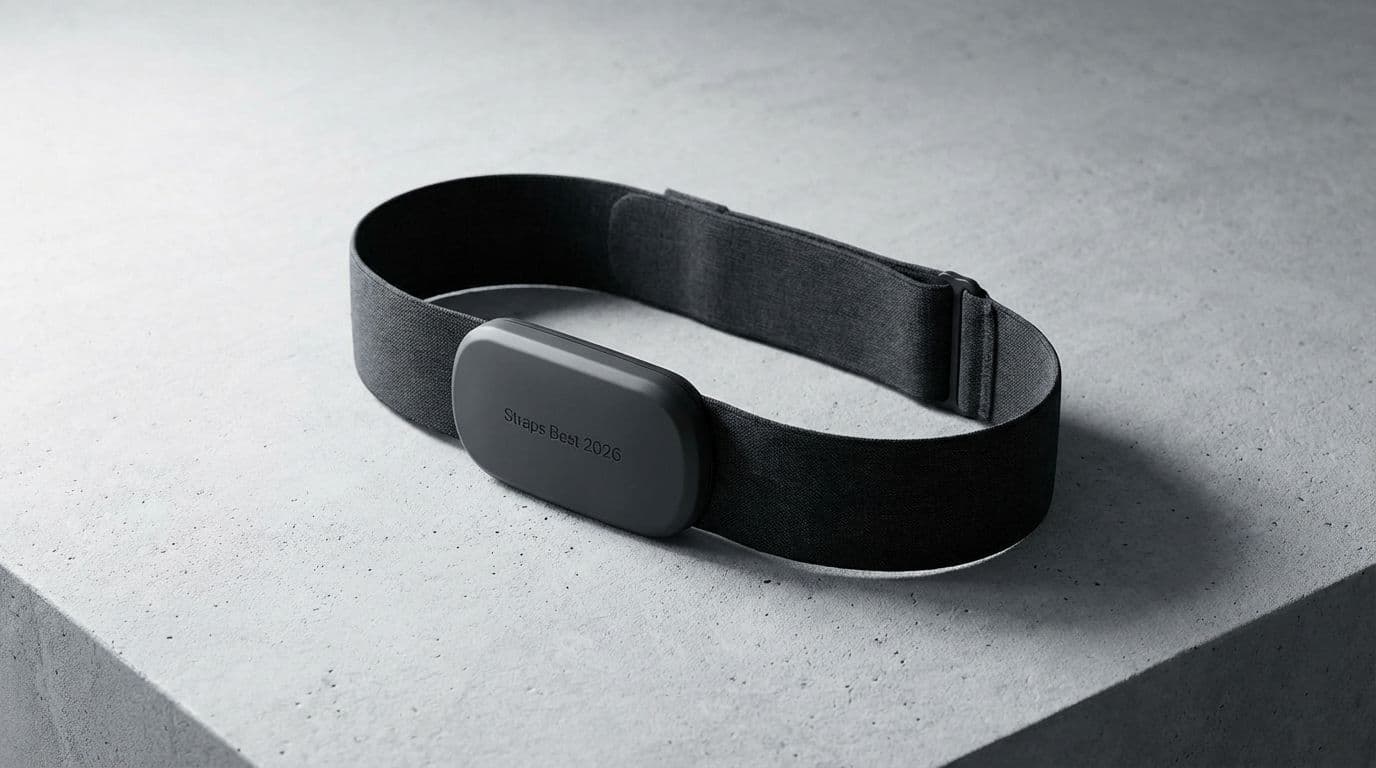
Best Heart Rate Chest Straps 2026: Top Picks & Smartwatch Comparison

Team Gimmie

Team Gimmie

1/14/2026

Best Heart Rate Chest Straps 2026: Top Picks & Smartwatch Comparison

THE HEART OF THE MATTER: WHY CHEST STRAPS STILL OWN THE GYM IN 2026

We have all been there. You are halfway through a brutal set of heavy kettlebell swings or a 400-meter sprint, your lungs are screaming, and you glance down at your top-of-the-line smartwatch only to see a heart rate of 98 beats per minute. A few seconds later, while you are standing still catching your breath, the number suddenly jumps to 170. It is a frustrating lag that athletes call the ghost in the machine, and in 2026, despite all our technological leaps, it is the primary reason why the humble chest strap remains the undisputed king of performance data.

After a decade of testing everything from basic pulse-oximeters to high-end smart rings, I have learned one hard truth: if you want to train with precision, you have to go to the source. Your wrist is a noisy neighborhood for data. Skin tone, sweat, ambient light, and the literal movement of your arm during a workout all interfere with optical sensors. A chest strap, however, sits right over the engine. It listens to the electrical impulses of your heart, providing medical-grade accuracy that your watch simply cannot replicate during high-intensity movement.

THE 2026 UPGRADE: SPATIAL FITNESS AND CONNECTIVITY

You might wonder why we are still talking about chest straps in 2026. Haven't smartwatches caught up? While wrist-based sensors have improved for steady-state activities like walking or sleeping, the demands of modern fitness have evolved even faster.

The biggest shift we have seen this year is the explosion of spatial fitness. Whether you are training in a Meta Quest 4 or using the latest Apple Vision Pro fitness modules, these immersive environments demand zero-latency data. When you are dodging virtual obstacles or boxing in an augmented reality ring, the split-second delay of an optical wrist sensor ruins the experience.

Modern 2026 chest straps have adapted by integrating dual-band Bluetooth 6.0 and ultra-low-power connectivity. This allows them to beam your vitals to your headset, your bike computer, and your gym’s rowing machine simultaneously without a hiccup. We are also seeing a massive leap in battery longevity; the latest models are pushing 500 hours of active use on a single coin cell, making them the most reliable tool in your gear bag.

THE TOP THREE STRAPS FOR EVERY TYPE OF ATHLETE

Choosing a monitor depends entirely on how you move. I have narrowed the field down to three distinct champions that represent the best of what 2026 has to offer.

  1. THE PROFESSIONAL STANDARD: POLAR H10 The Polar H10 is the industry benchmark for a reason. It is the strap that researchers use in clinical studies because its accuracy is as close to a laboratory ECG as you can get. In 2026, it remains a favorite because of its simplicity and the quality of its Pro Strap—the actual fabric band. It uses tiny silicone friction dots to ensure the sensor does not slide down your torso during a sweaty HIIT session. If you are a competitive runner or someone who obsesses over Heart Rate Variability (HRV) for recovery, this is your gold standard.

  2. THE INDEPENDENT PERFORMER: WAHOO TICKR X The TICKR X is designed for the person who wants to leave the world behind. It features significant internal memory that can store up to 50 hours of workout data. This is perfect for the swimmer or the athlete who finds a smartphone or watch distracting during training. You simply strap it on, do your work, and sync it later. The 2026 model also includes advanced motion analytics, giving you a smoothness score for your cycling cadence or your running form, making it much more than just a heart rate tracker.

  3. THE DATA ARCHITECT: GARMIN HRM-PRO PLUS For the triathlete or the hardcore data nerd, the HRM-Pro Plus is unmatched. While it pairs beautifully with the Garmin ecosystem, its real power lies in its Running Dynamics. It tracks vertical oscillation, ground contact time, and stride length—data points that used to require a full sports-science lab. If you are training for a marathon and want to see exactly how your form breaks down as you fatigue, this is the tool that will tell you. It also features a tool-less battery door, a small but much-appreciated 2026 design refinement.

THE BUYERS CHECKLIST: COMPATIBILITY SECRETS

If you are buying a chest strap as a gift, you want it to be a seamless experience, not a tech-support nightmare. Before you click buy, go through this quick checklist to ensure it fits the recipients existing ecosystem:

Does it support ANT+ and Bluetooth? Most modern straps do, but double-check. Garmin users usually rely on ANT+, while Apple Watch and smartphone users need Bluetooth.

Is the strap size adjustable enough? Most straps are one-size-fits-most, but if you are shopping for a very petite athlete or a large-framed powerlifter, look for brands that offer optional strap extensions.

Does it play well with their favorite apps? Check for specific integrations. For example, if they are a Peloton fanatic or a Zwift cyclist, ensure the strap is listed as a verified compatible device to avoid connection drops mid-ride.

Does it have onboard memory? If they hate wearing a watch or carrying a phone while they exercise, memory is a non-negotiable feature.

A PRO TIP ON STRAP HYGIENE

Here is something the glossy marketing materials never tell you: if you don't take care of your strap, it will eventually lie to you. Salt buildup from dried sweat can interfere with the electrodes, leading to erratic readings or drops in connection.

My expert advice? Rinse the strap under fresh water after every single workout. Once a week, pop the electronic sensor off and wash the fabric strap in a bowl of warm water with a drop of mild dish soap. Never put the strap in a high-heat dryer—it ruins the elasticity and the conductive fibers. Treat your strap like high-performance athletic wear, and it will give you years of accurate data.

WHO ACTUALLY NEEDS THIS IN 2026?

I’ll be honest: if your primary form of exercise is a daily 30-minute walk or light yoga, your smartwatch is more than enough. But the moment you start training for a goal—whether that is a faster 5K, a heavier deadlift, or better cardiovascular health—the margin for error shrinks.

A chest strap is for the person who wants to know, not guess. It is for the athlete who understands that training in the wrong zone is a waste of precious time. In a world of flashy gadgets and AI-generated fitness hype, the chest strap remains a rare thing: a piece of technology that does one thing perfectly. As a gift to yourself or a fellow athlete, it is an investment in the most important data point you have—your own heart.

#Polar H10 vs Garmin HRM-Pro Plus#optical heart rate sensor accuracy#spatial fitness gear#Wahoo TICKR X review#chest strap maintenance