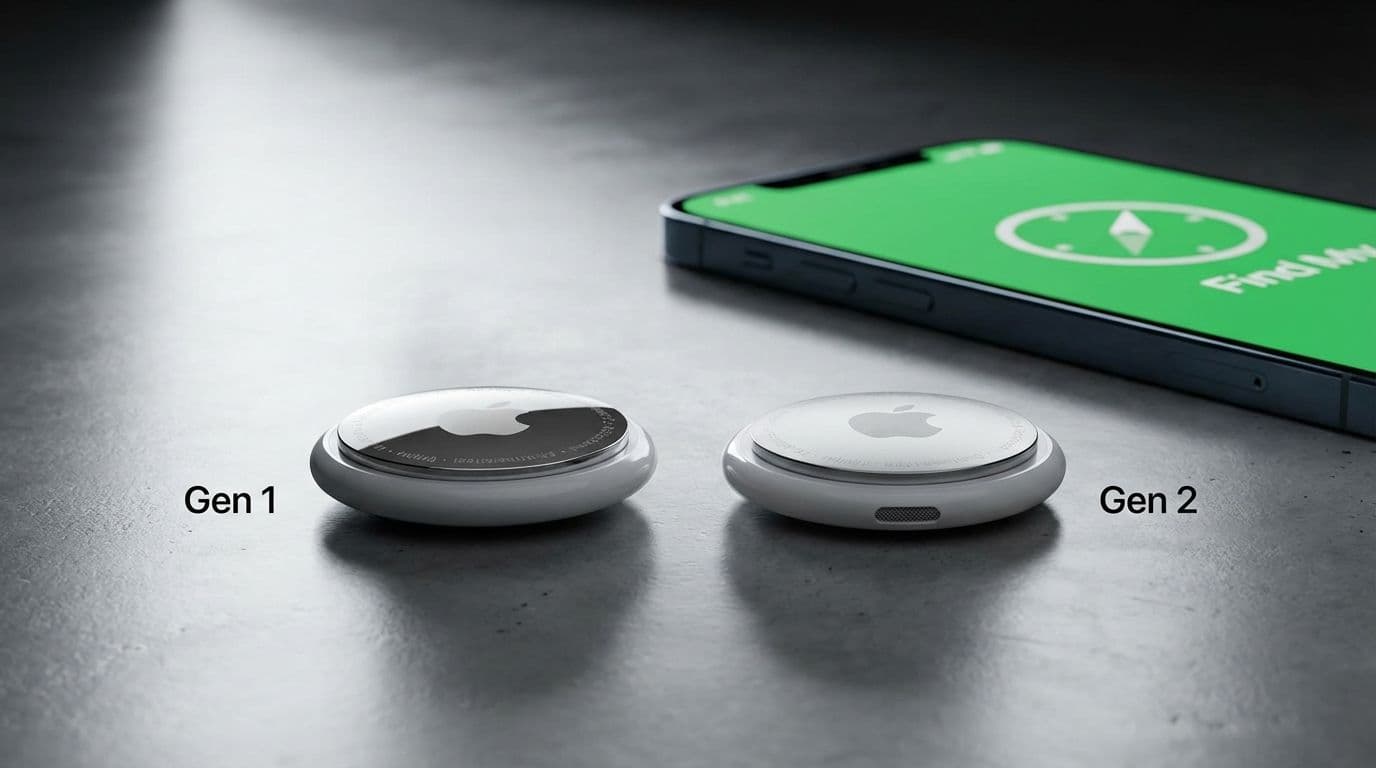
Apple AirTag 2 vs. Gen 1: Should You Buy or Wait in 2026?

Team Gimmie

Team Gimmie

1/31/2026

Apple AirTag 2 vs. Gen 1: Should You Buy or Wait in 2026?

The Art of the Upgrade: Why Apple’s Smallest Gadget Is Suddenly a Big Topic

When Apple simplifies a gadget, it’s usually worth paying attention. Think about the iPod, the iPhone, or the iPad. Each of those devices took a crowded, messy category and stripped it down to its essential function. In doing so, they created something revolutionary. Now, we find ourselves at a strange crossroads with Apple’s most ubiquitous, yet often overlooked, device: the AirTag.

For years, the AirTag has been the default choice for anyone trying to keep tabs on their keys, luggage, or the various items they’re prone to losing. It’s a small, unassuming disc that leverages Apple’s Find My network to turn hundreds of millions of iPhones into a global search party for your stuff. But as we move into 2026, the original AirTag is starting to show its age. It’s functional, sure, but it’s also a bit of a scratch magnet that hasn't seen a hardware refresh since 2021.

With credible leaks and supply chain reports pointing to an AirTag 2 release later this year, we have to ask the question: Is it still worth buying the one that’s currently on the shelf, or should you wait for the next generation?

The Great Wait vs. Buy Debate

If you walk into an Apple Store today, you’re looking at a product that is essentially five years old. That’s an eternity in tech. While the original AirTag still works beautifully within the Find My ecosystem, it has its flaws. The stainless steel back scratches if you so much as look at it the wrong way, and the plastic front isn't much better.

The rumored AirTag 2 promises to address these aesthetic and functional grumbles. We’re expecting a more durable finish—potentially brushed aluminum—and, more importantly, an upgraded Ultra-Wideband chip. This would improve the Precision Finding feature, making it even faster and more accurate when you’re hunting for your keys under a couch cushion.

So, should you buy now? If you have a big international trip coming up next month and you’re worried about your checked bags, don’t wait. A Gen 1 AirTag is better than no AirTag. They are frequently discounted in four-packs right now as retailers clear space. However, if you’re looking to deck out your gear for the long haul and you don't have an immediate emergency, waiting for the 2026 refresh is the smarter play. You’ll likely get better range, improved privacy features to prevent stalking, and a design that doesn’t look like it’s been through a rock tumbler after a week on your keychain.

The Hidden Accessory Tax

One thing that hasn’t changed—and likely won’t with the new version—is the hidden cost of entry. When you look at the price tag, whether it’s $29 for one or $99 for four, keep in mind that the "real" price is higher. Unlike many of its competitors, the AirTag does not have a hole in it.

To actually attach it to anything, you have to buy a holder. Apple will happily sell you a leather key ring or a polyurethane loop for another $15 to $30. For gift-givers, this is a crucial detail. If you give someone just the disc, you’re essentially giving them a chore. You’re giving them a polished pebble they have to keep in a pocket until they go out and buy their own mounting hardware.

This is where third-party competitors like Chipolo and Pebblebee have a distinct advantage. Both brands offer trackers that work natively with Apple’s Find My app, but they often include a built-in hole for a keyring. They are also usually thinner, fitting into wallets more comfortably than the somewhat "bulky" AirTag. If you’re buying for a minimalist who hates extra bulk, those third-party options might actually be the better gift.

The Reality of Pet Tracking

It’s the use case everyone asks about, and it’s the one where we need to be the most honest: tracking your dog or cat. It’s incredibly tempting to slide an AirTag onto a collar for peace of mind, but Apple officially advises against it, and they have good reasons.

First, there’s the safety risk. An AirTag is exactly the right size to be swallowed by a medium-to-large dog. If the dog chews it, the CR2032 coin cell battery inside is highly toxic and can cause life-threatening internal burns if it leaks. Furthermore, the AirTag relies on proximity to other iPhones. If your dog runs off into a wooded area or a rural field where there are no people, the AirTag is useless. It is not a GPS tracker; it is a Bluetooth crowdsourcing tool. For true pet safety, a dedicated GPS collar with its own cellular connection is always the safer, though more expensive, choice.

What Actually Matters to Buyers

Despite the competition and the quirks, the AirTag remains a powerhouse because of the software. When you’re making your decision, focus on these four pillars:

  1. Reliability: Apple’s Find My network is best-in-class. Because there are over a billion active Apple devices worldwide, the chances of your lost item being "pinged" are significantly higher than with any other brand.

  2. Ease of Use: The setup is still magic. You hold the tag near your iPhone, a card pops up, and you’re done. There’s no digging through Bluetooth menus or troubleshooting pairing codes.

  3. Durability: This is the main reason to wait for the 2026 model. The current Gen 1 is water-resistant, but the physical wear and tear is real. The next version is expected to be much more robust.

  4. Battery Life: One of the best things about the AirTag is that it doesn’t require another charging cable. It uses a standard battery that lasts about a year. While some want a rechargeable version, the current system is actually more reliable for something you might not look at for months at a time.

Who Is This For?

If you decide to pull the trigger now—perhaps on a discounted four-pack—the updated AirTag (or the current one) remains a perfect fit for a few specific types of people.

The Frequent Flyer: Attach it to your luggage. Even if the airline tells you your bag is in Chicago, you’ll know it’s actually still sitting on the tarmac in London. That information is power when you’re dealing with customer service.

The Commuter: If you carry a laptop bag or a backpack on public transit, having a tag tucked into a hidden interior pocket is a low-cost insurance policy.

The Forgetful Perfectionist: For the person who loses their keys inside their own house three times a week, the Precision Finding feature is a genuine life-saver. It turns "I think they’re in the kitchen" into "They are three feet to your left, under that pile of mail."

The Final Verdict

Apple’s knack for refining a category is on full display here. The AirTag took a niche product—the Bluetooth tracker—and made it a household essential. But as we stand at the beginning of 2026, the original model feels like a legacy device.

If you can wait a few more months, the AirTag 2 is poised to be the "pro" version of this concept, with better materials and more precise tech. If you can’t wait, buy the current model but factor in the cost of a good case and be aware of its limitations. It’s not a gadget that will change your life, but it is one that can save your afternoon. And in our increasingly busy world, that’s a luxury worth paying for.

#AirTag buying guide 2026#AirTag for pets safety#Find My network features#AirTag battery life#Bluetooth tracker comparison